Department of Food Chemistry and Toxicology, Faculty of Chemistry, University of Vienna, Waehringerstr. 38, 1090, Vienna, Austria.
Arch Toxicol. 2018 Nov;92(11):3347-3358. doi: 10.1007/s00204-018-2299-4. Epub 2018 Sep 3.
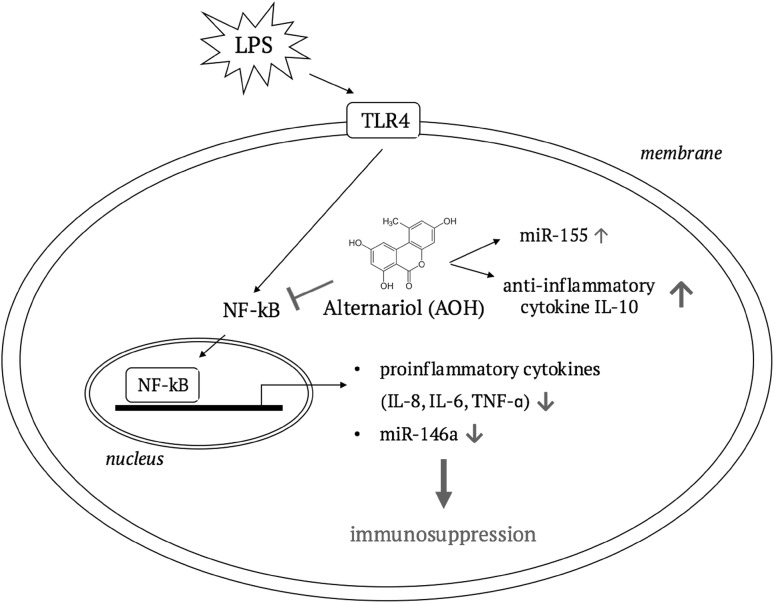
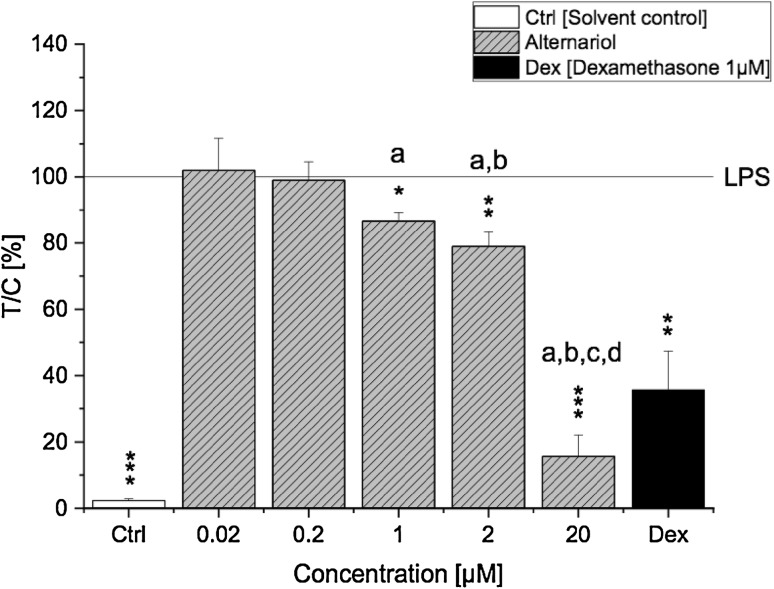
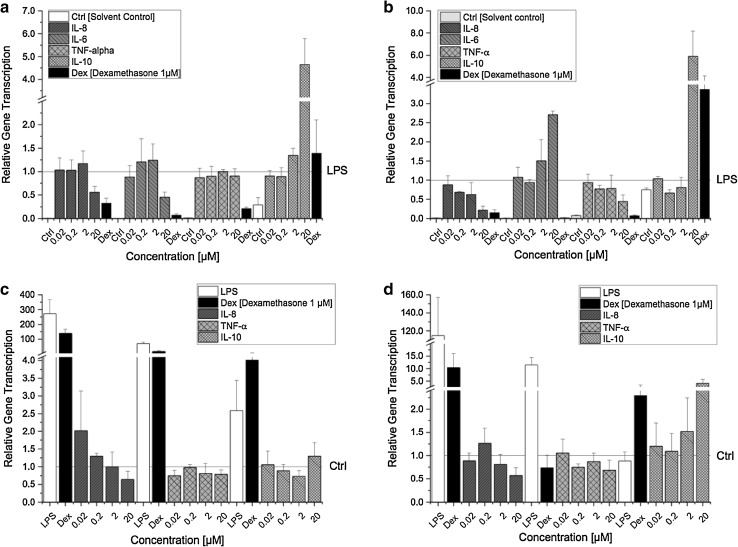
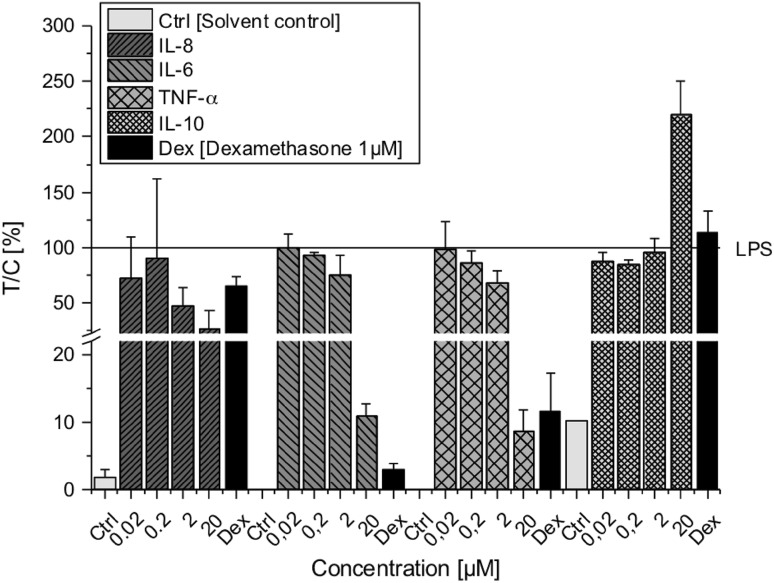
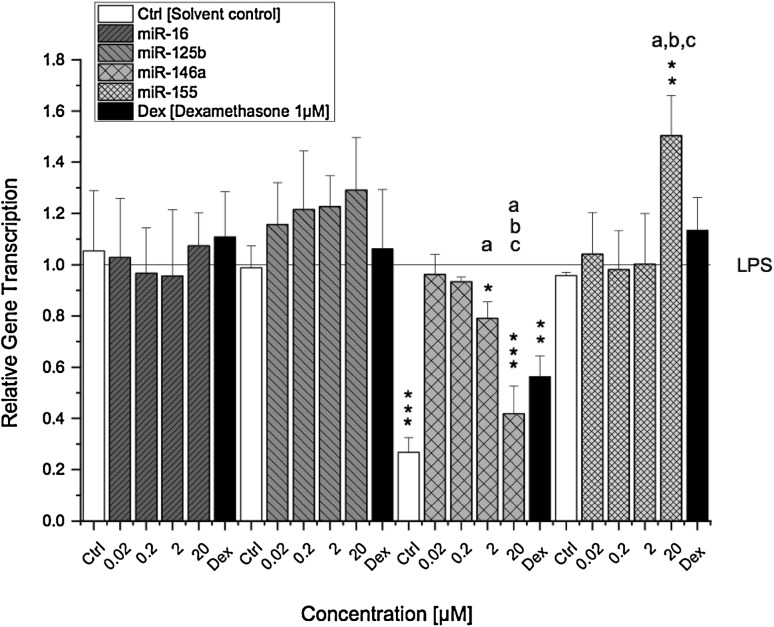
Alternariol (AOH) is a secondary metabolite formed by black mold of the genus Alternaria alternata. Due to limited hazard and occurrence data, AOH is still considered as an "emerging mycotoxin" and, as such, not monitored and regulated yet. Recent studies indicate immunosuppressive effects in vitro by altering the expression of CD molecules and proinflammatory cytokines, which are indispensable in mounting an innate immune response. However, the mode of action by which AOH exerts its immunosuppressive effects has not been unraveled yet. The present study aimed to characterise the impact of AOH on the nuclear factor kappa B (NF-κB) pathway, the expression of NF-κB target cytokines and involved regulatory microRNAs (miRNAs). In THP-1 derived macrophages, AOH (1-20 µM) was found to suppress lipopolysaccharide (LPS)-induced NF-κB pathway activation, decrease secretion of the proinflammatory cytokines IL-8, IL-6, TNF-α and to induce secretion of the anti-inflammatory IL-10. Thereby, a distinct pattern of cytokine mRNA levels was monitored, varying between short- and long-term exposure. Concomitantly, AOH (2-20 µM) affected the transcription levels of miR-146a and miR-155 in LPS-stimulated THP-1 derived macrophages dose-dependently by down- and upregulation, respectively. In contrast, transcription of miR-16 and miR-125b, two other immune-related miRNAs, was not modulated. In the absence of a LPS stimulus, AOH (20 µM) did not affect basal NF-κB activity, but increased IL-10 transcription. Collectively, our results indicate, that AOH itself does not induce a proinflammatory immune response in human macrophages; however, in an inflamed environment it possesses the ability to repress inflammation by targeting the NF-κB signalling pathway and regulatory miRNAs.
交替单端孢霉烯醇(AOH)是一种由交链孢霉属的黑曲霉产生的次生代谢物。由于危害和发生数据有限,AOH 仍然被认为是一种“新兴真菌毒素”,因此尚未进行监测和监管。最近的研究表明,AOH 通过改变 CD 分子和促炎细胞因子的表达在体外具有免疫抑制作用,而这些在引发先天免疫反应中是不可或缺的。然而,AOH 发挥其免疫抑制作用的作用方式尚未被揭示。本研究旨在研究 AOH 对核因子 kappa B(NF-κB)途径、NF-κB 靶细胞因子的表达以及涉及的调节 microRNA(miRNA)的影响。在 THP-1 衍生的巨噬细胞中,发现 AOH(1-20µM)可抑制脂多糖(LPS)诱导的 NF-κB 途径激活,减少促炎细胞因子 IL-8、IL-6、TNF-α的分泌,并诱导抗炎细胞因子 IL-10 的分泌。因此,监测到不同的细胞因子 mRNA 水平模式,分别在短期和长期暴露之间变化。同时,AOH(2-20µM)以剂量依赖性方式分别下调和上调 LPS 刺激的 THP-1 衍生巨噬细胞中 miR-146a 和 miR-155 的转录水平。相比之下,miR-16 和 miR-125b 的转录,两种其他与免疫相关的 miRNA,则不受调节。在没有 LPS 刺激的情况下,AOH(20µM)不会影响基础 NF-κB 活性,但会增加 IL-10 的转录。总之,我们的结果表明,AOH 本身不会在人巨噬细胞中诱导促炎免疫反应;然而,在炎症环境中,它通过靶向 NF-κB 信号通路和调节 miRNA 具有抑制炎症的能力。