Favrod Céline, Jan du Chêne Lauranne, Martin Soelch Chantal, Garthus-Niegel Susan, Tolsa Jean-Francois, Legault Francois, Briet Virginie, Horsch Antje
Department Woman-Mother-Child, Lausanne University Hospital, Lausanne, Switzerland.
Department of Psychology, University of Fribourg, Fribourg, Switzerland.
Front Psychiatry. 2018 Aug 20;9:364. doi: 10.3389/fpsyt.2018.00364. eCollection 2018.
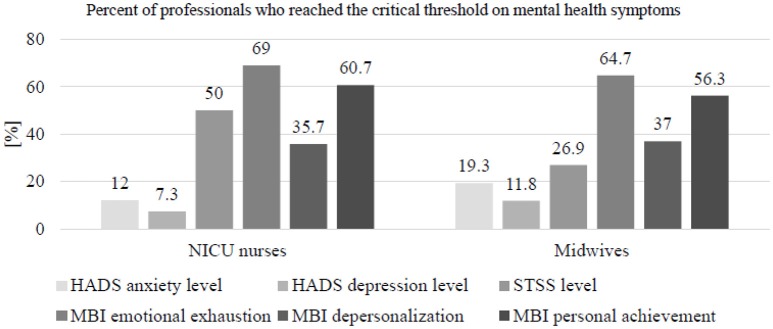
Hospital midwives and neonatal intensive care (NICU) nurses frequently encounter work-related stressors and are therefore vulnerable to developing mental health problems, such as secondary traumatic stress, burnout, anxiety, and depression. However, so far, the exact nature of these work-related stressors (traumatic vs. non-traumatic stressors) has not been investigated. This concurrent triangulation mixed methods cross-sectional study aimed to compare mental health symptoms in hospital midwives and NICU nurses, and to identify and compare work-related traumatic and non-traumatic stressors for both professional groups. 122 midwives and 91 NICU nurses of two Swiss university hospitals completed quantitative measures (Secondary Traumatic Stress Scale, STSS; Hospital Anxiety and Depression Scale, HADS; Maslach Burnout Inventory, MBI) and one qualitative question in an online survey. When controlling for socio-demographic variables, NICU nurses had a higher STSS total score and higher STSS subscales scores and less HADS anxiety subscale scores than hospital midwives. Work-related stressors were classified into five themes: "Working environment," "Nursing/midwifery care," "Dealing with death and dying," "Case management" and "Others." Forty-six (46.3%) percent of these were classified as traumatic work-related stressors. NICU nurses reported more traumatic stressors in their working environment but no other differences between professional groups regarding the total number of work-related traumatic vs. non-traumatic stressors were found. Measures, such as teaching strategies to amend the subjective appraisal of the traumatic stressors or providing time to recover in-between frequently occurring work-related traumatic stressors might not only improve the mental health of professionals but also decrease sick leave and improve the quality of patient care.
医院助产士和新生儿重症监护室(NICU)护士经常面临与工作相关的压力源,因此容易出现心理健康问题,如继发性创伤压力、职业倦怠、焦虑和抑郁。然而,到目前为止,这些与工作相关的压力源的确切性质(创伤性与非创伤性压力源)尚未得到研究。这项同步三角测量混合方法横断面研究旨在比较医院助产士和NICU护士的心理健康症状,并识别和比较这两个专业群体与工作相关的创伤性和非创伤性压力源。瑞士两家大学医院的122名助产士和91名NICU护士在一项在线调查中完成了定量测量(继发性创伤压力量表,STSS;医院焦虑抑郁量表,HADS;马氏职业倦怠量表,MBI)以及一个定性问题。在控制社会人口统计学变量后,NICU护士的STSS总分和STSS子量表得分更高,而HADS焦虑子量表得分低于医院助产士。与工作相关的压力源分为五个主题:“工作环境”、“护理/助产护理”、“应对死亡和濒死”、“病例管理”和“其他”。其中46%(46.3%)被归类为与工作相关的创伤性压力源。NICU护士报告在其工作环境中有更多创伤性压力源,但在专业群体之间,未发现与工作相关的创伤性与非创伤性压力源总数存在其他差异。诸如修改对创伤性压力源的主观评估的教学策略,或在频繁出现的与工作相关的创伤性压力源之间提供恢复时间等措施,可能不仅会改善专业人员的心理健康,还会减少病假并提高患者护理质量。