La Trobe Sport and Exercise Medicine Research Centre, School of Allied Health, La Trobe University, Melbourne, Victoria, Australia.
Institute of Anatomy, Paracelsus Medical University, Salzburg, Austria.
Am J Sports Med. 2018 Oct;46(12):2873-2883. doi: 10.1177/0363546518789685. Epub 2018 Sep 4.
An anterior cruciate ligament (ACL) injury is a well-established risk factor for the long-term development of radiographic osteoarthritis (OA). However, little is known about the early degenerative changes (ie, <5 years after injury) of individual joint features (ie, cartilage, bone marrow), which may be reversible and responsive to interventions.
To describe early degenerative changes between 1 and 5 years after ACL reconstruction (ACLR) on magnetic resonance imaging (MRI) and explore participant characteristics associated with these changes.
Case-control study; Level of evidence, 3.
Seventy-eight participants (48 men; median age, 32 years; median body mass index [BMI], 26 kg/m) underwent 3.0-T MRI at 1 and 5 years after primary hamstring autograft ACLR. Early tibiofemoral and patellofemoral OA features were assessed with the MRI Osteoarthritis Knee Score. The primary outcome was worsening (ie, incident or progressive) cartilage defects, bone marrow lesions (BMLs), osteophytes, and meniscal lesions. Logistic regression with generalized estimating equations evaluated participant characteristics associated with worsening features.
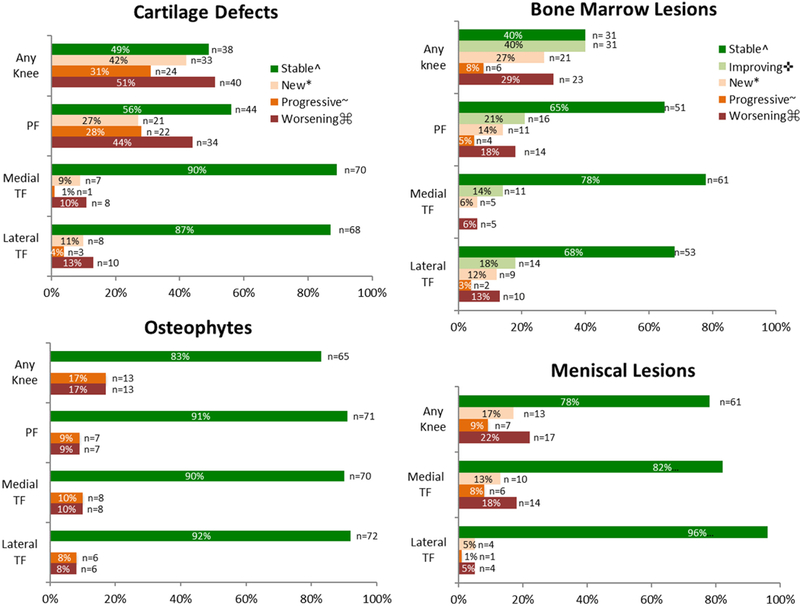
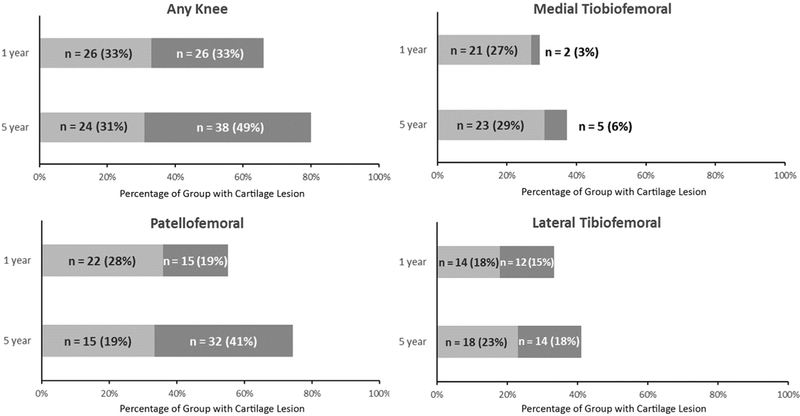
Worsening of cartilage defects in any compartment occurred in 40 (51%) participants. Specifically, worsening in the patellofemoral and medial and lateral tibiofemoral compartments was present in 34 (44%), 8 (10%), and 10 (13%) participants, respectively. Worsening patellofemoral and medial and lateral tibiofemoral BMLs (14 [18%], 5 [6%], and 10 [13%], respectively) and osteophytes (7 [9%], 8 [10%], and 6 [8%], respectively) were less prevalent, while 17 (22%) displayed deteriorating meniscal lesions. Worsening of at least 1 MRI-detected OA feature, in either the patellofemoral or tibiofemoral compartment, occurred in 53 (68%) participants. Radiographic OA in any compartment was evident in 5 (6%) and 16 (21%) participants at 1 and 5 years, respectively. A high BMI (>25 kg/m) was consistently associated with elevated odds (between 2- and 5-fold) of worsening patellofemoral and tibiofemoral OA features.
High rates of degenerative changes occur in the first 5 years after ACLR, particularly the development and progression of patellofemoral cartilage defects. Older patients with a higher BMI may be at particular risk and should be educated about this risk.
前交叉韧带(ACL)损伤是长期发展为放射学骨关节炎(OA)的明确危险因素。然而,对于个体关节特征(即软骨、骨髓)的早期退行性改变(即损伤后<5 年)知之甚少,这些改变可能是可逆的,并对干预措施有反应。
描述 ACL 重建(ACLR)后 1 至 5 年期间 MRI 上的早期退行性变化,并探讨与这些变化相关的参与者特征。
病例对照研究;证据水平,3 级。
78 名参与者(48 名男性;中位年龄 32 岁;中位体重指数 [BMI],26kg/m)在 ACLR 后 1 年和 5 年接受 3.0-T MRI 检查。使用 MRI 骨关节炎膝关节评分评估早期髌股和髁间窝 OA 特征。主要结局是软骨缺损、骨髓病变(BML)、骨赘和半月板病变的恶化(即新发或进展)。使用广义估计方程的逻辑回归评估与恶化特征相关的参与者特征。
40 名(51%)参与者出现任何部位的软骨缺损恶化。具体而言,34 名(44%)、8 名(10%)和 10 名(13%)参与者出现髌股和内侧及外侧胫骨髁间窝软骨缺损恶化。髌股和内侧及外侧胫骨髁间窝 BML 恶化(14 例[18%]、5 例[6%]和 10 例[13%])和骨赘恶化(7 例[9%]、8 例[10%]和 6 例[8%])的发生率较低,而 17 名(22%)参与者的半月板病变恶化。至少有 1 种 MRI 检测到的 OA 特征在髌股或胫骨髁间窝恶化的参与者占 53 名(68%)。任何部位的放射学 OA 在 1 年和 5 年时分别在 5 名(6%)和 16 名(21%)参与者中可见。高 BMI(>25kg/m)与髌股和胫骨髁间窝 OA 特征恶化的几率增加(2 至 5 倍)一致相关。
在 ACLR 后 5 年内,会发生很高的退行性变化率,特别是髌股软骨缺损的发展和进展。年龄较大且 BMI 较高的患者可能面临特定风险,应告知他们这一风险。