Department of Endocrinology, Shandong Provincial Qianfoshan Hospital, Shandong University, Jinan, Shandong, China.
Division of Endocrinology, Department of Internal Medicine, Shandong University of Traditional Chinese Medicine, Jinan, Shandong, China.
Mol Med. 2018 Sep 4;24(1):47. doi: 10.1186/s10020-018-0042-5.
Sulfonylureas (SUs) are widely prescribed for the treatment of type 2 diabetes (T2DM). Sulfonylurea receptors (SURs) are their main functional receptors. These receptors are also found in kidney, especially the tubular cells. However, the effects of SUs on renal proximal tubular epithelial cells (PTECs) were unclear.
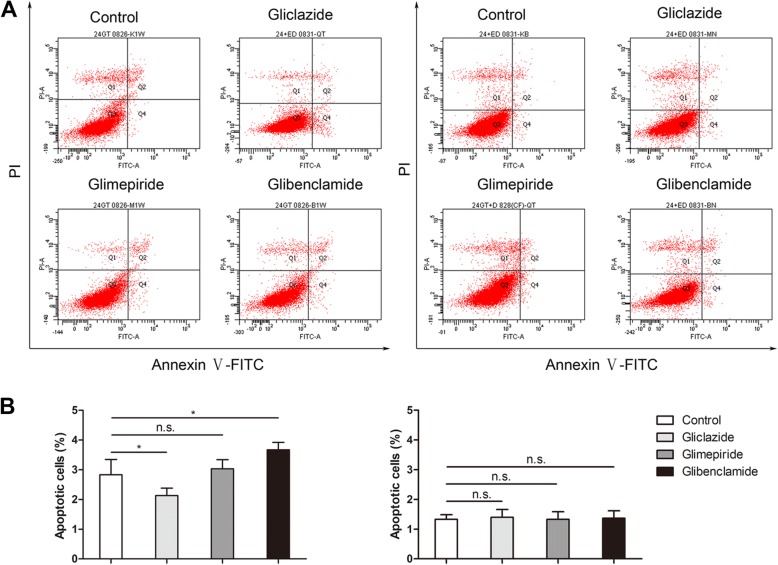
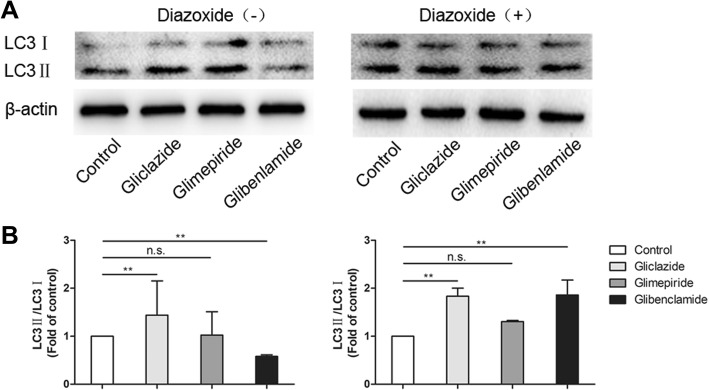
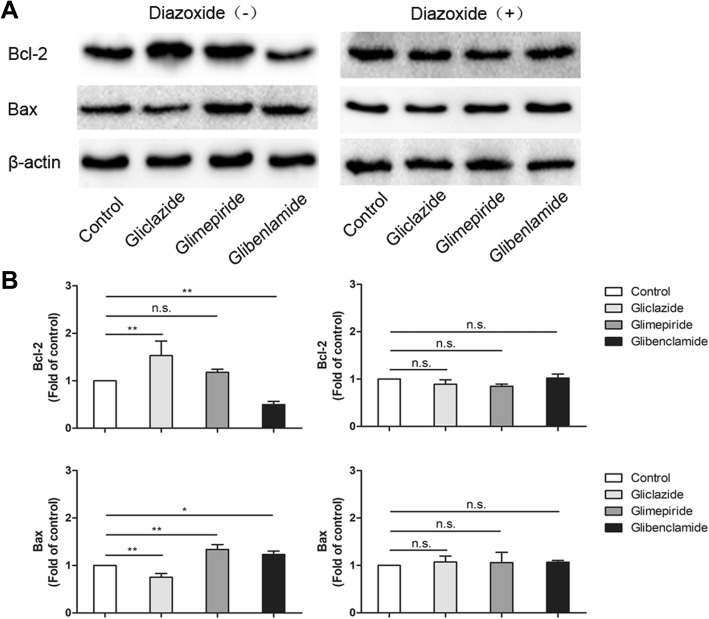
Three commonly used SUs were included in this study to investigate if different SUs have different effects on the apoptosis of PTECs. HK-2 cells were exposed to SUs for 24 h prior to exposure to 30 mM glucose, the apoptosis rate was evaluated by Annexin/PI flow cytometry. Bcl-2, Bax and the ratio of LC3II to LC3I were also studied by western blot in vitro. Diazoxide was used to evaluate the role of K channel in SUs-induced apoptosis of PTECs. A Student's t-test was used to assess significance for data within two groups.
Treatment with glibenclamide aggravated the apoptosis of HK-2 cells in high-glucose, as indicated by a significant decrease in the expression of Bcl-2 and increase in Bax. Additionally, the decreased LC3II/LC3I reflects that the autophagy was inhibited by glibenclamide. Similar but less pronounced change was found in glimepiride group, however, nearly opposite effects were found in gliclazide group. Further, the effects of glibenclamide on apoptosis promotion and the decreased LC3II/LC3I were ameliorated obviously by treatment with 100uM diazoxide. The potential protection effect of gliclazide was also inhibited after opening the K channel.
Our results suggest that, the effects of glibenclamide and glimepiride on PTECs apoptosis, especially the former, were achieved in part by closing the K channel. In contrast to glibenclamide and glimepiride, therapeutic concentrations of gliclazide showed an inhibitory effect on apoptosis of PTECs, which may have a benefit in the preservation of functional PTECs mass.
磺酰脲类药物(SUs)被广泛用于治疗 2 型糖尿病(T2DM)。磺酰脲受体(SURs)是它们的主要功能受体。这些受体也存在于肾脏中,特别是在管状细胞中。然而,SUs 对近端肾小管上皮细胞(PTECs)的影响尚不清楚。
本研究纳入了三种常用的 SUs,以研究不同的 SUs 是否对 PTEC 凋亡有不同的影响。在暴露于 30mM 葡萄糖之前,将 HK-2 细胞用 SUs 处理 24 小时,通过 Annexin/PI 流式细胞术评估细胞凋亡率。通过 Western blot 研究体外 Bcl-2、Bax 和 LC3II/LC3I 的比值。用二氮嗪评估 K 通道在 SUs 诱导的 PTECs 凋亡中的作用。用 Student's t-test 评估两组间数据的显著性。
格列本脲治疗加重了高糖培养的 HK-2 细胞的凋亡,表现为 Bcl-2 表达显著降低,Bax 表达增加。此外,LC3II/LC3I 的减少反映了格列本脲抑制自噬。在格列美脲组中发现了类似但程度较轻的变化,但在格列齐特组中发现了几乎相反的效果。此外,格列本脲对促进凋亡和降低 LC3II/LC3I 的作用明显被 100uM 二氮嗪治疗所改善。开放 K 通道后,格列齐特的潜在保护作用也被抑制。
我们的结果表明,格列本脲和格列美脲对 PTECs 凋亡的影响,特别是前者,部分是通过关闭 K 通道实现的。与格列本脲和格列美脲不同,治疗浓度的格列齐特对 PTECs 凋亡具有抑制作用,这可能有利于保留功能性 PTECs 数量。