Zhao Na, Yuan Li-Xia, Jia Xi-Ze, Zhou Xu-Feng, Deng Xin-Ping, He Hong-Jian, Zhong Jianhui, Wang Jue, Zang Yu-Feng
Center for Cognition and Brain Disorders, Institutes of Psychological Sciences, Hangzhou Normal University, Hangzhou, China.
Zhejiang Key Laboratory for Research in Assessment of Cognitive Impairments, Hangzhou, China.
Front Neuroinform. 2018 Aug 21;12:54. doi: 10.3389/fninf.2018.00054. eCollection 2018.
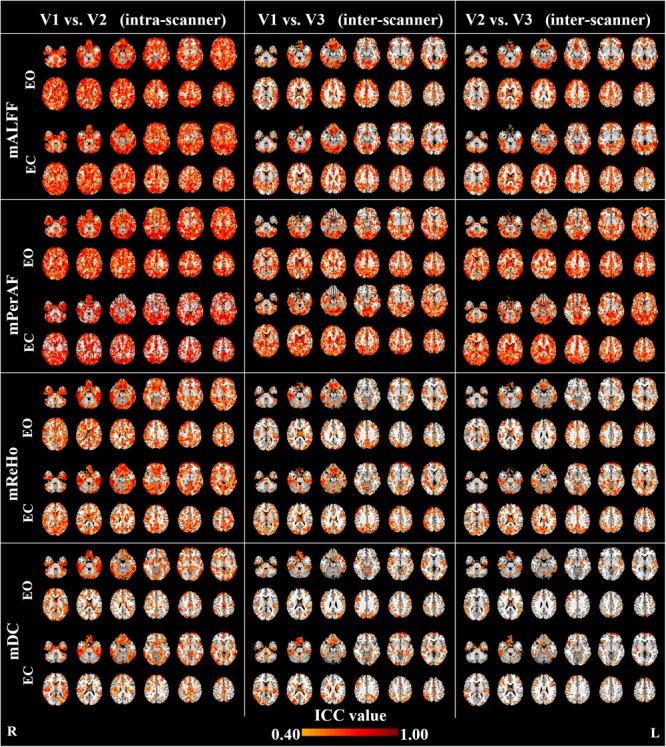
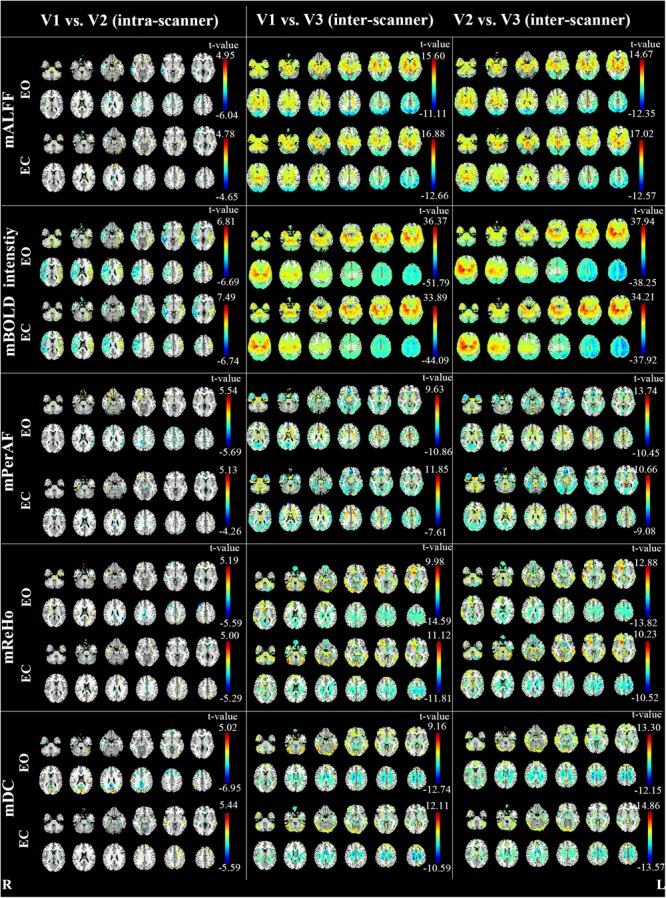
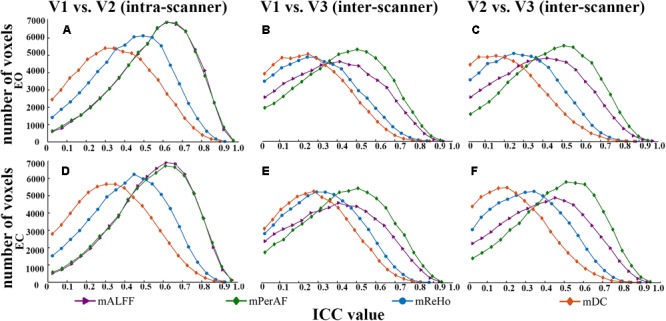
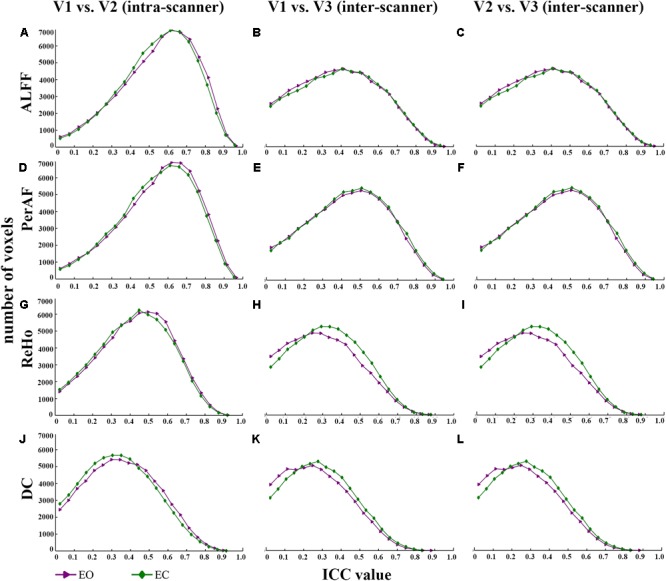
As the multi-center studies with resting-state functional magnetic resonance imaging (RS-fMRI) have been more and more applied to neuropsychiatric studies, both intra- and inter-scanner reliability of RS-fMRI are becoming increasingly important. The amplitude of low frequency fluctuation (ALFF), regional homogeneity (ReHo), and degree centrality (DC) are 3 main RS-fMRI metrics in a way of voxel-wise whole-brain (VWWB) analysis. Although the intra-scanner reliability (i.e., test-retest reliability) of these metrics has been widely investigated, few studies has investigated their inter-scanner reliability. In the current study, 21 healthy young subjects were enrolled and scanned with blood oxygenation level dependent (BOLD) RS-fMRI in 3 visits (V1 - V3), with V1 and V2 scanned on a GE MR750 scanner and V3 on a Siemens Prisma. RS-fMRI data were collected under two conditions, eyes open (EO) and eyes closed (EC), each lasting 8 minutes. We firstly evaluated the intra- and inter-scanner reliability of ALFF, ReHo, and DC. Secondly, we measured systematic difference between two scanning visits of the same scanner as well as between two scanners. Thirdly, to account for the potential difference of intra- and inter-scanner local magnetic field inhomogeneity, we measured the difference of relative BOLD signal intensity to the mean BOLD signal intensity of the whole brain between each pair of visits. Last, we used percent amplitude of fluctuation (PerAF) to correct the difference induced by relative BOLD signal intensity. The inter-scanner reliability was much worse than intra-scanner reliability; Among the VWWB metrics, DC showed the worst (both for intra-scanner and inter-scanner comparisons). PerAF showed similar intra-scanner reliability with ALFF and the best reliability among all the 4 metrics. PerAF reduced the influence of BOLD signal intensity and hence increase the inter-scanner reliability of ALFF. For multi-center studies, inter-scanner reliability should be taken into account.
随着静息态功能磁共振成像(RS-fMRI)的多中心研究越来越多地应用于神经精神疾病研究,RS-fMRI的扫描仪内和扫描仪间可靠性变得越来越重要。低频振幅(ALFF)、局部一致性(ReHo)和度中心性(DC)是体素级全脑(VWWB)分析中3个主要的RS-fMRI指标。尽管这些指标的扫描仪内可靠性(即重测可靠性)已得到广泛研究,但很少有研究探讨它们的扫描仪间可靠性。在本研究中,招募了21名健康青年受试者,并在3次扫描(V1 - V3)中采用血氧水平依赖(BOLD)RS-fMRI进行扫描,其中V1和V2在GE MR750扫描仪上扫描,V3在西门子Prisma扫描仪上扫描。RS-fMRI数据在睁眼(EO)和闭眼(EC)两种状态下采集,每种状态持续8分钟。我们首先评估了ALFF、ReHo和DC的扫描仪内和扫描仪间可靠性。其次,我们测量了同一扫描仪的两次扫描之间以及两台扫描仪之间的系统差异。第三,为了考虑扫描仪内和扫描仪间局部磁场不均匀性的潜在差异,我们测量了每次扫描之间相对于全脑平均BOLD信号强度的相对BOLD信号强度差异。最后,我们使用波动百分比幅度(PerAF)来校正由相对BOLD信号强度引起的差异。扫描仪间可靠性远低于扫描仪内可靠性;在VWWB指标中,DC的可靠性最差(在扫描仪内和扫描仪间比较中均如此)。PerAF在扫描仪内的可靠性与ALFF相似,且在所有4个指标中可靠性最佳。PerAF减少了BOLD信号强度的影响,从而提高了ALFF的扫描仪间可靠性。对于多中心研究,应考虑扫描仪间可靠性。