Bacca Jorge, Baldiris Silvia, Fabregat Ramon
Institute of Informatics and Applications, University of Girona, Girona, Spain.
Direction of Research, Innovation and Social Projection, Fundación Universitaria Tecnológico Comfenalco, Cartagena, Colombia.
Front Psychol. 2018 Aug 21;9:1486. doi: 10.3389/fpsyg.2018.01486. eCollection 2018.
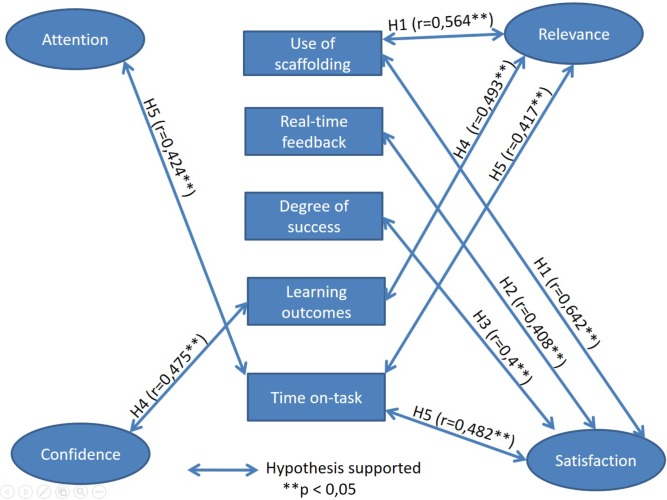
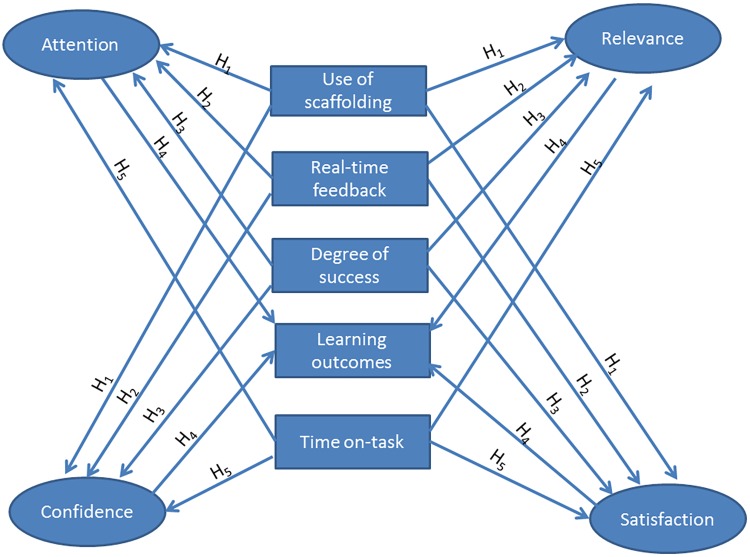
Research on Augmented Reality (AR) in education has demonstrated that AR applications designed with diverse components boost student motivation in educational settings. However, most of the research conducted to date, does not define exactly what those components are and how these components positively affect student motivation. This study, therefore, attempts to identify some of the components that positively affect student motivation in mobile AR learning experiences to contribute to the design and development of motivational AR learning experiences for the Vocational Education and Training (VET) level of education. To identify these components, a research model constructed from the literature was empirically validated with data obtained from two sources: 35 students from four VET institutes interacting with an AR application for learning for a period of 20 days, and a self-report measure obtained from the Instructional Materials Motivation Survey (IMMS). We found that the following variables: use of scaffolding, real-time feedback, degree of success, time on-task and learning outcomes are positively correlated with the four dimensions of the ARCS model of motivation: Attention, Relevance, Confidence, and Satisfaction. Implications of these results are also described.
教育领域对增强现实(AR)的研究表明,设计包含多种组件的AR应用程序能够提高教育环境中学生的学习动机。然而,迄今为止进行的大多数研究并未确切定义这些组件是什么,以及这些组件如何对学生的学习动机产生积极影响。因此,本研究试图确定在移动AR学习体验中对学生学习动机有积极影响的一些组件,以为职业教育与培训(VET)教育水平的激励性AR学习体验的设计和开发做出贡献。为了确定这些组件,从文献中构建的一个研究模型通过从两个来源获得的数据进行了实证验证:来自四所VET院校的35名学生与一个用于学习的AR应用程序进行了为期20天的交互,以及从教学材料动机调查(IMMS)中获得的一份自我报告测量。我们发现以下变量:支架的使用、实时反馈、成功程度、任务时间和学习成果与动机的ARCS模型的四个维度:注意力、相关性、信心和满意度呈正相关。还描述了这些结果的含义。