Department of Genetics, Cancer Research Institute, Biomedical Research Center, Slovak Academy of Sciences, v.v.i., Dubravska cesta 9, 845 05, Bratislava, Slovak Republic.
Institute of Molecular Biomedicine, Faculty of Medicine, Comenius University, Sasinkova 4, 811 08, Bratislava, Slovak Republic.
BMC Cancer. 2018 Sep 6;18(1):875. doi: 10.1186/s12885-018-4783-x.
In breast cancer (BC), deregulation of DNA methylation leads to aberrant expressions and functions of key regulatory genes. In our study, we investigated the relationship between the methylation profiles of genes associated with cancer invasivity and clinico-pathological parameters. In detail, we studied differences in the methylation levels between BC patients with haematogenous and lymphogenous cancer dissemination.
We analysed samples of primary tumours (PTs), lymph node metastases (LNMs) and peripheral blood cells (PBCs) from 59 patients with sporadic disseminated BC. Evaluation of the DNA methylation levels of six genes related to invasivity, ADAM23, uPA, CXCL12, TWIST1, SNAI1 and SNAI2, was performed by pyrosequencing.
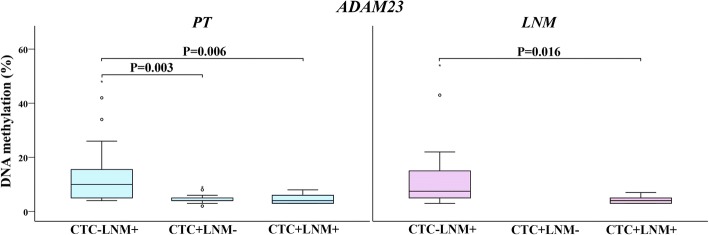
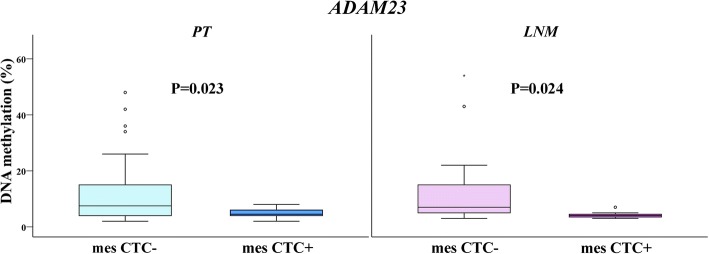
Among the cancer-specific methylated genes, we found lower methylation levels of the SNAI2 gene in histologic grade 3 tumours (OR = 0.61; 95% CI, 0.39-0.97; P = 0.038) than in fully or moderately differentiated cancers. We also evaluated the methylation profiles in patients with different cancer cell dissemination statuses (positivity for circulating tumour cells (CTCs) and/or LNMs). We detected the significant association between reduced DNA methylation of ADAM23 in PTs and presence of CTCs in the peripheral blood of patients (OR = 0.45; 95% CI, 0.23-0.90; P = 0.023).
The relationships between the decreased methylation levels of the SNAI2 and ADAM23 genes and cancer de-differentiation and haematogenous dissemination, respectively, indicate novel functions of those genes in the invasive processes. After experimental validation of the association between the lower values of SNAI2 and ADAM23 methylation and clinical features of aggressive BCs, these methylation profiles could improve the management of metastatic disease.
在乳腺癌(BC)中,DNA 甲基化的失调导致关键调控基因的异常表达和功能。在我们的研究中,我们调查了与癌症侵袭性相关的基因的甲基化谱与临床病理参数之间的关系。具体来说,我们研究了血液传播和淋巴传播的 BC 患者之间基因甲基化水平的差异。
我们分析了 59 例散发播散性 BC 患者的原发肿瘤(PTs)、淋巴结转移(LNMs)和外周血细胞(PBCs)样本。通过焦磷酸测序分析了与侵袭性相关的六个基因(ADAM23、uPA、CXCL12、TWIST1、SNAI1 和 SNAI2)的 DNA 甲基化水平。
在癌症特异性甲基化基因中,我们发现组织学分级 3 肿瘤中 SNAI2 基因的甲基化水平较低(OR=0.61;95%CI,0.39-0.97;P=0.038),而完全或中度分化的癌症中则较高。我们还评估了具有不同癌细胞播散状态(外周血中存在循环肿瘤细胞(CTCs)和/或 LNMs)的患者的甲基化谱。我们发现 PT 中 ADAM23 基因的 DNA 甲基化降低与患者外周血中 CTCs 的存在之间存在显著相关性(OR=0.45;95%CI,0.23-0.90;P=0.023)。
SNAI2 和 ADAM23 基因甲基化水平降低分别与癌症去分化和血液传播相关,表明这些基因在侵袭过程中具有新的功能。在对 SNAI2 和 ADAM23 较低甲基化值与侵袭性 BC 临床特征之间的相关性进行实验验证后,这些甲基化谱可改善转移性疾病的管理。