Zappe Maren, Feldner Anja, Arnold Caroline, Sticht Carsten, Hecker Markus, Korff Thomas
Division of Cardiovascular Physiology, Institute of Physiology and Pathophysiology, Heidelberg University, Heidelberg, Germany.
Medical Research Center, Medical Faculty Mannheim, Heidelberg University, Heidelberg, Germany.
Front Physiol. 2018 Aug 23;9:1190. doi: 10.3389/fphys.2018.01190. eCollection 2018.
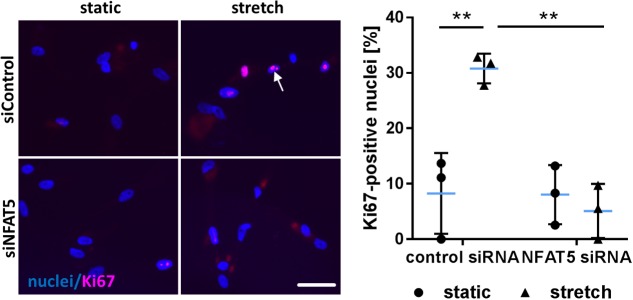
Vascular cells are continuously exposed to mechanical stress that may wreak havoc if exceeding physiological levels. Consequently, mechanisms facing such a challenge are indispensable and contribute to the adaptation of the cellular phenotype. To this end, vascular smooth muscle cells (VSMCs) activate mechanoresponsive transcription factors promoting their proliferation and migration to initiate remodeling the arterial wall. In mechanostimulated VSMCs, we identified nuclear factor of activated T-cells 5 (NFAT5) as transcriptional regulator protein and intended to unravel mechanisms controlling its expression and nuclear translocation. In cultured human VSMCs, blocking RNA synthesis diminished both baseline and stretch-induced NFAT5 mRNA expression while inhibition of the proteasome promoted accumulation of the NFAT5 protein. Detailed PCR analyses indicated a decrease in expression of NFAT5 isoform A and an increase in isoform C in mechanoactivated VSMCs. Upon overexpression, only NFAT5c was capable to enter the nucleus in control- and stretch-stimulated VSMCs. As evidenced by analyses of NFAT5c mutants, nuclear translocation required palmitoylation, phosphorylation at Y143 and was inhibited by phosphorylation at S1197. On the functional level, overexpression of NFAT5c forces its accumulation in the nucleus as well as transcriptional activity and stimulated VSMC proliferation and migration. These findings suggest that NFAT5 is continuously expressed and degraded in resting VSMCs while expression and accumulation of isoform C in the nucleus is facilitated during biomechanical stress to promote an activated VSMC phenotype.
血管细胞持续暴露于机械应力之下,如果超过生理水平,这种应力可能会造成严重破坏。因此,应对这一挑战的机制必不可少,并有助于细胞表型的适应。为此,血管平滑肌细胞(VSMC)激活机械反应性转录因子,促进其增殖和迁移,从而启动动脉壁重塑。在机械刺激的VSMC中,我们鉴定出活化T细胞核因子5(NFAT5)作为转录调节蛋白,并试图阐明控制其表达和核转位的机制。在培养的人VSMC中,阻断RNA合成可降低基线和拉伸诱导的NFAT5 mRNA表达,而抑制蛋白酶体则促进NFAT5蛋白的积累。详细的PCR分析表明,在机械激活的VSMC中,NFAT5同工型A的表达减少,同工型C的表达增加。过表达后,只有NFAT5c能够在对照和拉伸刺激的VSMC中进入细胞核。通过对NFAT5c突变体的分析证明,核转位需要棕榈酰化、Y143位点的磷酸化,并受到S1197位点磷酸化的抑制。在功能水平上,NFAT5c的过表达促使其在细胞核中积累以及转录活性增加,并刺激VSMC增殖和迁移。这些发现表明,NFAT5在静息VSMC中持续表达和降解,而在生物力学应激期间,同工型C在细胞核中的表达和积累有助于促进VSMC的活化表型。