Hödebeck Maren, Scherer Clemens, Wagner Andreas H, Hecker Markus, Korff Thomas
Division of Cardiovascular Physiology, Institute of Physiology and Pathophysiology, University of Heidelberg Heidelberg, Germany.
Front Physiol. 2014 Dec 3;5:467. doi: 10.3389/fphys.2014.00467. eCollection 2014.
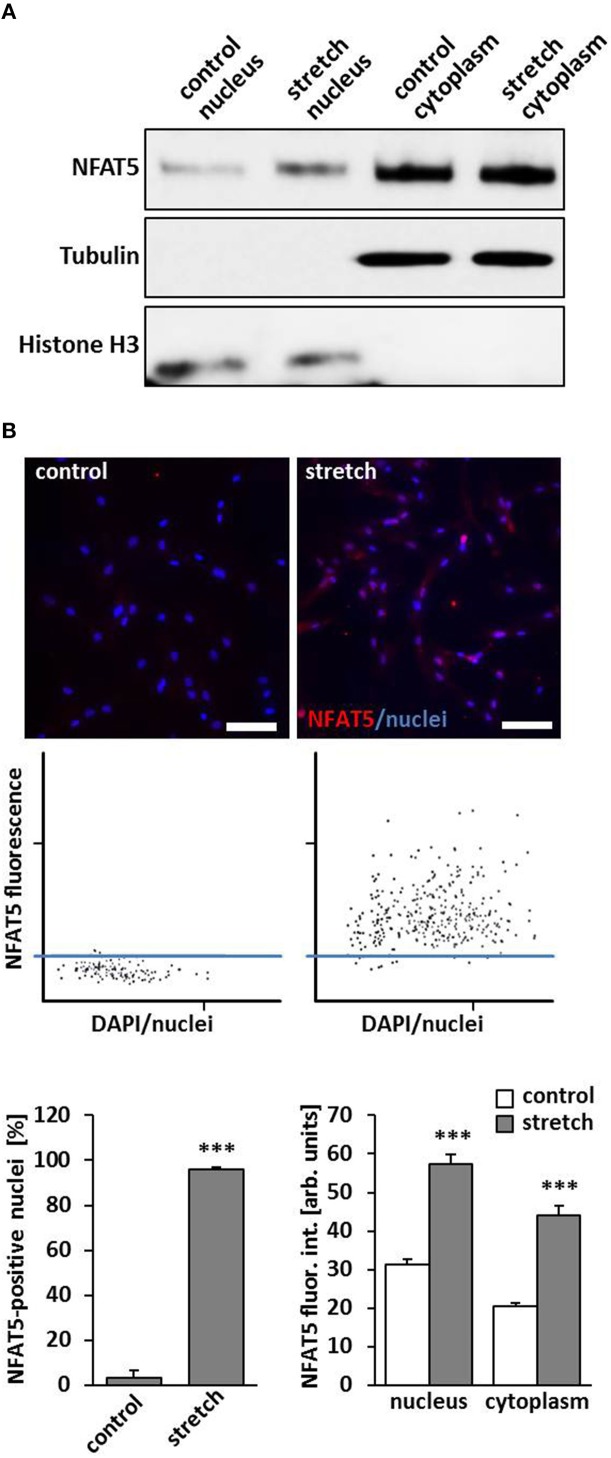
Cytoskeletal reorganization and migration are critical responses which enable vascular smooth muscle cells (VSMCs) cells to evade, compensate, or adapt to alterations in biomechanical stress. An increase in wall stress or biomechanical stretch as it is elicited by arterial hypertension promotes their reorganization in the vessel wall which may lead to arterial stiffening and contractile dysfunction. This adaptive remodeling process is dependent on and driven by subtle phenotype changes including those controlling the cytoskeletal architecture and motility of VSMCs. Recently, it has been reported that the transcription factor nuclear factor of activated T-cells 5 (TonEBP/NFAT5) controls critical aspects of the VSMC phenotype and is activated by biomechanical stretch. We therefore hypothesized that NFAT5 controls the expression of gene products orchestrating cytoskeletal reorganization in stretch-stimulated VSMCs. Automated immunofluorescence and Western blot analyses revealed that biomechanical stretch enhances the expression and nuclear translocation of NFAT5 in VSMCs. Subsequent in silico analyses suggested that this transcription factor binds to the promotor region of ACTBL2 encoding kappa-actin which was shown to be abundantly expressed in VSMCs upon exposure to biomechanical stretch. Furthermore, ACTBL2 expression was inhibited in these cells upon siRNA-mediated knockdown of NFAT5. Kappa-actin appeared to be aligned with stress fibers under static culture conditions, dispersed in lamellipodia and supported VSMC migration as its knockdown diminishes lateral migration of these cells. In summary, our findings delineated biomechanical stretch as a determinant of NFAT5 expression and nuclear translocation controlling the expression of the cytoskeletal protein ACTBL2. This response may orchestrate the migratory activity of VSMCs and thus promote maladaptive rearrangement of the arterial vessel wall during hypertension.
细胞骨架重组和迁移是关键反应,使血管平滑肌细胞(VSMC)能够逃避、补偿或适应生物力学应激的变化。动脉高血压引起的壁应力或生物力学拉伸增加会促进血管壁中VSMC的重组,这可能导致动脉僵硬和收缩功能障碍。这种适应性重塑过程依赖于并由微妙的表型变化驱动,包括那些控制VSMC细胞骨架结构和运动性的变化。最近,有报道称活化T细胞的转录因子核因子5(TonEBP/NFAT5)控制VSMC表型的关键方面,并被生物力学拉伸激活。因此,我们假设NFAT5控制在拉伸刺激的VSMC中协调细胞骨架重组的基因产物的表达。自动免疫荧光和蛋白质印迹分析表明,生物力学拉伸增强了VSMC中NFAT5的表达和核转位。随后的计算机分析表明,该转录因子与编码κ-肌动蛋白的ACTBL2的启动子区域结合,在暴露于生物力学拉伸后,κ-肌动蛋白在VSMC中大量表达。此外,在siRNA介导的NFAT5敲低后,这些细胞中ACTBL2的表达受到抑制。在静态培养条件下,κ-肌动蛋白似乎与应力纤维对齐,分散在片状伪足中,并支持VSMC迁移,因为其敲低会减少这些细胞的侧向迁移。总之,我们的研究结果表明生物力学拉伸是NFAT5表达和核转位的决定因素,控制细胞骨架蛋白ACTBL2的表达。这种反应可能协调VSMC的迁移活动,从而在高血压期间促进动脉血管壁的适应不良重排。