Song Hu, Liu Lingling, Song Zhaoquan, Ren Yongqiang, Li Chao, Huo Jiege
1 Department of Gastrointestinal Surgery, the Affiliated Hospital of Xuzhou Medical University, Xuzhou, Jiangsu, China.
2 Department of Clinical Laboratory, Shandong Provincial Hospital Affiliated to Shandong University, Jinan, Shandong, China.
Technol Cancer Res Treat. 2018 Jan 1;17:1533033818796485. doi: 10.1177/1533033818796485.
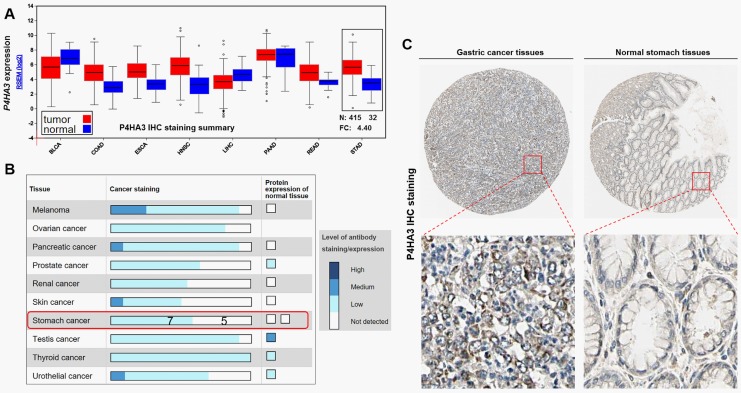
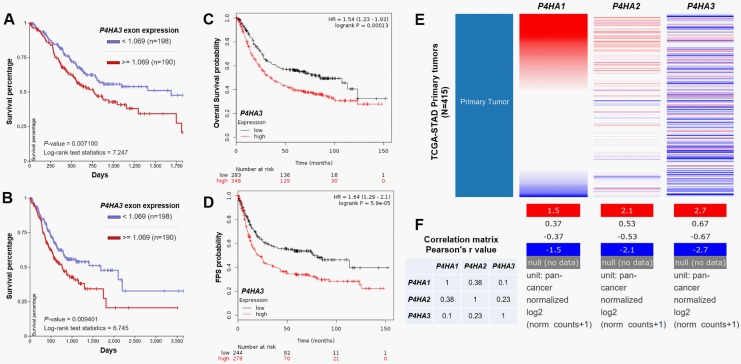
Prolyl 4-hydroxylase alpha subunit is the enzymic active site of prolyl 4-hydroxylase, which is a critical enzyme to maintain the stability of newly synthesized collagens. The expression profile and functional role of P4HA3 in gastric cancer have not been explored. In the Cancer Genome Atlas-Stomach Cancer, P4HA3 RNA is significantly upregulated in gastric cancer than in normal stomach tissues. In the Human Protein Atlas, Prolyl 4-hydroxylase alpha subunit is not detectable by immunohistochemistry staining in normal stomach tissues, but it has weak staining in 7 of 12 gastric cancer tissues. Further study showed that SNAI2 (encoding Slug) is highly coexpressed with P4HA3 (Pearson r = 0.70) in Cancer Genome Atlas-Stomach Cancer. In vitro cell assay showed that Slug could efficiently bind to the P4HA3 promoter and increase its transcription. P4HA3 exon array data in Cancer Genome Atlas-Stomach Cancer revealed that 2 exons are significantly upregulated in M1 (N = 27) cases than in M0 (N = 367) cases. In MKN-45 and AGS cells, P4HA3 upregulation could enhance cell motility and invasiveness. In Cancer Genome Atlas-Stomach Cancer, high P4HA3 exon expression is associated with significantly worse 5-year and 10-year overall survival ( P = .007 and .009, respectively). Data mining in Kaplan-Meier plotter also showed that high P4HA3 expression is related to unfavorable overall survival (hazard ratio: 1.54, 95% confidence interval: 1.23-1.93, P < .001) and first progression-free survival (hazard ratio: 1.64, 95% confidence interval: 1.29-2.1, P < .001). Based on findings above, we infer that P4HA3 is epigenetically activated by Slug, and its deregulation is associated with enhanced metastasis and poor survival of gastric cancer.
脯氨酰4-羟化酶α亚基是脯氨酰4-羟化酶的酶活性位点,脯氨酰4-羟化酶是维持新合成胶原蛋白稳定性的关键酶。P4HA3在胃癌中的表达谱和功能作用尚未得到研究。在癌症基因组图谱-胃癌数据库中,与正常胃组织相比,胃癌中P4HA3 RNA显著上调。在人类蛋白质图谱中,正常胃组织中通过免疫组织化学染色无法检测到脯氨酰4-羟化酶α亚基,但在12例胃癌组织中有7例显示弱阳性染色。进一步研究表明,在癌症基因组图谱-胃癌数据库中,SNAI2(编码Slug)与P4HA3高度共表达(皮尔逊相关系数r = 0.70)。体外细胞试验表明,Slug能够有效结合P4HA3启动子并增加其转录。癌症基因组图谱-胃癌数据库中的P4HA3外显子阵列数据显示,与M0(N = 367)病例相比,M1(N = 27)病例中有2个外显子显著上调。在MKN-45和AGS细胞中,P4HA3上调可增强细胞运动性和侵袭性。在癌症基因组图谱-胃癌数据库中,P4HA3外显子高表达与5年和10年总生存率显著降低相关(分别为P = 0.007和0.009)。在Kaplan-Meier绘图仪中的数据挖掘还显示,P4HA3高表达与不良总生存率(风险比:1.54,95%置信区间:1.23 - 1.93,P < 0.001)和首次无进展生存率(风险比:1.64,95%置信区间:1.29 - 2.1,P < 0.001)相关。基于上述发现,我们推断P4HA3被Slug表观遗传激活,其失调与胃癌转移增强和生存率降低有关。