
哈萨克族和汉族糖尿病患者的基因表达谱及DNA甲基化状态比较
Comparative gene expression profile and DNA methylation status in diabetic patients of Kazak and Han people.
作者信息
Wang Cuizhe, Ha Xiaodan, Li Wei, Xu Peng, Zhang Zhiwei, Wang Tingting, Li Jun, Wang Yan, Li Siyuan, Xie Jianxin, Zhang Jun
机构信息
Shihezi University School of Medicine Department of Endocrinology and Metabolism, First Affiliated Hospital, Shihezi University School of Medicine, Shihezi Endocrinology Department of the Xinjiang Uygur Autonomous Region People's Hospital, Urumqi, Xinjiang, China.
出版信息
Medicine (Baltimore). 2018 Sep;97(36):e11982. doi: 10.1097/MD.0000000000011982.
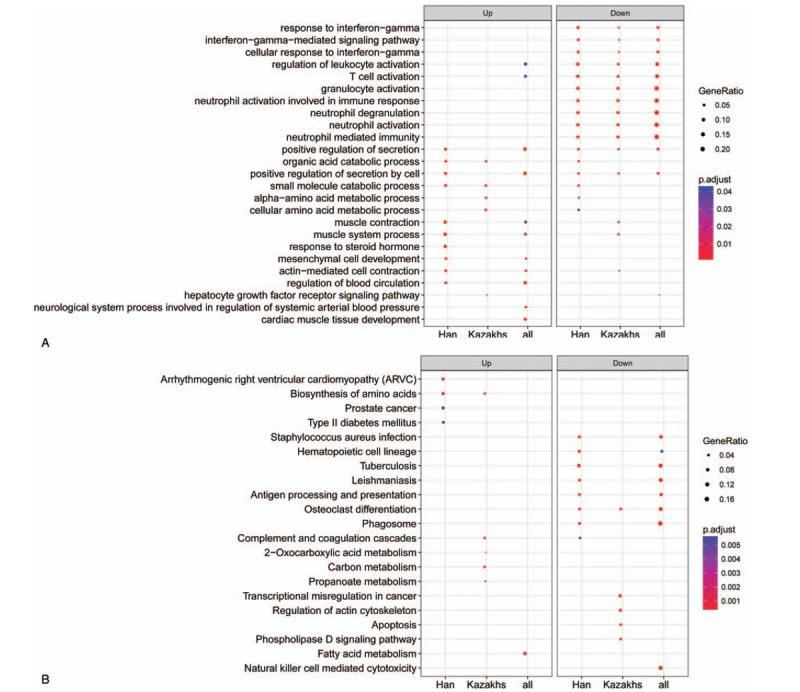
We attempted to investigate the mechanism and susceptibility genes for diabetes in Han and Kazak ethnic individuals.The abdominal omental adipose tissues were obtained from diabetic cases and healthy controls. The gene expression and methylation data were produced for Kazak and Han individuals, respectively, and analyzed by bioinformatics analysis.We obtained 921 differentially expressed genes (DEGs) in Han group and 1772 in Kazak group. DEGs in Han group were significantly related with type 2 diabetes mellitus, and biosynthesis of amino acids, while the DEGs specific to Kazak patients were significantly enriched in metabolism-related pathways such as carbon metabolism, propanoate metabolism, and 2-oxocarboxylic acid metabolism. Major facilitator superfamily domain containing 1 (MFSD1) was found to be a methylation associated gene at hypermethylation site of cg16289538 in Han group. Rho guanine nucleotide exchange factor 1 (ARHGEF1) was the susceptible gene corresponding to the methylation sites of cg18800192 and cg00759295 in Kazak group. ARHGEF1 was also a node in protein-protein interaction network and significantly enriched in hsa04270: vascular smooth muscle contraction pathways.The molecular mechanism of diabetes may be different in Han and Kazak patients. MFSD1 and ARHGEF1 may be the diabetes susceptible genes.
我们试图研究汉族和哈萨克族个体糖尿病的发病机制及易感基因。从糖尿病患者和健康对照者中获取腹部网膜脂肪组织。分别针对哈萨克族和汉族个体生成基因表达和甲基化数据,并通过生物信息学分析进行分析。我们在汉族组中获得了921个差异表达基因(DEG),在哈萨克族组中获得了1772个。汉族组中的DEG与2型糖尿病及氨基酸生物合成显著相关,而哈萨克族患者特有的DEG在碳代谢、丙酸代谢和2-氧代羧酸代谢等代谢相关途径中显著富集。发现主要易化子超家族结构域包含蛋白1(MFSD1)是汉族组中cg16289538高甲基化位点的甲基化相关基因。Rho鸟嘌呤核苷酸交换因子1(ARHGEF1)是哈萨克族组中cg18800192和cg00759295甲基化位点对应的易感基因。ARHGEF1也是蛋白质-蛋白质相互作用网络中的一个节点,并且在hsa04270:血管平滑肌收缩途径中显著富集。汉族和哈萨克族患者糖尿病的分子机制可能不同。MFSD1和ARHGEF1可能是糖尿病易感基因。




 Zotero 插件