Wu Wei-Ting, Chang Ke-Vin, Han Der-Sheng, Lin Chih-Peng, Özçakar Levent
Department of Physical Medicine and Rehabilitation, National Taiwan University Hospital, BeiHu Branch and National Taiwan University College of Medicine Department of Anaesthesiology, National Taiwan University Hospital and National Taiwan University College of Medicine, Taipei, Taiwan Department of Physical and Rehabilitation Medicine, Hacettepe University Medical School, Ankara, Turkey.
Medicine (Baltimore). 2018 Sep;97(36):e12247. doi: 10.1097/MD.0000000000012247.
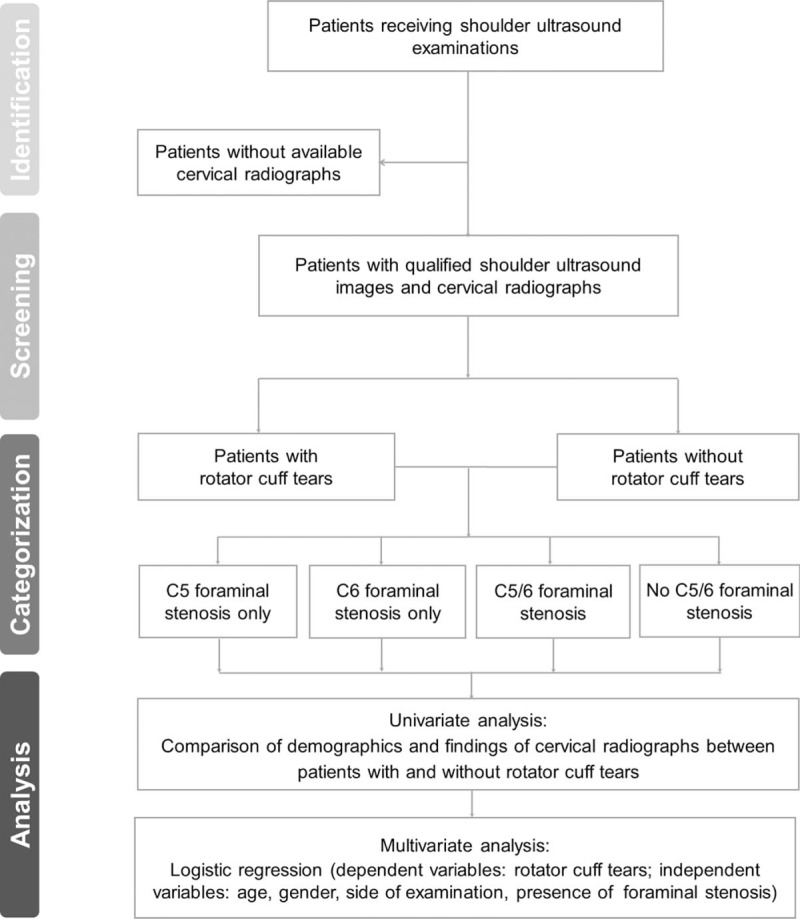
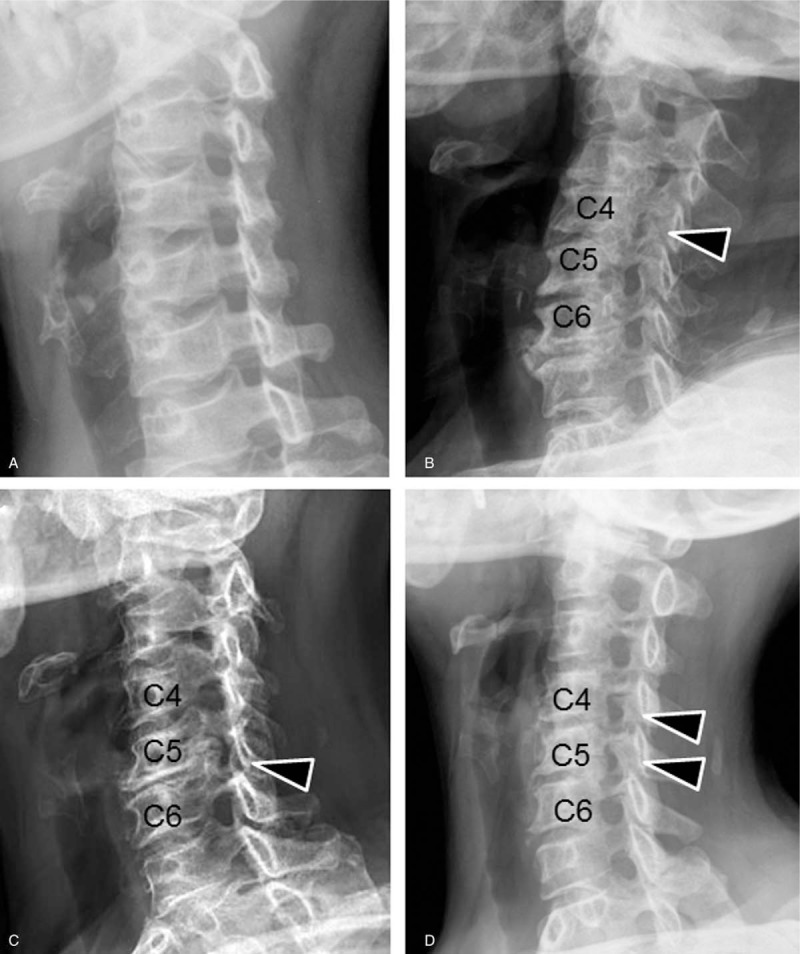
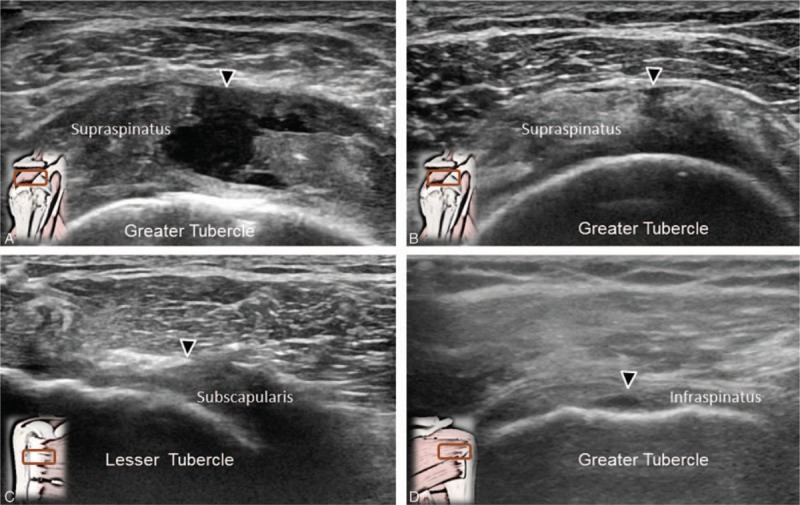
Rotator cuff tendon tears are prevalent in patients with shoulder pain, the third most common musculoskeletal complaint. As shoulders are largely innervated by cervical nerves, it seems possible that rotator cuff pathology could have an association with cervical spine disorders, although few studies have investigated this possibility. This study aimed to explore the association between rotator cuff tendon tears and cervical radiculopathy (at C5 and C6 levels) in the shoulder pain population.We conducted a retrospective review of a clinical registry of shoulder ultrasound (US) examinations and cervical spine radiographs, recruiting a total of 126 patients with cervical spine radiographs taken within 1 year of US examinations. Foraminal stenosis was grouped into 4 categories: C4/5 intervertebral foramen only, C5/6 intervertebral foramen only, both C4/5 and C5/6 intervertebral foramina, and neither C4/5 nor C5/6 intervertebral foramen. The groups with and without rotator cuff tendon tears were compared for various factors, using the Mann-Whitney U test for continuous variables and the χ test for categorical variables. A multivariate analysis was conducted using a logistic regression model to investigate the association between rotator cuff tendon tears and cervical foraminal stenosis.Patients with rotator cuff tendon tears tended to be older and had more night-time pain. No significant association was identified between rotator cuff tendon tears and cervical foraminal stenosis at C5 and C6 levels. The only factor significantly predicting rotator cuff tendon tears was old age (odds ratio, 1.04; 95% confidence interval: 1.00-1.09).In patients with shoulder or neck pain, no significant association existed between rotator cuff tendon tears and cervical foraminal stenosis (at the C5 and C6 levels). When patients present with undifferentiated shoulder and neck pain, physicians should take a detailed history, perform physical examinations and imaging studies of both the neck and shoulder regions.
肩袖肌腱撕裂在肩痛患者中很常见,是第三大常见的肌肉骨骼疾病。由于肩部主要由颈神经支配,肩袖病变似乎有可能与颈椎疾病有关,尽管很少有研究探讨这种可能性。本研究旨在探讨肩痛人群中肩袖肌腱撕裂与颈神经根病(C5和C6水平)之间的关联。我们对肩部超声(US)检查和颈椎X线片的临床登记进行了回顾性研究,共招募了126例在US检查后1年内进行颈椎X线片检查的患者。椎间孔狭窄分为4类:仅C4/5椎间孔、仅C5/6椎间孔、C4/5和C5/6椎间孔均有、C4/5和C5/6椎间孔均无。使用Mann-Whitney U检验对连续变量和χ检验对分类变量比较有和没有肩袖肌腱撕裂的组的各种因素。使用逻辑回归模型进行多变量分析,以研究肩袖肌腱撕裂与颈椎椎间孔狭窄之间的关联。有肩袖肌腱撕裂的患者往往年龄较大,夜间疼痛更多。在C5和C6水平上,未发现肩袖肌腱撕裂与颈椎椎间孔狭窄之间存在显著关联。唯一显著预测肩袖肌腱撕裂的因素是年龄较大(优势比,1.04;95%置信区间:1.00-1.09)。在有肩部或颈部疼痛的患者中,肩袖肌腱撕裂与颈椎椎间孔狭窄(C5和C6水平)之间不存在显著关联。当患者出现未分化的肩部和颈部疼痛时,医生应详细询问病史,对颈部和肩部区域进行体格检查和影像学检查。