Department of Neurosurgery, University Medical Center Hamburg- Eppendorf, Hamburg, Germany.
Department of Trauma, Hand and Reconstructive Surgery, University Medical Center Hamburg-Eppendorf, Hamburg, Germany.
Scand J Trauma Resusc Emerg Med. 2018 Sep 10;26(1):76. doi: 10.1186/s13049-018-0546-6.
Peripheral nerve injury (PNI) as an adjunct lesion in patients with upper extremity trauma has not been investigated in a Central European setting so far, despite of its devastating long-term consequences. This study evaluates a large multinational trauma registry for prevalence, mechanisms, injury severity and outcome characteristics of upper limb nerve lesions.
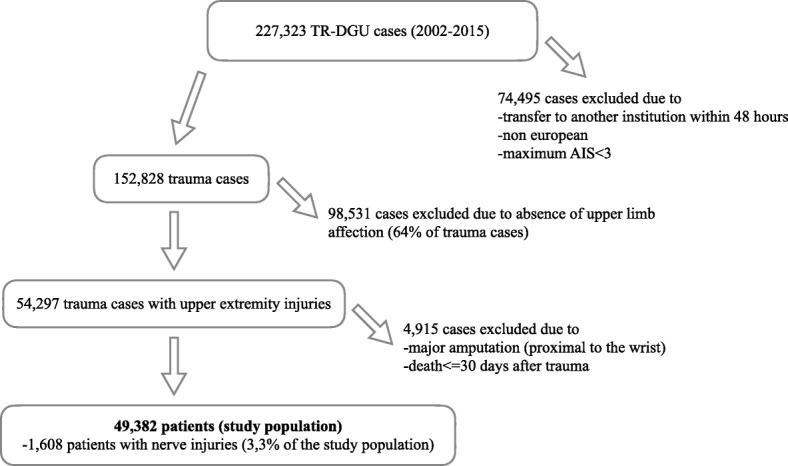
After formal approval the TraumaRegister DGU® (TR-DGU) was searched for severely injured cases with upper extremity involvement between 2002 and 2015. Patients were separated into two cohorts with regard to presence of an accompanying nerve injury. For all cases demographic data, trauma mechanism, concomitant lesions, severity of injury and outcome characteristics were obtained and group comparisons performed.
About 3,3% of all trauma patients with upper limb affection (n = 49,382) revealed additional nerve injuries. PNI cases were more likely of male gender (78,6% vs.73,2%) and tended to be significantly younger than their counterparts without nerve lesions (mean age 40,6 y vs. 47,2 y). Motorcycle accidents were the most frequently encountered single cause of injury in PNI patients (32,5%), whereas control cases primarily sustained their trauma from high or low falls (32,2%). Typical lesions recognized in PNI patients were fractures of the humerus (37,2%) or ulna (20,3%), vascular lacerations (arterial 10,9%; venous 2,4%) and extensive soft tissue damage (21,3%). Despite of similar average trauma severity in both groups patients with nerve affection had a longer primary hospital stay (30,6 d vs. 24,2 d) and required more subsequent inpatient rehabilitation (36,0% vs. 29,2%).
PNI complicating upper extremity trauma might be more commonly encountered in Central Europe than suggested by previous foreign studies. PNI typically affect males of young age who show significantly increased length of hospitalization and subsequent need for inpatient rehabilitation. Hence these lesions induce extraordinary high financial expenses besides their impact on health related quality of life for the individual patient. Further research is necessary to develop specific prevention strategies for this kind of trauma.
在中欧地区,外周神经损伤(PNI)作为上肢创伤的合并损伤尚未得到研究,尽管它会造成长期的破坏性后果。本研究评估了一个大型多国家创伤登记处,以评估上肢神经损伤的患病率、机制、损伤严重程度和结局特征。
在正式批准后,TR-DGU 登记处(TR-DGU)搜索了 2002 年至 2015 年期间上肢受累的严重受伤病例。根据是否存在伴随的神经损伤,将患者分为两组。对于所有病例,获取人口统计学数据、创伤机制、伴随损伤、损伤严重程度和结局特征,并进行组间比较。
上肢受累的所有创伤患者中约有 3.3%(n=49382)存在额外的神经损伤。PNI 患者更可能为男性(78.6%比 73.2%),且平均年龄明显小于无神经损伤的患者(40.6 岁比 47.2 岁)。摩托车事故是 PNI 患者最常见的单一受伤原因(32.5%),而对照组主要因高或低坠伤(32.2%)受伤。PNI 患者典型的损伤包括肱骨(37.2%)或尺骨(20.3%)骨折、血管裂伤(动脉 10.9%;静脉 2.4%)和广泛的软组织损伤(21.3%)。尽管两组患者的平均创伤严重程度相似,但患有神经损伤的患者的住院时间更长(30.6 天比 24.2 天),需要更多的后续住院康复治疗(36.0%比 29.2%)。
PNI 合并上肢创伤在中欧地区比以往的国外研究更为常见。PNI 通常影响年轻男性,他们的住院时间明显延长,随后需要住院康复治疗。因此,除了对个体患者的健康相关生活质量产生影响外,这些损伤还会带来巨大的经济费用。需要进一步研究以制定针对这种创伤的特定预防策略。