Applegate Megan E, France Christopher R, Russ David W, Leitkam Samuel T, Thomas James S
Wyss Institute for Biologically Inspired Engineering, Cambridge, MA, United States.
Department of Psychology, Ohio University, Athens, OH, United States.
JMIR Serious Games. 2018 Sep 10;6(3):e10522. doi: 10.2196/10522.
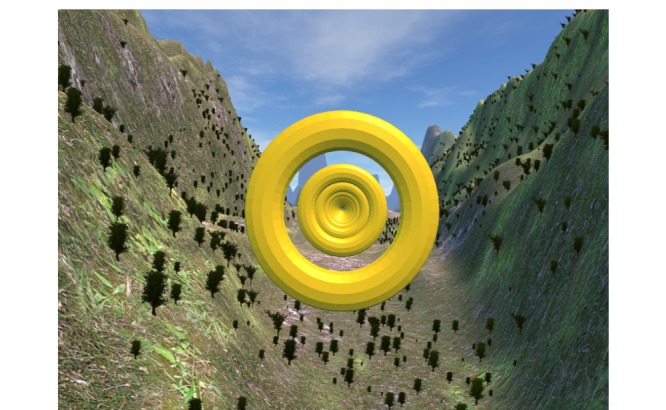
Sørensen trunk extension endurance test performance predicts the development of low back pain and is a strong discriminator of those with and without low back pain. Performance may greatly depend on psychological factors, such as kinesiophobia, self-efficacy, and motivation. Virtual reality video games have been used in people with low back pain to encourage physical activity that would otherwise be avoided out of fear of pain or harm. Accordingly, we developed a virtual reality video game to assess the influence of immersive gaming on the Sørensen test performance.
The objective of our study was to determine the physiological and psychological predictors of time to task failure (TTF) on a virtual reality Sørensen test in participants with and without a history of recurrent low back pain.
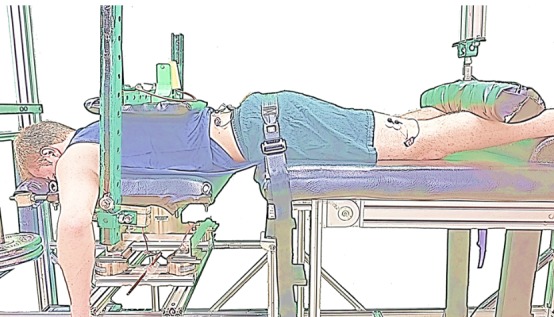
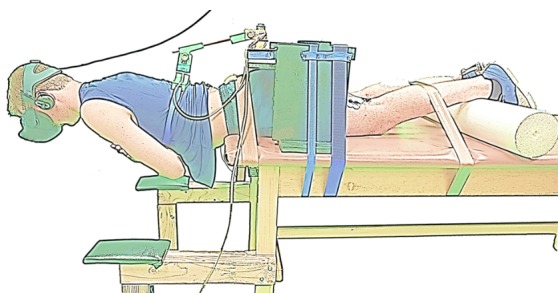
We recruited 24 individuals with a history of recurrent low back pain and 24 sex-, age-, and body mass index-matched individuals without a history of low back pain. Participants completed a series of psychological measures, including the Center for Epidemiological Studies-Depression Scale, Pain Resilience Scale, Pain Catastrophizing Scale, Tampa Scale for Kinesiophobia, and a self-efficacy measure. The maximal isometric strength of trunk and hip extensors and TTF on a virtual reality Sørensen test were measured. Electromyography of the erector spinae, gluteus maximus, and biceps femoris was recorded during the strength and endurance trials.
A two-way analysis of variance revealed no significant difference in TTF between groups (P=.99), but there was a trend for longer TTF in females on the virtual reality Sørensen test (P=.06). Linear regression analyses were performed to determine predictors of TTF in each group. In healthy participants, the normalized median power frequency slope of erector spinae (beta=.450, P=.01), biceps femoris (beta=.400, P=.01), and trunk mass (beta=-.32, P=.02) predicted TTF. In participants with recurrent low back pain, trunk mass (beta=-.67, P<.001), Tampa Scale for Kinesiophobia (beta=-.43, P=.01), and self-efficacy (beta=.35, P=.03) predicted TTF.
Trunk mass appears to be a consistent predictor of performance. Kinesiophobia appears to negatively influence TTF for those with a history of recurrent low back pain, but does not influence healthy individuals. Self-efficacy is associated with better performance in individuals with a history of recurrent low back pain, whereas a less steep median power frequency slope of the trunk and hip extensors is associated with better performance in individuals without a history of low back pain.
索伦森躯干伸展耐力测试表现可预测下背痛的发生,并且是区分有无下背痛人群的有力指标。其表现可能很大程度上取决于心理因素,如运动恐惧、自我效能感和动机。虚拟现实视频游戏已被用于下背痛患者,以鼓励他们进行体育活动,否则他们会因害怕疼痛或受伤而避免运动。因此,我们开发了一款虚拟现实视频游戏,以评估沉浸式游戏对索伦森测试表现的影响。
我们研究的目的是确定有或无复发性下背痛病史的参与者在虚拟现实索伦森测试中任务失败时间(TTF)的生理和心理预测因素。
我们招募了24名有复发性下背痛病史的个体以及24名性别、年龄和体重指数匹配且无下背痛病史的个体。参与者完成了一系列心理测量,包括流行病学研究中心抑郁量表、疼痛恢复力量表、疼痛灾难化量表、坦帕运动恐惧量表以及一项自我效能感测量。测量了躯干和髋部伸肌的最大等长力量以及在虚拟现实索伦森测试中的TTF。在力量和耐力试验期间记录了竖脊肌、臀大肌和股二头肌的肌电图。
双向方差分析显示两组之间的TTF无显著差异(P = 0.99),但在虚拟现实索伦森测试中女性的TTF有延长趋势(P = 0.06)。进行线性回归分析以确定每组中TTF的预测因素。在健康参与者中,竖脊肌(β = 0.450,P = 0.01)、股二头肌(β = 0.400,P = 0.01)的标准化中位功率频率斜率以及躯干质量(β = -0.32,P = 0.02)可预测TTF。在有复发性下背痛的参与者中,躯干质量(β = -0.67,P < 0.001)、坦帕运动恐惧量表(β = -0.43,P = 0.01)和自我效能感(β = 0.35,P = 0.03)可预测TTF。
躯干质量似乎是表现的一致预测因素。运动恐惧似乎对有复发性下背痛病史的人的TTF有负面影响,但对健康个体没有影响。自我效能感与有复发性下背痛病史的个体的更好表现相关,而对于无下背痛病史的个体,躯干和髋部伸肌较平缓的中位功率频率斜率与更好的表现相关。