Department of Medicine, Queen Mary Hospital, The University of Hong Kong, Pokfulam Road, Pokfulam, Hong Kong.
Department of Metabolism and Endocrinology, The Second Xiangya Hospital, Central South University, Changsha, Hunan, China.
Sci Rep. 2018 Sep 10;8(1):13522. doi: 10.1038/s41598-018-31820-9.
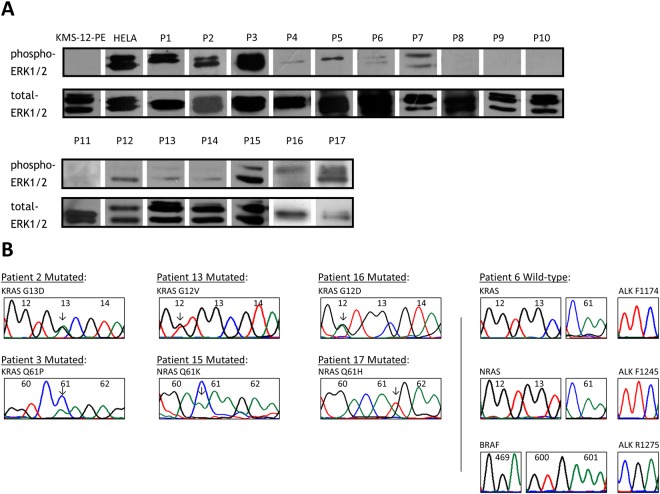
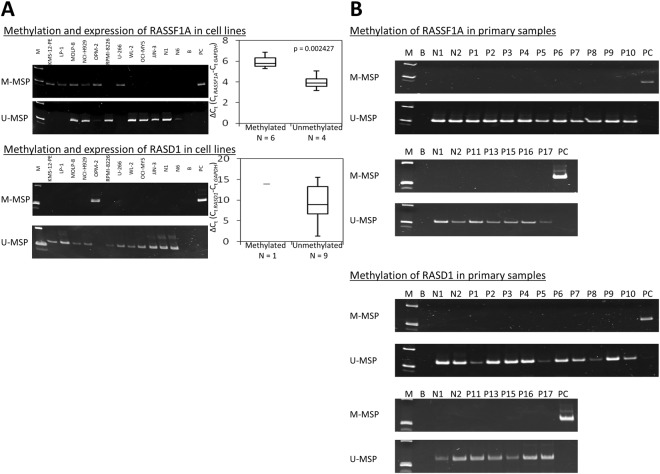
RAS mutations are frequent in relapsed/refractory multiple myeloma (RRMM) but functional study in primary samples is scanty. Herein, in primary myeloma plasma cells of 17 suspected RRMM, functional activation of RAS signalling was studied by Western blot of phosphorylated ERK1/2 (phospho-ERK1/2). Moreover, activating mutations in KRAS, NRAS, BRAF, and ALK were studied by PCR and bidirectional direct sequencing. Furthermore, methylation of negative RAS signalling regulator genes, RASSF1A and RASD1, were analyzed by methylation-specific PCR. As evidenced by phospho-ERK1/2 over-expression, functional RAS activation was detected in 12 (75.0%) RRMM. Of patients with functional RAS activation, sequencing data showed only seven (58.3%) patients with one each had NRAS Q61H, NRAS Q61K, KRAS G12D, KRAS G12V, KRAS G13D, KRAS Q61P, or BRAF V600E mutation, whereas five (41.7%) patients had no RAS/RAF mutation. Conversely, patients without functional RAS activation had no RAS/RAF mutation. Moreover, none of the patients with functional RAS activation had ALK mutations, or methylation of RASSF1A and RASD1. Collectively, functional activation of RAS signalling was present in majority of RRMM but only about half (58.3%) accountable by RAS/RAF mutations. If verified in larger studies, clinical investigations of MEK inhibitors are warranted regardless of RAS/RAF mutations.
RAS 突变在复发性/难治性多发性骨髓瘤(RRMM)中很常见,但对原发性样本的功能研究很少。在此,在 17 例疑似 RRMM 的原发性骨髓瘤浆细胞中,通过 Western blot 检测磷酸化 ERK1/2(磷酸化 ERK1/2)来研究 RAS 信号转导的功能激活。此外,通过 PCR 和双向直接测序研究 KRAS、NRAS、BRAF 和 ALK 的激活突变。此外,通过甲基化特异性 PCR 分析负 RAS 信号调节剂基因 RASSF1A 和 RASD1 的甲基化。磷酸化 ERK1/2 过表达表明,12 例(75.0%)RRMM 存在功能性 RAS 激活。在具有功能性 RAS 激活的患者中,测序数据显示仅 7 例(58.3%)患者各有一个 NRAS Q61H、NRAS Q61K、KRAS G12D、KRAS G12V、KRAS G13D、KRAS Q61P 或 BRAF V600E 突变,而 5 例(41.7%)患者没有 RAS/RAF 突变。相反,没有功能性 RAS 激活的患者没有 RAS/RAF 突变。此外,没有功能性 RAS 激活的患者没有 ALK 突变,也没有 RASSF1A 和 RASD1 的甲基化。总之,大多数 RRMM 存在 RAS 信号转导的功能激活,但只有约一半(58.3%)可归因于 RAS/RAF 突变。如果在更大的研究中得到验证,无论是否存在 RAS/RAF 突变,都需要对 MEK 抑制剂进行临床研究。