Department of Breast Surgical Oncology, St. Luke's International Hospital, 9-1 Akashi-cho, Chuo-ku, Tokyo, 104-8560, Japan.
The Japanese HBOC Consortium, Division of Breast Surgical Oncology, Department of Surgery, Showa University School of Medicine, 1-5-8 Hatanodai, Shinagawa-ku, Tokyo, 142-8666, Japan.
Breast Cancer Res Treat. 2018 Dec;172(3):679-687. doi: 10.1007/s10549-018-4953-1. Epub 2018 Sep 10.
Prophylactic surgery is a preemptive strategy for hereditary breast and ovarian cancer (HBOC). Prophylactic mastectomy (PM) reduces breast cancer risk by > 90%. The aim of our study is to analyze the information of the Japanese pedigrees and to utilize the results for clinical practice.
We statistically analyzed records of HBOC registrees who had undergone BRCA1/2 genetic testing at seven medical institutions up until 2016. In the cases of PM, we examined breasts with the use of mammography (MMG), ultrasound (US), and magnetic resonance imaging (MRI) before surgery. After PM, the specimens were divided about 1 cm serially and examined in their entirety.
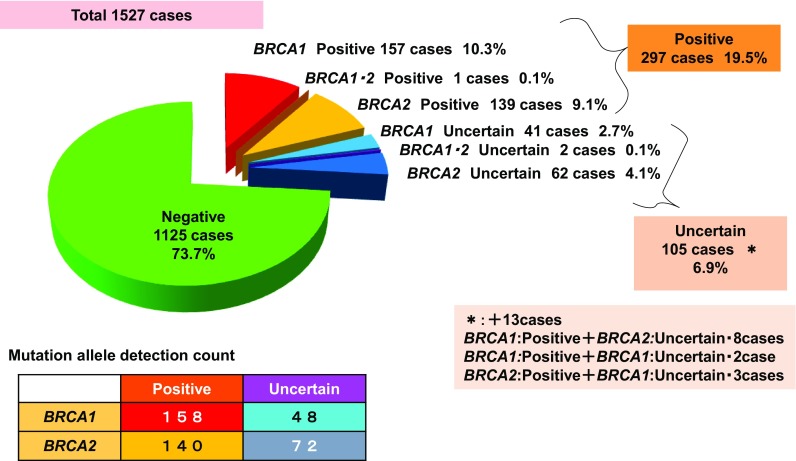
Of 1527 registrees who underwent BRCA testing, 1125 (73.7%) were negative for BRCA1/2 mutation, 297 (19.5%) were positive for BRCA1/2 mutation (BRCA1/2), and 105 (6.9%) had uncertain results. To decide whether to undergo total mastectomy vs. breast-conserving surgery (BCS), 370 registrees underwent presurgical genetic testing. During the follow-up period, four new-onset breast cancers were found among the 55 non-affected BRCA carriers. Among the 73 BRCA1/2 carriers who underwent BCS, 3 were found to have ipsilateral breast cancer. Of 189 BRCA1/2 carriers with unilateral breast cancer, 8 were found to have contralateral breast cancer. Of 53 PM specimens, 6 (11.3%) were found to have occult breast cancer despite using MMG, US, and MRI.
Our report showed a relatively higher incidence rate of occult cancer at 11.3% in PM specimens despite thorough pre-operative radiological evaluations, which included a breast MRI. Considering the occult cancer rates and the various pathological methods of our study and published studies, we propose the necessity of a histopathological protocol.
预防性手术是遗传性乳腺癌和卵巢癌(HBOC)的一种先发制人的策略。预防性乳房切除术(PM)可将乳腺癌风险降低>90%。我们研究的目的是分析日本家系的信息,并将结果应用于临床实践。
我们对截至 2016 年在七家医疗机构进行 BRCA1/2 基因检测的 HBOC 登记患者的记录进行了统计学分析。对于 PM,我们在手术前使用乳房 X 线照相术(MMG)、超声(US)和磁共振成像(MRI)检查乳房。PM 后,将标本每 1cm 切开并进行全面检查。
在接受 BRCA 检测的 1527 名登记患者中,1125 名(73.7%)BRCA1/2 突变阴性,297 名(19.5%)BRCA1/2 突变阳性(BRCA1/2),105 名(6.9%)结果不确定。为了决定是否进行全乳房切除术与保乳手术(BCS),370 名登记患者进行了术前基因检测。在随访期间,在 55 名非受影响的 BRCA 携带者中发现了 4 例新发乳腺癌。在接受 BCS 的 73 名 BRCA1/2 携带者中,有 3 名发现同侧乳腺癌。在 189 名单侧乳腺癌的 BRCA1/2 携带者中,有 8 名发现对侧乳腺癌。在 53 个 PM 标本中,尽管使用了 MMG、US 和 MRI,但仍有 6 个(11.3%)发现隐匿性乳腺癌。
尽管术前进行了包括乳房 MRI 在内的全面影像学评估,但我们的报告显示 PM 标本中隐匿性癌症的发生率相对较高,为 11.3%。考虑到隐匿性癌症的发生率以及我们研究和已发表研究的各种病理方法,我们提出了制定组织病理学方案的必要性。