Jia Ziqi, Li Jiaxin, Zhang Yuelun, Wang Xin, Xing Jiahua, Xing Zeyu, Huang Xin, Liu Gang, Zhang Menglu, Feng Kexin, Wu Jiang, Wang Wenyan, Wang Jie, Liu Jiaqi, Wang Xiang
Department of Breast Surgical Oncology, National Cancer Center/National Clinical Research Center for Cancer/Cancer Hospital, Chinese Academy of Medical Sciences and Peking Union Medical College, 100021, Beijing, China.
School of Clinical Medicine, Chinese Academy of Medical Sciences & Peking Union Medical College, Beijing, 100005, China.
Cancer Cell Int. 2021 Sep 25;21(1):512. doi: 10.1186/s12935-021-02194-2.
Unilateral breast cancer (UBC) patients with germline pathogenic BRCA1/2 variants have a higher risk of developing contralateral breast cancer (CBC) and need contralateral risk-reducing local treatments, including contralateral risk-reducing mastectomy (CRRM) and prophylactic irradiation (CPI). The aim of our study was to systematically explore the efficacy of CRRM and CPI in reducing CBC risk and increasing survival.
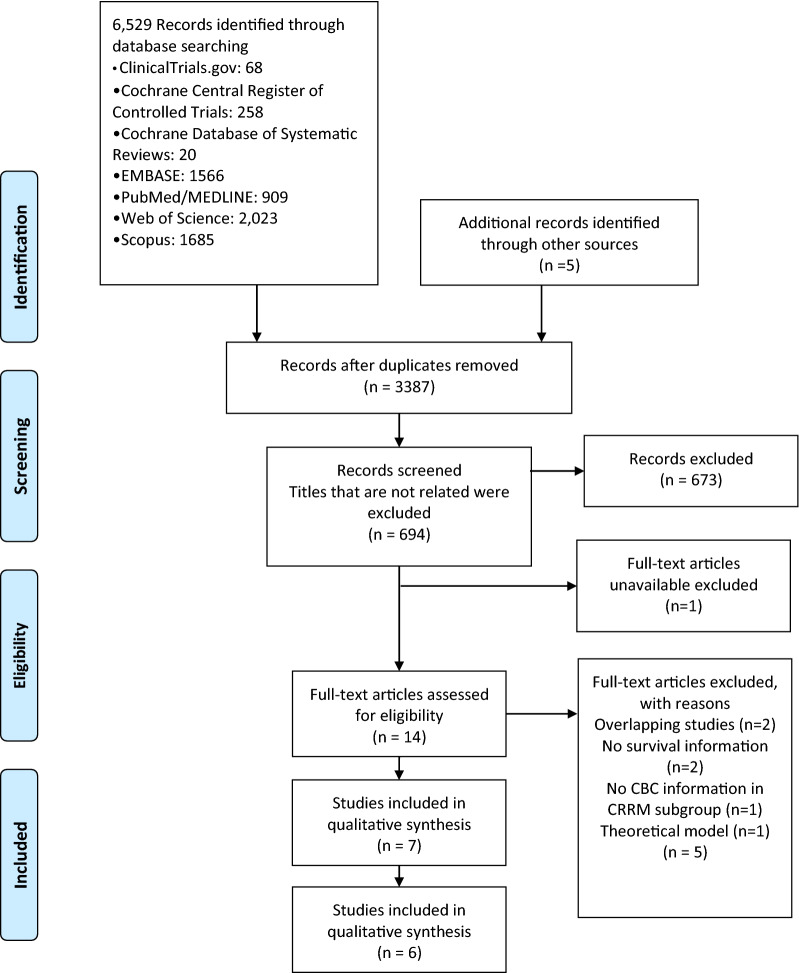
A search was done, and eligible randomized trials and cohort studies should include and compare UBC patients with germline pathogenic BRCA1/2 variants who have and have not received contralateral risk-reducing local treatment. Random-effects meta-analysis was used in this study. Primary outcomes of the studies included overall survival (OS) and the incidence of contralateral breast cancer (CBC), and secondary outcomes included breast cancer-specific survival (BCSS).
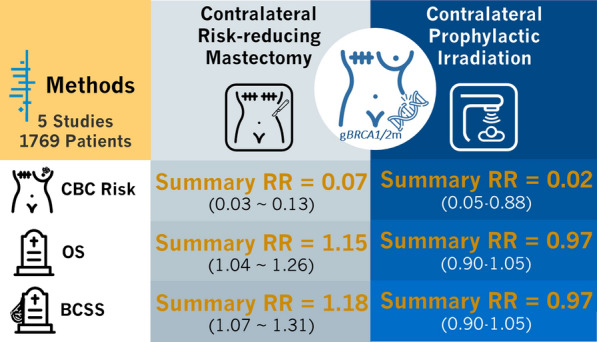
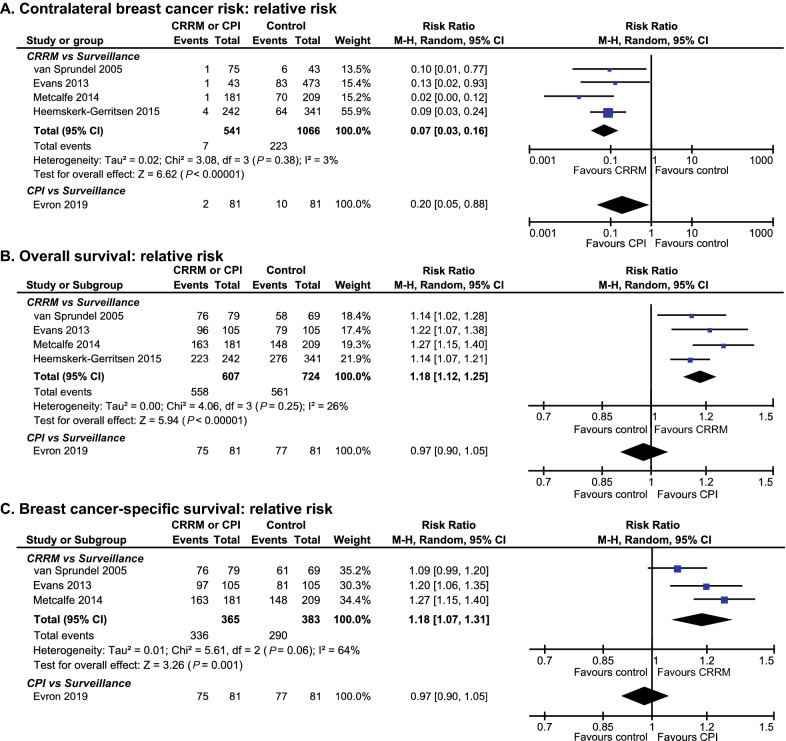
A total of five studies with 1769 UBC patients with germline pathogenic BRCA1/2 variants were enrolled in our meta-analysis. CRRM was correlated with a lower risk of CBC in UBC patients with germline pathogenic BRCA1/2 variants (summary RR = 0.07; 95%CI 0.03-0.13, I = 3%), a significantly increased OS (summary RR, 1.15; 95%CI 1.04-1.26, I = 26%) and a significantly increased BCSS (summary RR, 1.18; 95%CI 1.07-1.31, I = 64%) compared with surveillance. CPI also decreased the risk of CBC (RR 0.02; 95%CI 0.05-0.88) but did not significantly improve OS (RR 0.97; 95%CI 0.90-1.05) and BCSS (RR 0.97; 95%CI 0.90-1.05) compared with surveillance.
CRRM reduces CBC risk and increases OS and BCSS in UBC patients with germline pathogenic BRCA1/2 variants, and could be offered as a risk-reducing local treatment. For those who oppose CRRM, CPI could be offered for CBC-risk reduction, while its survival benefit is still uncertain.
携带种系致病性BRCA1/2变异的单侧乳腺癌(UBC)患者发生对侧乳腺癌(CBC)的风险较高,需要进行对侧降低风险的局部治疗,包括对侧预防性乳房切除术(CRRM)和预防性放疗(CPI)。我们研究的目的是系统地探讨CRRM和CPI在降低CBC风险及提高生存率方面的疗效。
进行了一项检索,纳入的合格随机试验和队列研究应纳入并比较携带种系致病性BRCA1/2变异且接受和未接受对侧降低风险局部治疗的UBC患者。本研究采用随机效应荟萃分析。研究的主要结局包括总生存期(OS)和对侧乳腺癌(CBC)的发病率,次要结局包括乳腺癌特异性生存期(BCSS)。
共有五项研究纳入了1769例携带种系致病性BRCA1/2变异的UBC患者进行荟萃分析。与监测相比,CRRM与携带种系致病性BRCA1/2变异的UBC患者发生CBC的风险较低相关(汇总RR = 0.07;95%CI 0.03 - 0.13,I² = 3%),OS显著提高(汇总RR,1.15;95%CI 1.04 - 1.26,I² = 26%),BCSS显著提高(汇总RR,1.18;95%CI 1.07 - 1.31,I² = 64%)。与监测相比,CPI也降低了CBC的风险(RR 0.02;95%CI 0.05 - 0.88),但未显著改善OS(RR 0.97;95%CI 0.90 - 1.05)和BCSS(RR 0.97;95%CI 0.90 - 1.05)。
CRRM可降低携带种系致病性BRCA1/2变异的UBC患者发生CBC的风险,并提高OS和BCSS,可作为一种降低风险的局部治疗方法。对于反对CRRM的患者,可提供CPI以降低CBC风险,但其生存获益仍不确定。