Colgan Dana Dharmakaya, Wahbeh Helané, Pleet Mollie, Besler Kristen, Christopher Michael
1 Pacific University, Hillsboro, OR, USA.
2 Oregon Health & Science University, Portland, OR, USA.
J Evid Based Complementary Altern Med. 2017 Jul;22(3):482-493. doi: 10.1177/2156587216684999. Epub 2017 Jan 2.
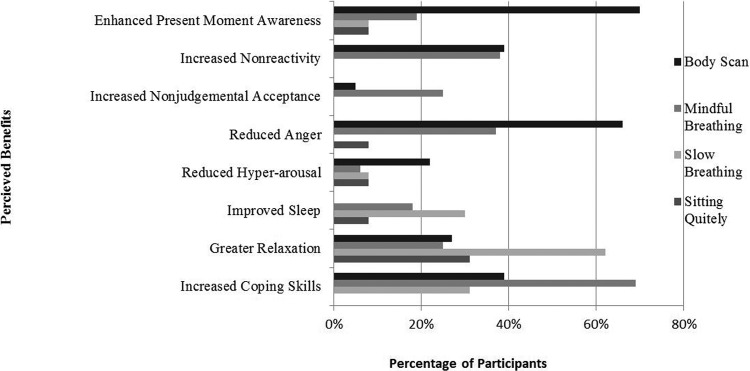
This qualitative study explored and compared the subjective experiences of 102 veterans with posttraumatic stress disorder (PTSD) who were randomly assigned to 1 of 4 arms: ( a) body scan, ( b) mindful breathing, ( c) slow breathing, or ( d) sitting quietly. Qualitative data were obtained via semistructured interviews following the intervention and analyzed using conventional content analysis. The percentage of participants within each intervention who endorsed a specific theme was calculated. Two-proportion z tests were then calculated to determine if the differences among themes endorsed in specific groups were statistically significant. Six core themes emerged from analysis of participant responses across the 4 groups: ( a) enhanced present moment awareness, ( b) increased nonreactivity, ( c) increased nonjudgmental acceptance, ( d) decreased physiological arousal and stress reactivity, ( e) increased active coping skills, and ( f) greater relaxation. More participants in the mindfulness intervention groups reported improvement in PTSD symptoms when compared to participants in non-mindfulness groups. Different types of intervention targeted different symptoms and aspects of well-being. Furthermore, type of intervention may have also differentially targeted potential mechanisms of action. This article highlights the importance of employing both quantitative and qualitative research methods when investigating the dynamic process of mindfulness and may inform how practices can be tailored to the needs of the veteran with PTSD.
这项定性研究探索并比较了102名创伤后应激障碍(PTSD)退伍军人的主观体验,这些退伍军人被随机分配到4组中的一组:(a)身体扫描,(b)正念呼吸,(c)慢呼吸,或(d)安静坐着。定性数据通过干预后的半结构化访谈获得,并使用传统内容分析法进行分析。计算了每组干预措施中认可特定主题的参与者的百分比。然后进行双比例z检验,以确定特定组中认可的主题之间的差异是否具有统计学意义。通过对4组参与者的回答进行分析,出现了6个核心主题:(a)增强当下意识,(b)增加无反应性,(c)增加无评判性接纳,(d)降低生理唤醒和应激反应性,(e)增加积极应对技能,以及(f)更大程度的放松。与非正念组的参与者相比,正念干预组中有更多参与者报告创伤后应激障碍症状有所改善。不同类型的干预针对不同的症状和幸福方面。此外,干预类型可能还会以不同方式针对潜在的作用机制。本文强调了在研究正念的动态过程时采用定量和定性研究方法的重要性,并可能为如何根据创伤后应激障碍退伍军人的需求调整实践提供参考。