Ott Caroline V, Vinberg Maj, Bowie Christopher R, Christensen Ellen Margrethe, Knudsen Gitte M, Kessing Lars V, Miskowiak Kamilla W
Copenhagen Affective Disorder Research Center (CADIC), Psychiatric Centre Copenhagen, Copenhagen University Hospital, Rigshospitalet, Copenhagen, Denmark.
Department of Psychology, University of Copenhagen, Copenhagen, Denmark.
Trials. 2018 Sep 12;19(1):487. doi: 10.1186/s13063-018-2860-8.
Cognitive impairment is present in bipolar disorder (BD) during the acute and remitted phases and hampers functional recovery. However, there is currently no clinically available treatment with direct and lasting effects on cognitive impairment in BD. We will examine the effect of a novel form of cognitive remediation, action-based cognitive remediation (ABCR), on cognitive impairment in patients with BD, and explore the neural substrates of potential treatment efficacy on cognition.
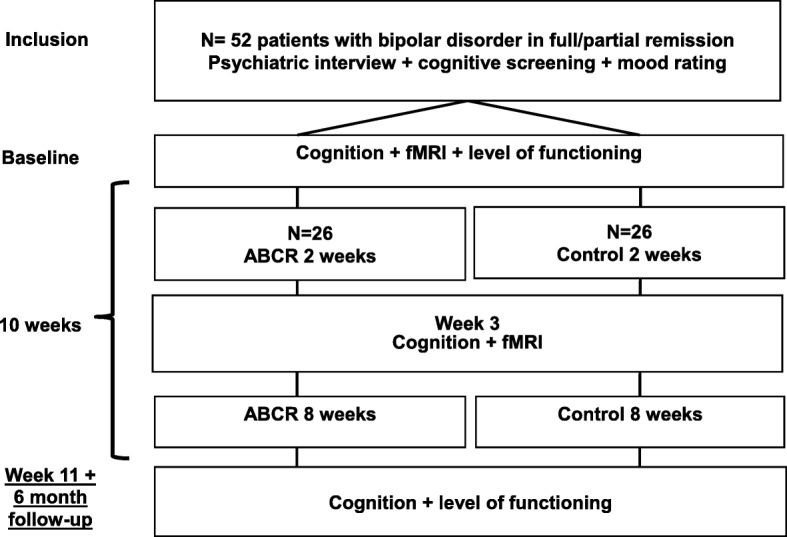
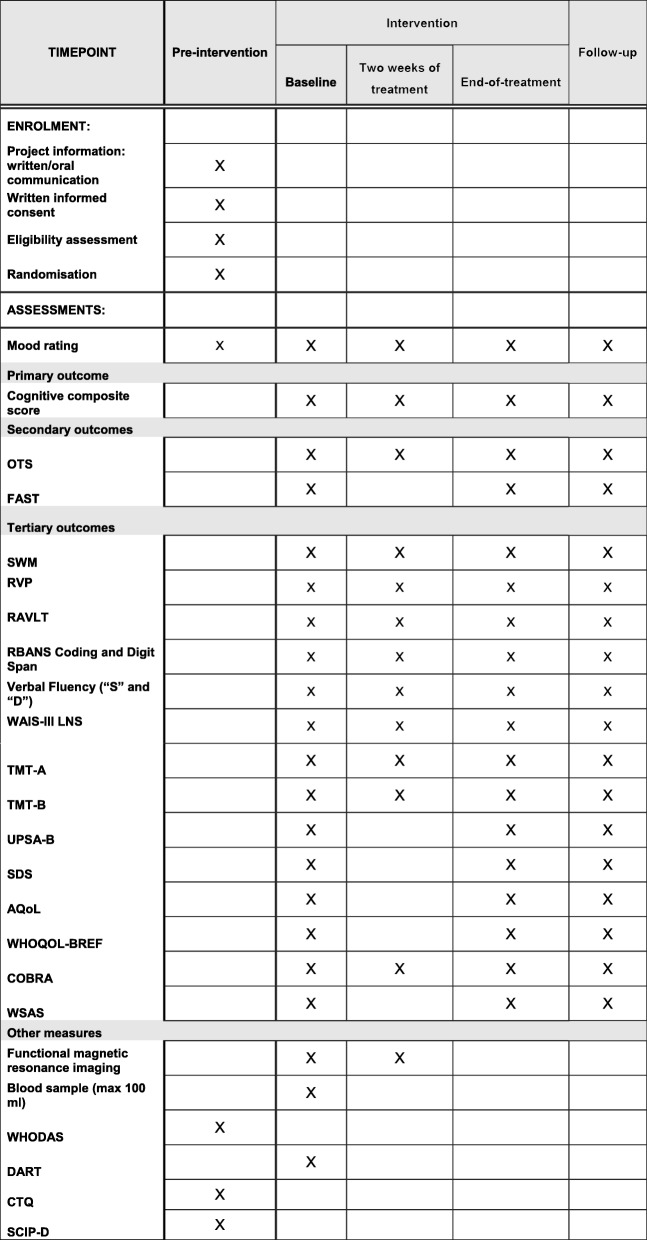
METHODS/DESIGN: The trial has a randomized, controlled, parallel-group design. In total, 58 patients with BD in full or partial remission aged 18-55 years with objective cognitive impairment will be recruited. Participants are randomized to 10 weeks of ABCR or a control group. Assessments encompassing neuropsychological testing and mood ratings, and questionnaires on subjective cognitive complaints, psychosocial functioning, and quality of life are carried out at baseline, after 2 weeks of treatment, after the end of treatment, and at a six-month-follow-up after treatment completion. Functional magnetic resonance imaging scans are performed at baseline and 2 weeks into treatment. The primary outcome is a cognitive composite score spanning verbal memory, attention, and executive function. Two complete data sets for 52 patients will provide a power of 80% to detect a clinically relevant between-group difference on the primary outcome. Behavioral data will be analyzed using mixed models in SPSS while MRI data will be analyzed with the FMRIB Expert Analysis Tool (FEAT). Early treatment-related changes in neural activity from baseline to week 2 will be investigated for the dorsal prefrontal cortex and hippocampus as the regions of interest and with an exploratory whole-brain analysis.
The results will provide insight into whether ABCR has beneficial effects on cognition and functioning in remitted patients with BD. The results will also provide insight into early changes in neural activity associated with improvement of cognition, which can aid future treatment development.
Clinicaltrials.gov , NCT03295305 . Registered on 26 September 2017.
双相情感障碍(BD)在急性期和缓解期均存在认知障碍,这会妨碍功能恢复。然而,目前尚无对BD认知障碍有直接且持久疗效的临床可用治疗方法。我们将研究一种新型认知康复形式——基于动作的认知康复(ABCR)对BD患者认知障碍的影响,并探索其对认知潜在治疗效果的神经基础。
方法/设计:该试验采用随机、对照、平行组设计。总共将招募58名年龄在18 - 55岁、处于完全或部分缓解期且有客观认知障碍的BD患者。参与者被随机分为接受10周ABCR治疗组或对照组。在基线、治疗2周后、治疗结束时以及治疗完成后6个月随访时,进行包括神经心理学测试和情绪评定,以及关于主观认知主诉、心理社会功能和生活质量的问卷调查。在基线和治疗2周时进行功能磁共振成像扫描。主要结局是一个涵盖言语记忆、注意力和执行功能的认知综合评分。52名患者的两个完整数据集将提供80%的检验效能,以检测主要结局上具有临床意义的组间差异。行为数据将在SPSS中使用混合模型进行分析,而MRI数据将使用FMRIB专家分析工具(FEAT)进行分析。将以背外侧前额叶皮层和海马体作为感兴趣区域,并通过探索性全脑分析,研究从基线到第2周与治疗相关的神经活动早期变化。
结果将为ABCR对缓解期BD患者的认知和功能是否有有益影响提供见解。结果还将为与认知改善相关的神经活动早期变化提供见解,这有助于未来治疗方法的开发。
Clinicaltrials.gov,NCT03295305。于2017年9月26日注册。