Bipolar and Depressive Disorders Unit, Institute of Neurosciences, Hospital Clinic, University of Barcelona, IDIBAPS, CIBERSAM, Barcelona, Catalonia, Spain.
Int J Neuropsychopharmacol. 2019 Aug 1;22(8):467-477. doi: 10.1093/ijnp/pyz018.
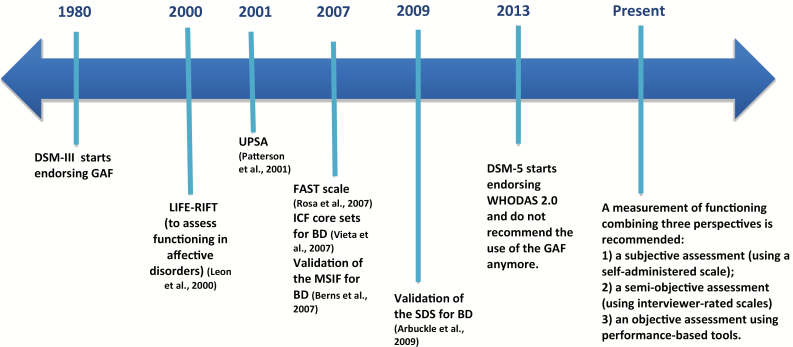
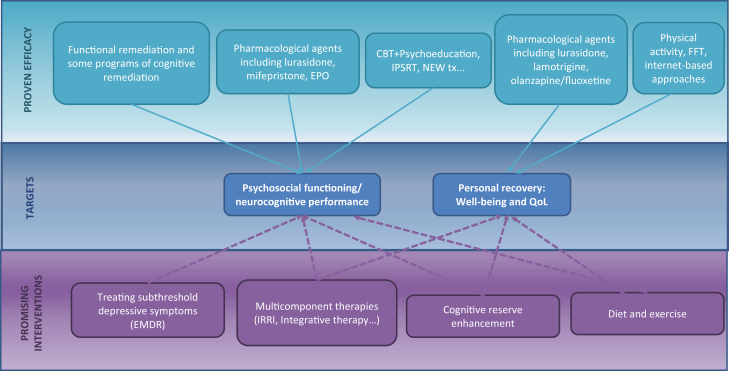
People with bipolar disorder frequently experience persistent residual symptoms, problems in psychosocial functioning, cognitive impairment, and poor quality of life. In the last decade, the treatment target in clinical and research settings has focused not only on clinical remission, but also on functional recovery and, more lately, in personal recovery, taking into account patients' well-being and quality of life. Hence, the trend in psychiatry and psychology is to treat bipolar disorder in an integrative and holistic manner. This literature review offers an overview regarding psychosocial functioning in bipolar disorder. First, a brief summary is provided regarding the definition of psychosocial functioning and the tools to measure it. Then, the most reported variables influencing the functional outcome in patients with bipolar disorder are listed. Thereafter, we include a section discussing therapies with proven efficacy at enhancing functional outcomes. Other possible therapies that could be useful to prevent functional decline and improve functioning are presented in another section. Finally, in the last part of this review, different interventions directed to improve patients' well-being, quality of life, and personal recovery are briefly described.
双相情感障碍患者经常出现持续的残留症状、社会心理功能障碍、认知障碍和生活质量差。在过去的十年中,临床和研究环境中的治疗目标不仅集中在临床缓解上,还集中在功能恢复上,最近还集中在个人康复上,考虑到患者的幸福和生活质量。因此,精神病学和心理学的趋势是采用综合和整体的方法来治疗双相情感障碍。本文综述了双相情感障碍的社会心理功能。首先,简要概述了社会心理功能的定义和测量工具。然后,列出了影响双相情感障碍患者功能结果的最常见变量。此后,我们讨论了经证实可提高功能结果的治疗方法。在另一节中介绍了其他可能对预防功能下降和改善功能有用的可能疗法。最后,在这篇综述的最后一部分,简要描述了旨在改善患者幸福感、生活质量和个人康复的不同干预措施。