Laboratory of Tumor Biology, Guangdong Provincial Hospital of Chinese Medicine, The Second Clinical Medical Collage, Guangzhou University of Chinese Medicine, 510120, Guangzhou, Guangdong Province, China.
Department of Medical Oncology, Guangdong Provincial Hospital of Chinese Medicine, The Second Clinical Medical Collage, Guangzhou University of Chinese Medicine, 510120, Guangzhou, Guangdong Province, China.
Exp Mol Med. 2018 Sep 12;50(9):1-14. doi: 10.1038/s12276-018-0146-6.
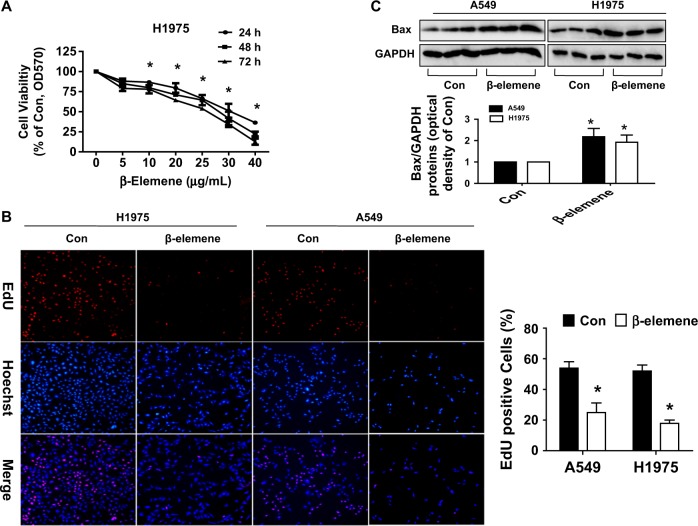
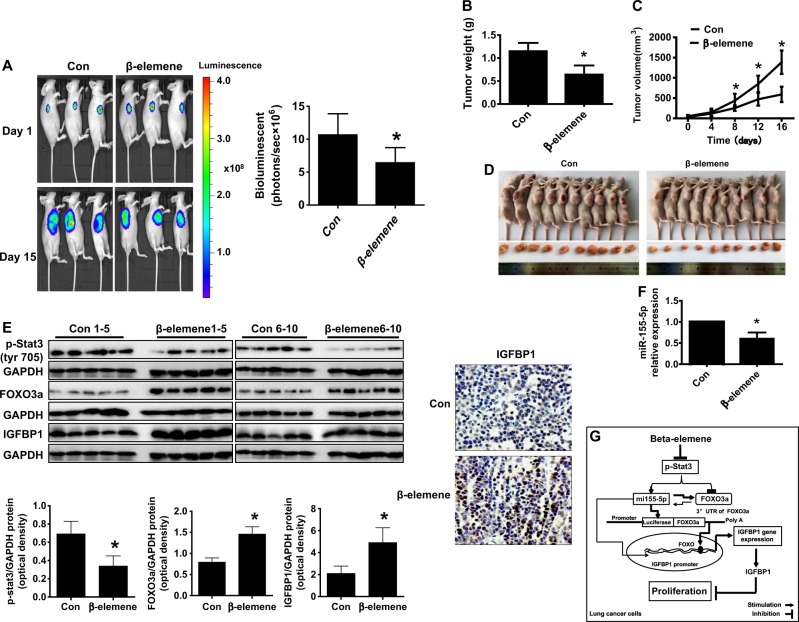
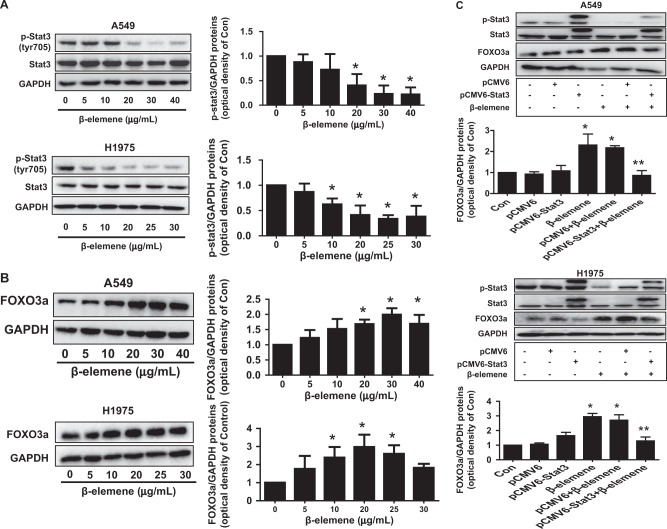
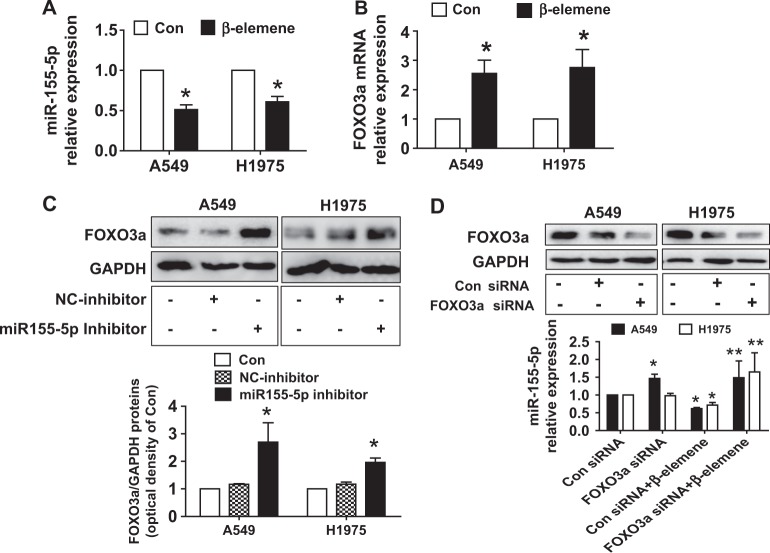
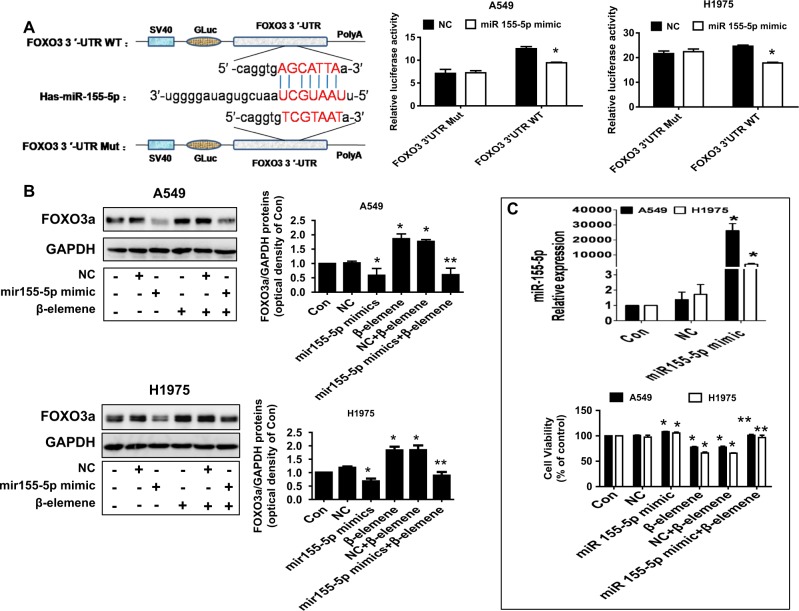
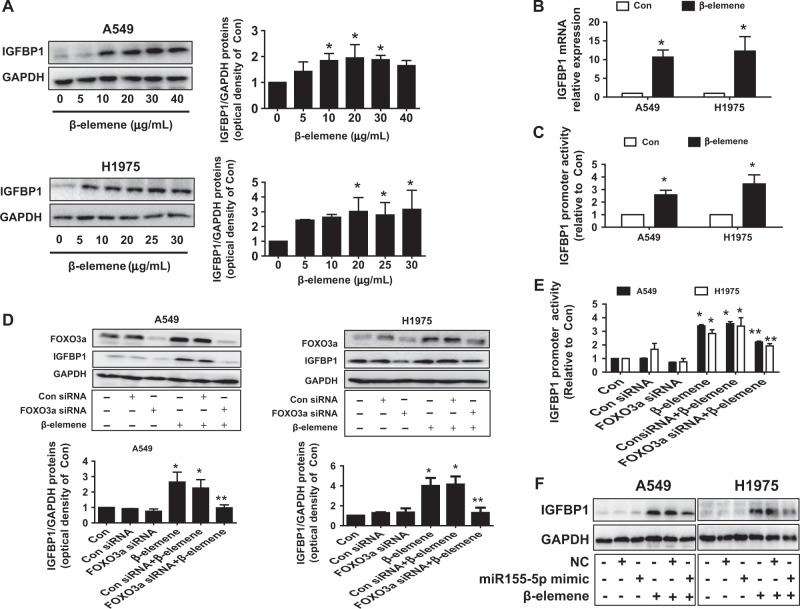
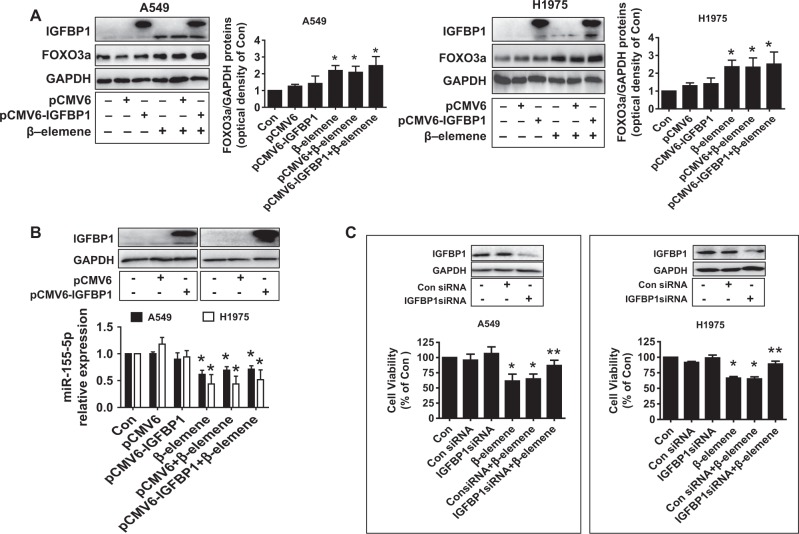
β-Elemene, an active component of natural plants, has been shown to exhibit anticancer properties. However, the detailed mechanism underlying these effects has yet to be determined. In this study, we show that β-elemene inhibits the growth of lung cancer cells. Mechanistically, we found that β-elemene decreased the phosphorylation of signal transducer and activator of transcription 3 (Stat3) and miRNA155-5p mRNA but induced the protein expression of human forkhead box class O (FOXO)3a; the latter two were abrogated in cells with overexpressed Stat3. Notably, miRNA155-5p mimics reduced FOXO3a luciferase reporter activity in the 3-UTR region and protein expression, whereas overexpressed FOXO3a countered the reduction of the miRNA155-5p levels by β-elemene. Moreover, β-elemene increased the mRNA and protein expression levels as well as promoter activity of insulin-like growth factor-binding protein 1 (IGFBP1); this finding was not observed in cells with a silenced FOXO3a gene and miRNA155-5p mimics. Finally, silencing of IGFBP1 blocked β-elemene-inhibited cell growth. Similar findings were observed in vivo. In summary, our results indicate that β-elemene increases IGFBP1 gene expression via inactivation of Stat3 followed by a reciprocal interaction between miRNA155-5p and FOXO3a. This effect leads to inhibition of human lung cancer cell growth. These findings reveal a novel molecular mechanism underlying the inhibitory effects of β-elemene on lung cancer cells.
β-榄香烯是一种天然植物的活性成分,已被证明具有抗癌特性。然而,其作用机制尚不清楚。在本研究中,我们发现β-榄香烯能抑制肺癌细胞的生长。机制上,我们发现β-榄香烯降低了信号转导和转录激活因子 3(Stat3)的磷酸化和 microRNA155-5p mRNA,但诱导了叉头框蛋白 O 类(FOXO)3a 的蛋白表达;在 Stat3 过表达的细胞中,后两者被阻断。值得注意的是,miRNA155-5p 模拟物降低了 FOXO3a 荧光素酶报告基因在 3'UTR 区域的活性和蛋白表达,而过表达的 FOXO3a 则抵消了β-榄香烯对 miRNA155-5p 水平的降低。此外,β-榄香烯增加了胰岛素样生长因子结合蛋白 1(IGFBP1)的 mRNA 和蛋白表达水平以及启动子活性;在沉默 FOXO3a 基因和 miRNA155-5p 模拟物的细胞中没有观察到这一发现。最后,沉默 IGFBP1 阻断了β-榄香烯抑制细胞生长。在体内也观察到了类似的发现。总之,我们的结果表明,β-榄香烯通过失活 Stat3 增加 IGFBP1 基因表达,随后 microRNA155-5p 和 FOXO3a 之间发生相互作用。这种作用导致人肺癌细胞生长受到抑制。这些发现揭示了β-榄香烯抑制肺癌细胞的作用的新的分子机制。