Darbois Nelly, Guillaud Albin, Pinsault Nicolas
Critical Thinking Research Federation FED 4276, University Grenoble-Alpes, Grenoble, France.
Cortecs team, Grenoble, France.
Rehabil Res Pract. 2018 Aug 19;2018:6412318. doi: 10.1155/2018/6412318. eCollection 2018.
Mirror therapy has been used in rehabilitation for multiple indications since the 1990s. Current evidence supports some of these indications, particularly for cerebrovascular accidents in adults and cerebral palsy in children. Since 2000s, computerized or robotic mirror therapy has been developed and marketed.
To map the extent, nature, and rationale of research activity in robotic or computerized mirror therapy and the type of evidence available for any indication. To investigate the relevance of conducting a systematic review and meta-analysis on these therapies.
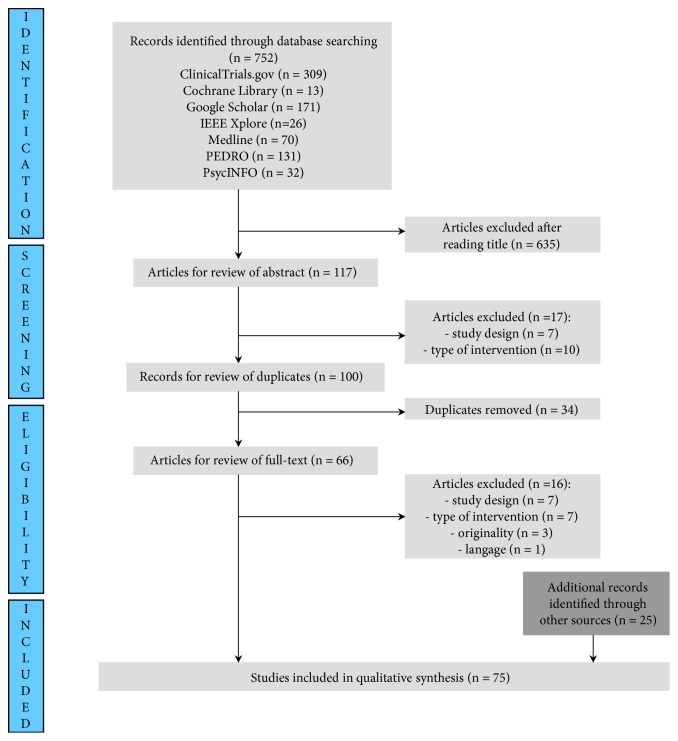
Systematic scoping review. Searches were conducted (up to May 2018) in the , and databases. References from identified studies were examined.
In sum, 75 articles met the inclusion criteria. Most studies were publicly funded (57% of studies; n = 43), without disclosure of conflict of interest (59% of studies; n = 44). The main outcomes assessed were pain, satisfaction on the device, and body function and activity, mainly for stroke and amputees patients and healthy participants. Most design studies were case reports (67% of studies; n = 50), with only 12 randomized controlled trials with 5 comparing standard mirror therapy versus virtual mirror therapy, 5 comparing second-generation mirror therapy versus conventional rehabilitation, and 2 comparing other interventions.
Much of the research on second-generation mirror therapy is of very low quality. Evidence-based rationale to conduct such studies is missing. It is not relevant to recommend investment by rehabilitation professionals and institutions in such devices.
自20世纪90年代以来,镜像疗法已被用于多种适应症的康复治疗。目前的证据支持其中一些适应症,特别是在成人脑血管意外和儿童脑瘫方面。自21世纪以来,已开发并销售了计算机化或机器人镜像疗法。
梳理机器人或计算机化镜像疗法研究活动的范围、性质和基本原理,以及任何适应症可用的证据类型。调查对这些疗法进行系统评价和荟萃分析的相关性。
系统综述。检索了(截至2018年5月)、和数据库。对已识别研究的参考文献进行了审查。
总计75篇文章符合纳入标准。大多数研究由公共资金资助(57%的研究;n = 43),未披露利益冲突(59%的研究;n = 44)。评估的主要结果是疼痛、对设备的满意度以及身体功能和活动,主要针对中风患者、截肢患者和健康参与者。大多数设计研究为病例报告(67%的研究;n = 50),只有12项随机对照试验,其中5项比较标准镜像疗法与虚拟镜像疗法,5项比较第二代镜像疗法与传统康复疗法,2项比较其他干预措施。
关于第二代镜像疗法的许多研究质量非常低。缺乏进行此类研究的循证依据。康复专业人员和机构投资此类设备并不合适。