Alkhubaizi Qoot, Sorkin John David, Hochberg Marc C, Gordon Sharon M
Department of General Dental Practice, Faculty of Dentistry, Kuwait University, Kuwait.
Geriatric Research, Education and Clinical Center, Baltimore VA Medical Center, Baltimore, USA.
J Dent Oral Biol. 2017;2(3). Epub 2017 Feb 9.
Temporomandibular disorder (TMD) is believed to be co-morbid with rheumatologic conditions such as Osteoarthritis (OA). We determine 30-day prevalence and cumulative incidence, and risk factors for facial pain in a cohort of subjects who either had or were at risk of developing symptomatic radiographic knee osteoarthritis (SRKOA).
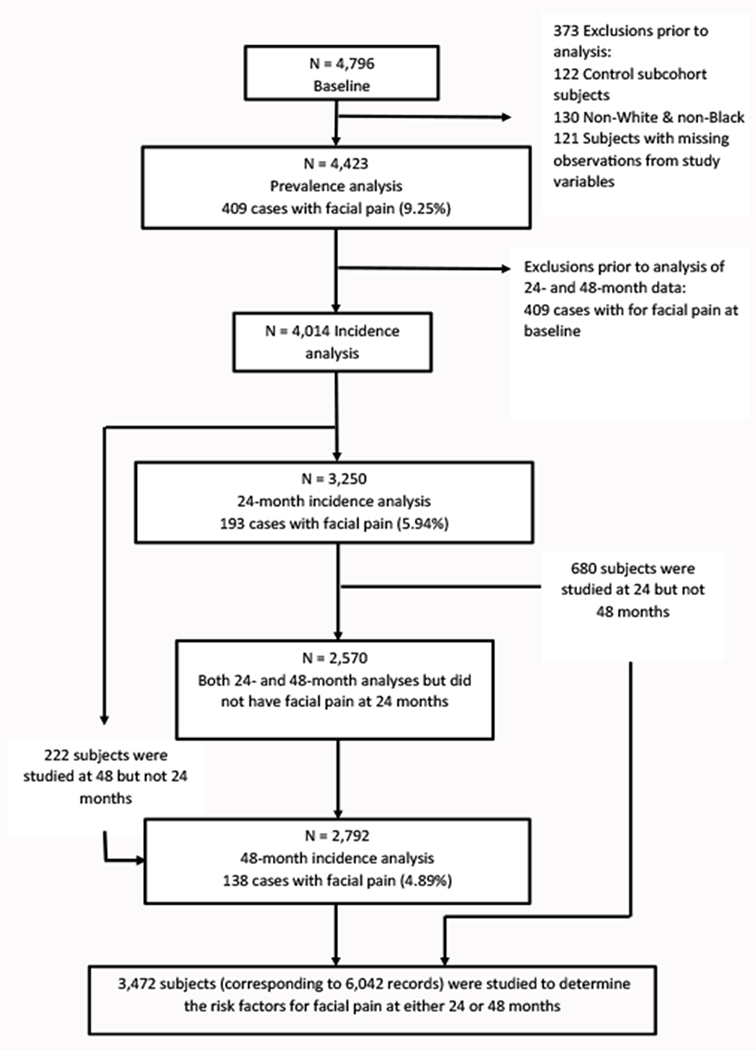
Poisson regression models examined whether age, sex, race, Center for Epidemiologic Studies-Depression Scale (CES-D) score, number of painful joints, and presence of SRKOA were risk factors for facial pain in 4,423 subjects at baseline and in 3,472 subjects at 24 and/or 48 months follow-up.
At baseline, 30-day period prevalence of facial pain was 9.25%; and 30-day cumulative incidence at 24-months and at 48-months was 5.9% and 4.9%, respectively. Factors associated with prevalence and incidence of facial pain were: younger age, female sex, (CES-D) score, and a larger number of painful joints. For each increase in age of one year, the incidence of facial pain decreased by 1%. Women had a 96% higher incidence than men, and each unit increase of (CES-D) score was associated with a 2% increase in the incidence of facial pain. For every additional painful joint, there was a 21% increase in the incidence of facial pain. Subjects with SRKOA had a 33% increase in the incidence of facial pain compared to those with risk factors for SRKOA.
OA and TMD share several risk factors. The risk factors identified in cross-sectional analysis of prevalence are similar to those identified in longitudinal analysis on incidence.
颞下颌关节紊乱病(TMD)被认为与骨关节炎(OA)等风湿性疾病共病。我们确定了一组有症状性膝关节影像学骨关节炎(SRKOA)或有发展为SRKOA风险的受试者中面部疼痛的30天患病率和累积发病率,以及相关危险因素。
采用泊松回归模型,研究年龄、性别、种族、流行病学研究中心抑郁量表(CES-D)评分、疼痛关节数量以及SRKOA的存在是否为4423名基线受试者以及3472名24个月和/或48个月随访受试者面部疼痛的危险因素。
在基线时,面部疼痛的30天期间患病率为9.25%;24个月和48个月时的30天累积发病率分别为5.9%和4.9%。与面部疼痛患病率和发病率相关的因素有:年龄较小、女性、(CES-D)评分以及更多的疼痛关节。年龄每增加一岁,面部疼痛发病率下降1%。女性的发病率比男性高96%,(CES-D)评分每增加一个单位,面部疼痛发病率增加2%。每增加一个疼痛关节,面部疼痛发病率增加21%。与有SRKOA危险因素的受试者相比,患有SRKOA的受试者面部疼痛发病率增加33%。
OA和TMD有几个共同的危险因素。在患病率横断面分析中确定的危险因素与发病率纵向分析中确定的危险因素相似。