Linde + Robinson Laboratories , California Institute of Technology , Pasadena , California 91125 , United States.
School of Civil and Environmental Engineering , Georgia Institute of Technology , Atlanta , Georgia 30332 , United States.
ACS Nano. 2018 Oct 23;12(10):10281-10290. doi: 10.1021/acsnano.8b05384. Epub 2018 Sep 19.
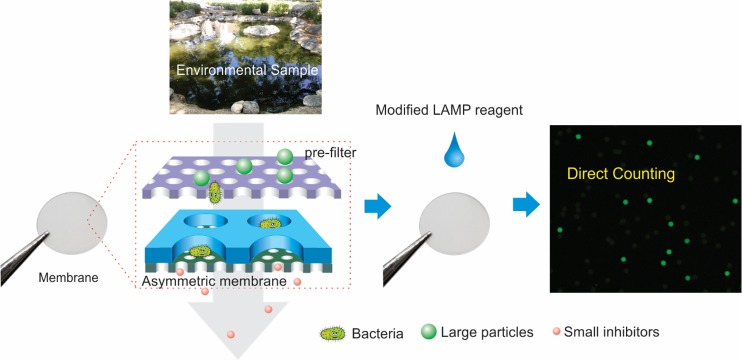
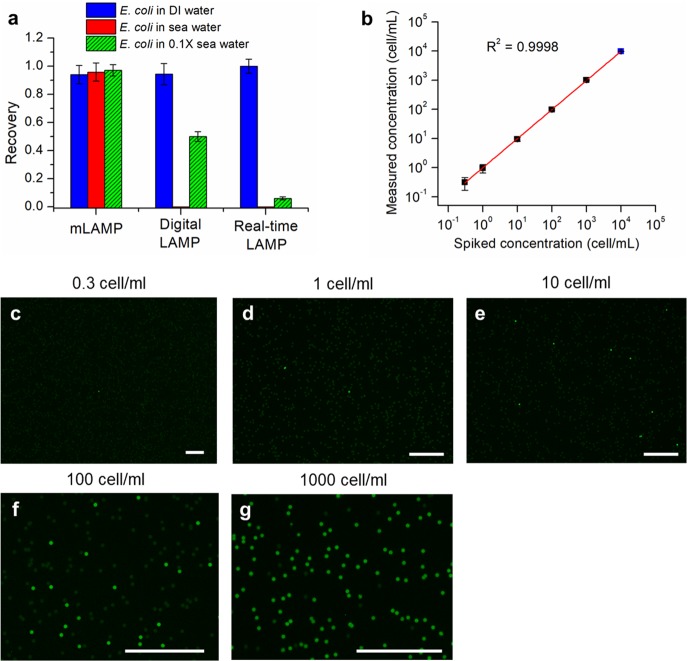
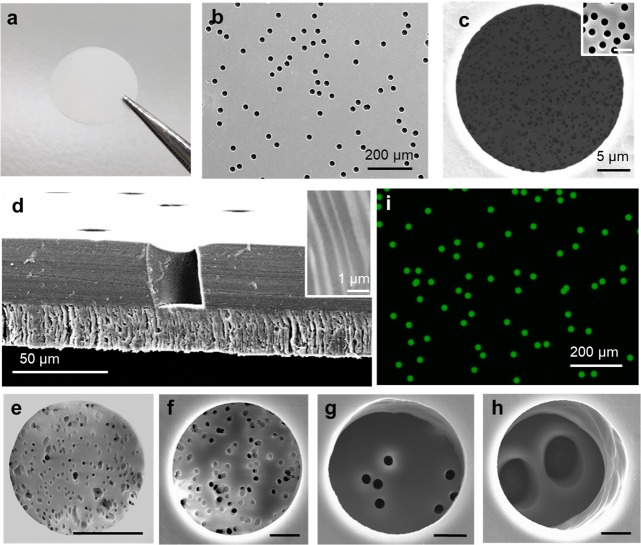
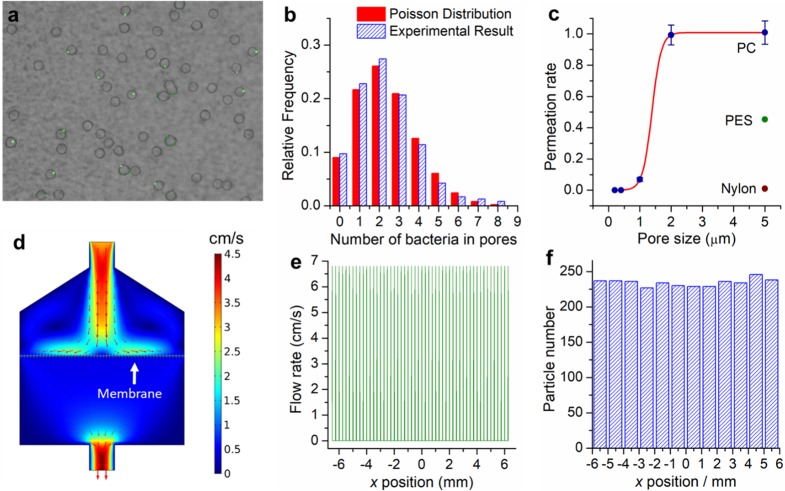
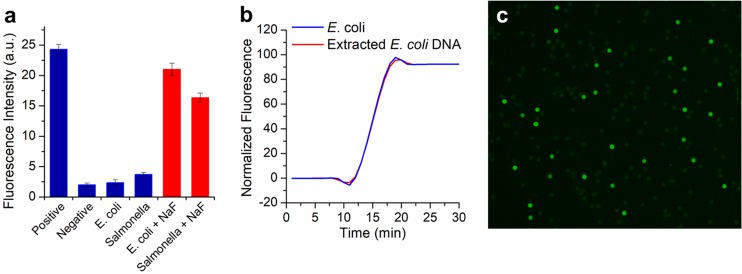
In this work, we introduce an asymmetric membrane as a simple and robust nanofluidic platform for digital detection of single pathogenic bacteria directly in 10 mL of unprocessed environmental water samples. The asymmetric membrane, consisting of uniform micropores on one side and a high density of vertically aligned nanochannels on the other side, was prepared within 1 min by a facile method. The single membrane covers all the processing steps from sample concentration, purification, and partition to final digital loop-mediated isothermal amplification (LAMP). By simple filtration, bacteria were enriched and partitioned inside the micropores, while inhibitors typically found in the environmental samples ( i.e., proteins, heavy metals, and organics) were washed away through the nanochannels. Meanwhile, large particles, indigenous plankton, and positively charged pollutants in the samples were excluded by using a sacrificial membrane stacked on top. After initial filtration, modified LAMP reagents, including NaF and lysozyme, were loaded onto the membrane. Each pore in the asymmetric membrane functioned as an individual nanoreactor for selective, rapid, and efficient isothermal amplification of single bacteria, generating a bright fluorescence for direct counting. Even though high levels of inhibitors were present, absolute quantification of Escherichia coli and Salmonella directly in an unprocessed environmental sample (seawater and pond water) was achieved within 1 h, with sensitivity down to single cell and a dynamic range of 0.3-10000 cells/mL. The simple and low-cost analysis platform described herein has an enormous potential for the detection of pathogens, exosomes, stem cells, and viruses as well as single-cell heterogeneity analysis in environmental, food, and clinical research.
在这项工作中,我们引入了一种不对称膜作为一种简单而强大的纳流控平台,用于直接在未经处理的 10 毫升环境水样中数字检测单个致病性细菌。不对称膜由一侧的均匀微孔和另一侧的高密度垂直排列的纳米通道组成,通过一种简单的方法在 1 分钟内制备。单个膜覆盖了从样品浓缩、净化和分配到最终数字环介导等温扩增(LAMP)的所有处理步骤。通过简单过滤,细菌在内微孔中被富集和分配,而通常在环境样品中发现的抑制剂(即蛋白质、重金属和有机物)通过纳米通道被冲走。同时,通过在顶部堆叠牺牲膜,将样品中的大颗粒、本土浮游生物和带正电荷的污染物排除在外。初始过滤后,将改良的 LAMP 试剂(包括 NaF 和溶菌酶)加载到膜上。不对称膜中的每个孔都作为单个纳米反应器,用于选择性、快速和高效地对单个细菌进行等温扩增,产生明亮的荧光以进行直接计数。即使存在高水平的抑制剂,也可以在 1 小时内直接在未经处理的环境样品(海水和池塘水)中定量检测大肠杆菌和沙门氏菌,灵敏度可达单细胞水平,动态范围为 0.3-10000 个细胞/mL。本文所述的简单且低成本的分析平台在环境、食品和临床研究中用于检测病原体、外泌体、干细胞和病毒以及单细胞异质性分析具有巨大的潜力。