Epidemiology and Public Health Group, University of Exeter Medical School, Exeter, Devon, United Kingdom.
Center on Aging, University of Connecticut Health, Farmington, Connecticut, United States of America.
PLoS One. 2018 Sep 13;13(9):e0203504. doi: 10.1371/journal.pone.0203504. eCollection 2018.
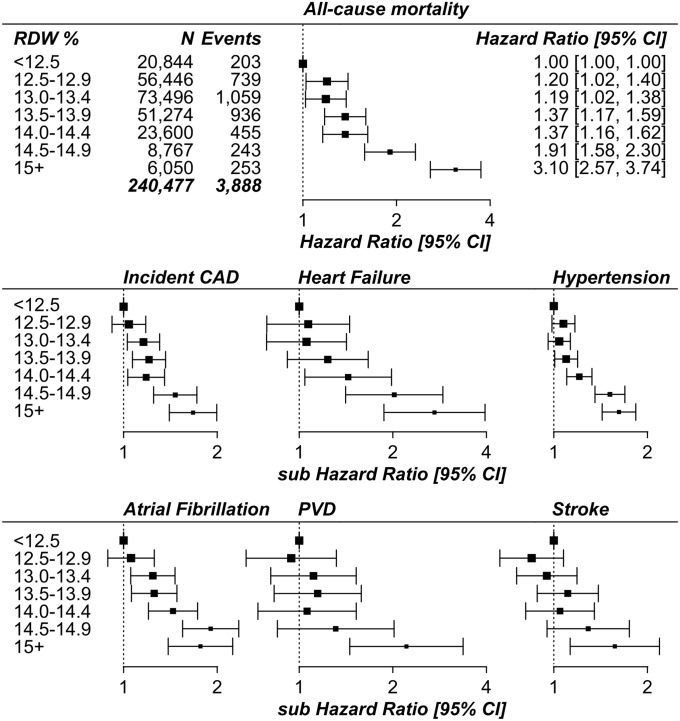
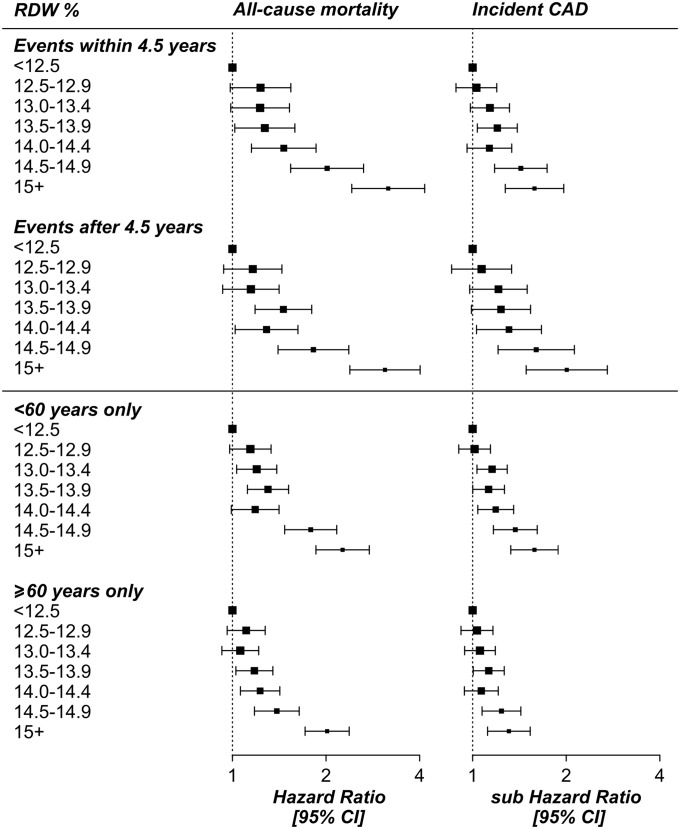
Higher Red Blood Cell Distribution Width (RDW or anisocytosis) predicts incident coronary artery disease (CAD) plus all-cause and cardiovascular mortality, but its predictive value for other common diseases in healthy volunteers is less clear. We aimed to determine the shorter and longer term associations between RDW and incident common conditions in participants free of baseline disease, followed for 9 years. We undertook a prospective analysis of RDW% using 240,477 healthy UK Biobank study volunteers aged 40-70 years at baseline, with outcomes ascertained during follow-up (≤9 years). Participants were free of anemia, CAD, type-2 diabetes, stroke, hypertension, COPD, and any cancer (except non-melanoma skin cancer) at baseline. Survival models (with competing Hazards) tested associations with outcomes from hospital admission records and death certificates. High RDW (≥15% variation, n = 6,050) compared to low (<12.5% n = 20,844) was strongly associated with mortality (HR 3.10: 95% CI 2.57 to 3.74), adjusted for age, sex, smoking status, education level, mean cell volume and hemoglobin concentration. Higher RDW was also associated with incident CAD (sub-HR 1.67: 1.40 to 1.99), heart failure, peripheral vascular disease, atrial fibrillation, stroke, and cancer (sHR 1.37: 1.21 to 1.55; colorectal cancer sHR 1.92: 1.36 to 2.72), especially leukemia (sHR 2.85: 1.63 to 4.97). Associations showed dose-response relationships, and RDW had long-term predictive value (≥4.5 years after assessment) for the majority of outcomes, which were similar in younger and older persons. In conclusion, higher RDW predicted onsets of a wide range of common conditions as well as mortality in a large healthy volunteer cohort. RDW is not just a short term predictor, as high levels were predictive 4.5 to 9 years after baseline in healthy volunteers. The wide range of outcomes reflects known RDW genetic influences, including diverse disease risks. RDW may be a useful clinical marker for inclusion in wellness assessments.
更高的红细胞分布宽度(RDW 或不均一性)可预测冠心病(CAD)的发生,以及全因和心血管死亡率,但它对健康志愿者中其他常见疾病的预测价值尚不清楚。我们的目的是确定在基线无疾病的参与者中,RDW 与短期和长期内发生的常见疾病之间的关联,随访时间为 9 年。我们对英国生物库研究的 240477 名年龄在 40-70 岁的健康志愿者进行了 RDW%的前瞻性分析,在随访期间(≤9 年)确定了结局。参与者在基线时无贫血、CAD、2 型糖尿病、中风、高血压、COPD 和任何癌症(除非黑色素瘤皮肤癌外)。生存模型(带有竞争风险)测试了与住院记录和死亡证明结果的关联。与低 RDW(<12.5%,n=20844)相比,高 RDW(≥15%,n=6050)与死亡率强烈相关(HR 3.10:95%CI 2.57 至 3.74),校正了年龄、性别、吸烟状况、教育程度、平均细胞体积和血红蛋白浓度。较高的 RDW 也与 CAD(亚 HR 1.67:1.40 至 1.99)、心力衰竭、外周血管疾病、心房颤动、中风和癌症(sHR 1.37:1.21 至 1.55;结直肠癌 sHR 1.92:1.36 至 2.72)相关,尤其是白血病(sHR 2.85:1.63 至 4.97)。关联显示出剂量反应关系,RDW 对大多数结局具有长期预测价值(在评估后≥4.5 年),且在年轻和老年人群中相似。总之,在一个大型健康志愿者队列中,较高的 RDW 预测了一系列常见疾病的发生以及死亡率。RDW 不仅是短期预测指标,因为在健康志愿者中,基线后 4.5 至 9 年时高水平仍具有预测价值。广泛的结果反映了已知的 RDW 遗传影响,包括不同的疾病风险。RDW 可能是纳入健康评估的有用临床指标。