Department of Physiology, Pharmacology and Neuroscience, City University of New York School of Medicine, New York, NY, 10031, USA.
Department of Biology and Neuroscience, Graduate School of the City University of New York, New York, NY, 10016, USA.
Mol Psychiatry. 2020 Apr;25(4):750-760. doi: 10.1038/s41380-018-0234-y. Epub 2018 Sep 13.
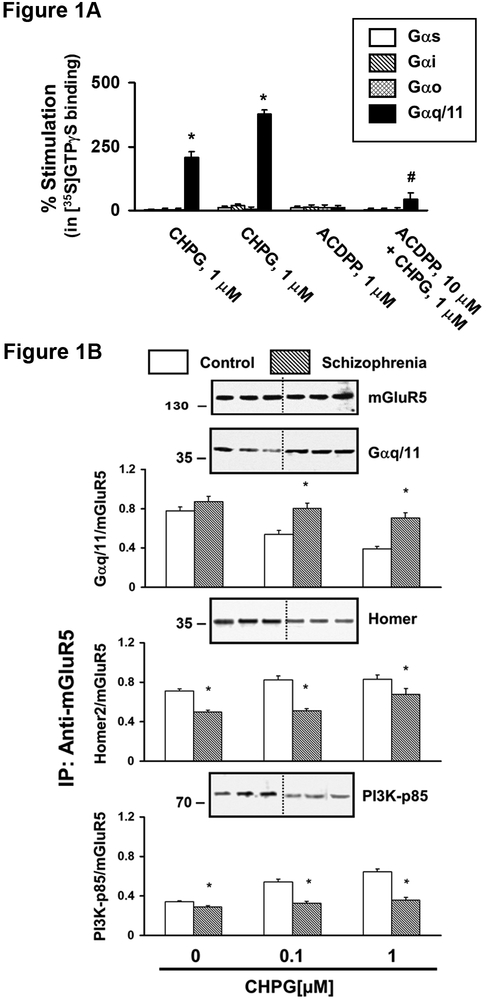
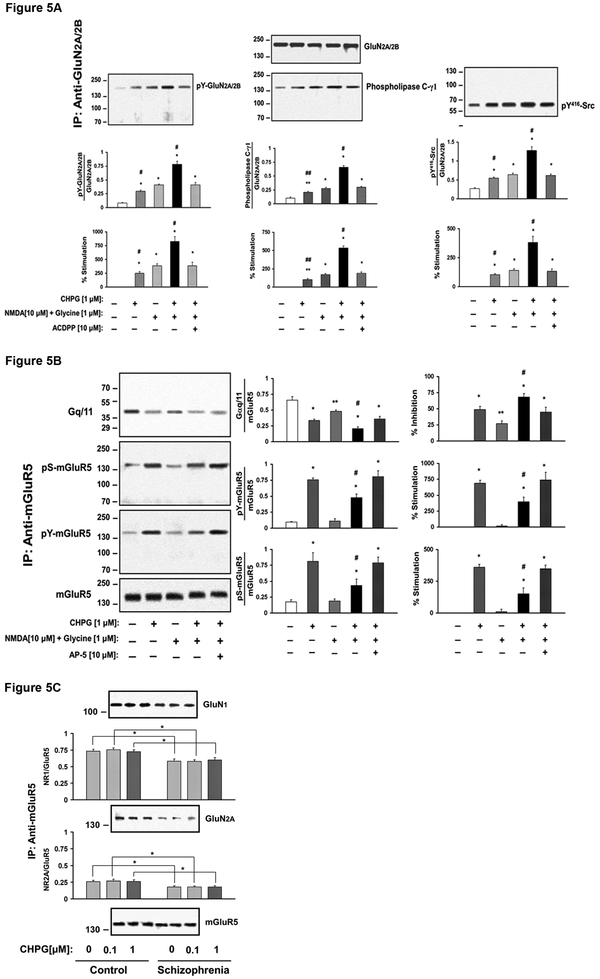
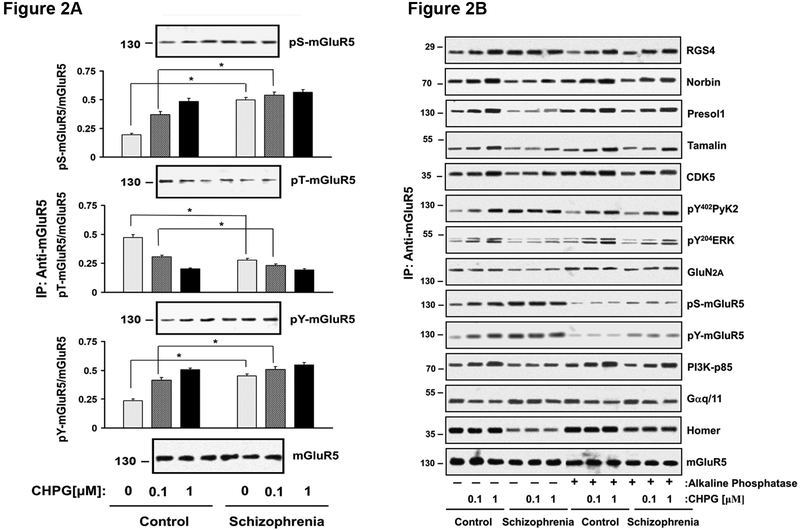
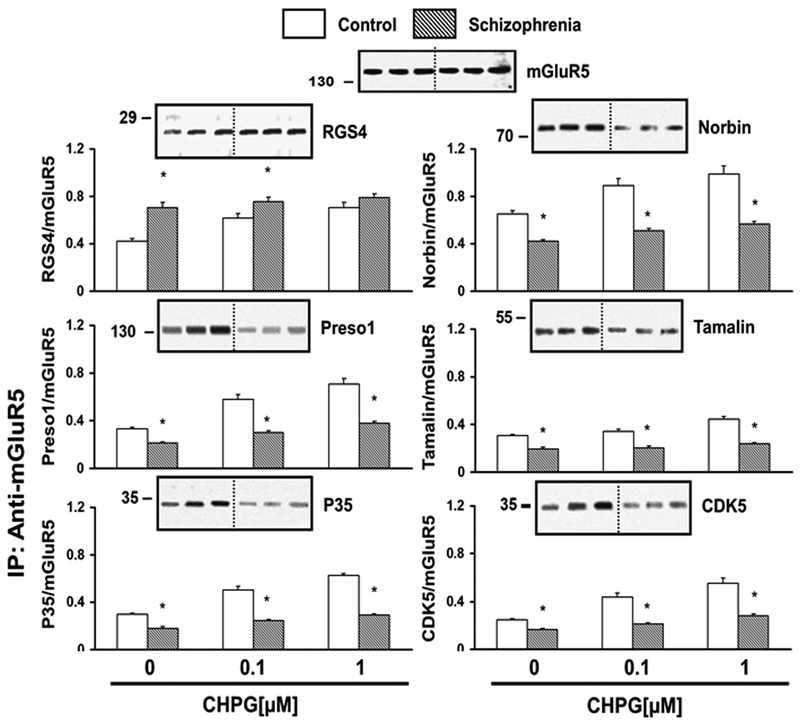
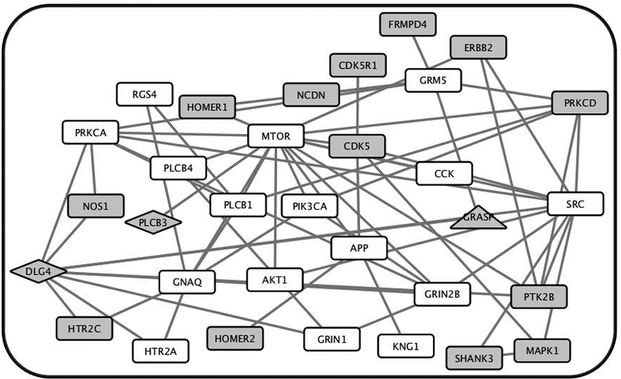
Multiple lines of evidence point to glutamatergic signaling in the postsynaptic density (PSD) as a pathophysiologic mechanism in schizophrenia. Integral to PSD glutamatergic signaling is reciprocal interplay between GluN and mGluR5 signaling. We examined agonist-induced mGluR5 signaling in the postmortem dorsolateral prefrontal cortex (DLPFC) derived from 17 patients and age-matched and sex-matched controls. The patient group showed a striking reduction in mGluR5 signaling, manifested by decreases in Gq/11 coupling and association with PI3K and Homer compared to controls (p < 0.01 for all). This was accompanied by increases in serine and tyrosine phosphorylation of mGluR5, which can decrease mGluR5 activity via desensitization (p < 0.01). In addition, we find altered protein-protein interaction (PPI) of mGluR5 with RGS4, norbin, Preso 1 and tamalin, which can also attenuate mGluR5 activity. We previously reported molecular underpinnings of GluN hypofunction (decreased GluN2 phosphorylation) and here we show those of reduced mGluR5 signaling in schizophrenia. We find that reduced GluN2 phosphorylation can be precipitated by attenuated mGluR5 activity and that increased mGluR5 phosphorylation can result from decreased GluN function, suggesting a reciprocal interplay between the two pathways in schizophrenia. Interestingly, the patient group showed decreased mGluR5-GluN association (p < 0.01), a mechanistic basis for the reciprocal facilitation. In sum, we present the first direct evidence for mGluR5 hypoactivity, propose a reciprocal interplay between GluN and mGluR5 pathways as integral to glutamatergic dysregulation and suggest protein-protein interactions in mGluR5-GluN complexes as potential targets for intervention in schizophrenia.
有多项证据表明,突触后密度(PSD)中的谷氨酸能信号转导是精神分裂症的病理生理机制。PSD 谷氨酸能信号转导的核心是 GluN 和 mGluR5 信号转导的相互作用。我们检查了来自 17 名患者和年龄及性别匹配的对照者死后背外侧前额叶皮层(DLPFC)中激动剂诱导的 mGluR5 信号转导。与对照组相比,患者组的 mGluR5 信号转导明显减弱,表现为 Gq/11 偶联和与 PI3K 和 Homer 的关联减少(所有 p 值均 <0.01)。这伴随着 mGluR5 的丝氨酸和酪氨酸磷酸化增加,这可以通过脱敏降低 mGluR5 的活性(所有 p 值均 <0.01)。此外,我们发现 mGluR5 与 RGS4、norbin、Preso 1 和 tamalin 的蛋白-蛋白相互作用(PPI)发生改变,这也可以减弱 mGluR5 的活性。我们之前报道了 GluN 功能低下(GluN2 磷酸化减少)的分子基础,在这里我们显示了精神分裂症中 mGluR5 信号转导减少的情况。我们发现,减弱的 mGluR5 活性可以引发 GluN2 磷酸化减少,而增加的 mGluR5 磷酸化可能源于 GluN 功能下降,这表明两种途径在精神分裂症中存在相互作用。有趣的是,患者组显示 mGluR5-GluN 关联减少(p <0.01),这是相互促进的机制基础。总之,我们首次提供了 mGluR5 活性降低的直接证据,提出了 GluN 和 mGluR5 途径的相互作用是谷氨酸能失调的核心,并提出 mGluR5-GluN 复合物中的蛋白-蛋白相互作用可能是精神分裂症干预的潜在靶点。