de Vries Sophie, de Vries Jan, von Dahlen Janina K, Gould Sven B, Archibald John M, Rose Laura E, Slamovits Claudio H
Department of Biochemistry and Molecular Biology, Dalhousie University, Halifax, Canada.
Institute of Population Genetics, Heinrich-Heine University Duesseldorf, Duesseldorf, Germany.
Commun Integr Biol. 2018 Aug 9;11(3):1-14. doi: 10.1080/19420889.2018.1486168. eCollection 2018.
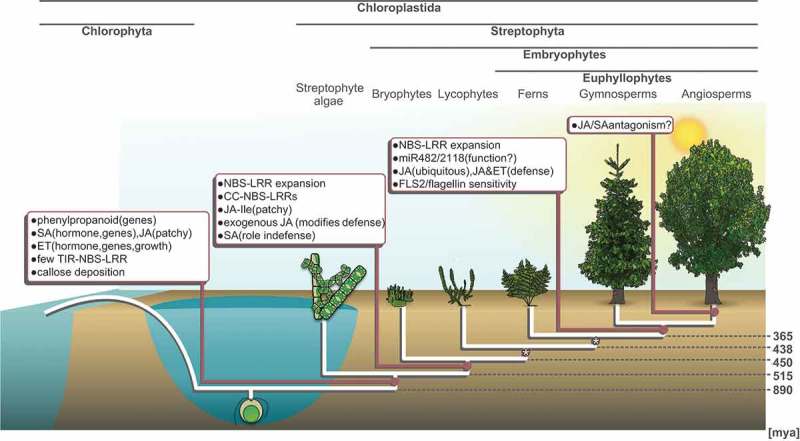
All land plants must cope with phytopathogens. Algae face pathogens, too, and it is reasonable to assume that some of the strategies for dealing with pathogens evolved prior to the origin of embryophytes - plant terrestrialization simply changed the nature of the plant-pathogen interactions. Here we highlight that many potential components of the angiosperm defense toolkit are i) found in streptophyte algae and non-flowering embryophytes and ii) might be used in non-flowering plant defense as inferred from published experimental data. Nonetheless, the common signaling networks governing these defense responses appear to have become more intricate during embryophyte evolution. This includes the evolution of the antagonistic signaling pathways of jasmonic and salicylic acid, multiple independent expansions of resistance genes, and the evolution of resistance gene-regulating microRNAs. Future comparative studies will illuminate which modules of the streptophyte defense signaling network constitute the core and which constitute lineage- and/or environment-specific (peripheral) signaling circuits.
所有陆地植物都必须应对植物病原体。藻类也面临病原体,因此可以合理推测,一些应对病原体的策略在有胚植物起源之前就已经进化出来了——植物向陆地的演化只是改变了植物与病原体相互作用的性质。在这里我们强调,被子植物防御工具包的许多潜在组成部分:一是存在于链形植物藻类和非开花有胚植物中;二是根据已发表的实验数据推断,可能用于非开花植物的防御。尽管如此,在有胚植物进化过程中,控制这些防御反应的常见信号网络似乎变得更加复杂。这包括茉莉酸和水杨酸拮抗信号通路的进化、抗性基因的多次独立扩展以及抗性基因调控微小RNA的进化。未来的比较研究将阐明链形植物防御信号网络的哪些模块构成核心,哪些构成特定谱系和/或环境的(外围)信号回路。