School of Nursing, Emory University, 1520 Clifton Road NE, Atlanta 30322, United States.
Department of Radiation, School of Medicine, Emory University, 1520 Clifton Road NE, Atlanta 30322, United States.
Brain Behav Immun. 2018 Nov;74:291-295. doi: 10.1016/j.bbi.2018.09.013. Epub 2018 Sep 11.
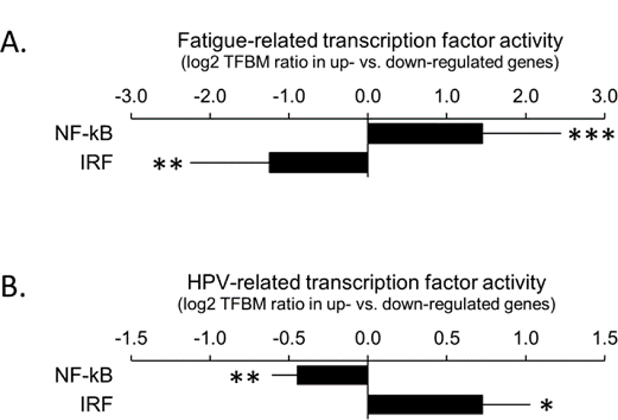
Previous studies have linked plasma inflammatory markers to elevated fatigue in patients with head and neck cancer (HNC). To identify the molecular mechanisms underlying this association, we conducted promoter-based bioinformatics analyses to determine the relationship between fatigue and specific gene expression profiles associated with inflammation in human papillomavirus (HPV)-related and -unrelated HNC patients undergoing treatment. Patients with newly diagnosed HNC without distant metastasis were assessed at baseline (pre-radiotherapy) and one-month post-radiotherapy. Fatigue was measured by the Multidimensional Fatigue Inventory. Genome-wide gene expression profiles were collected from peripheral blood mononuclear cells (PBMC). Promoter-based bioinformatics analyses were employed to identify transcription control pathways underlying transcriptomic correlates of fatigue in the sample as a whole and in HPV-related and HPV-unrelated HNC patients separately. In transcriptome profiling analyses of PBMC from 44 patients, TELiS bioinformatics analyses linked fatigue to increased nuclear factor-kappa B (NF-kB) transcriptional activity and decreased interferon regulatory factor family (IRF) transcription factor activity. Patients with HPV-related HNC showed lower levels of fatigue-related gene expression profile compared to HPV-unrelated HNC. Fatigue in HNC patients undergoing treatment is associated with gene expression profiles consistent with the conserved transcriptional response to adversity (CTRA) characterized by increased proinflammatory and decreased anti-antiviral transcriptional activity. Interestingly, this CTRA response was mitigated in patients with HPV-related HNC and may explain the lower level of fatigue they experience relative to HPV-unrelated HNC.
先前的研究已经将血浆炎症标志物与头颈部癌症(HNC)患者的疲劳升高联系起来。为了确定这种关联的分子机制,我们进行了基于启动子的生物信息学分析,以确定在接受治疗的 HPV 相关和不相关的 HNC 患者中,疲劳与与炎症相关的特定基因表达谱之间的关系。评估了无远处转移的新发 HNC 患者在基线(放疗前)和放疗后一个月的情况。疲劳通过多维疲劳量表进行测量。从外周血单核细胞(PBMC)中收集全基因组基因表达谱。采用基于启动子的生物信息学分析来确定转录控制途径,这些途径与整个样本以及 HPV 相关和 HPV 不相关的 HNC 患者的疲劳转录组相关性相关。在对 44 名患者的 PBMC 进行的转录组分析中,TELiS 生物信息学分析将疲劳与核因子-kappa B(NF-kB)转录活性增加和干扰素调节因子家族(IRF)转录因子活性降低联系起来。与 HPV 不相关的 HNC 相比,HPV 相关的 HNC 患者的疲劳相关基因表达谱水平较低。接受治疗的 HNC 患者的疲劳与基因表达谱相关,这些基因表达谱与保守的逆境转录反应(CTRA)一致,其特征是促炎转录活性增加和抗病毒转录活性降低。有趣的是,这种 CTRA 反应在 HPV 相关的 HNC 患者中得到缓解,这可能解释了他们与 HPV 不相关的 HNC 相比疲劳程度较低的原因。