• 文献检索
  • 文档翻译
  • 深度研究
  • 学术资讯
  • Suppr Zotero 插件Zotero 插件
  • 邀请有礼
  • 套餐&价格
  • 历史记录
应用&插件
Suppr Zotero 插件Zotero 插件浏览器插件Mac 客户端Windows 客户端微信小程序
定价
高级版会员购买积分包购买API积分包
服务
文献检索文档翻译深度研究API 文档MCP 服务
关于我们
关于 Suppr公司介绍联系我们用户协议隐私条款
关注我们

Suppr 超能文献

核心技术专利:CN118964589B侵权必究
粤ICP备2023148730 号-1Suppr @ 2026

文献检索

告别复杂PubMed语法,用中文像聊天一样搜索,搜遍4000万医学文献。AI智能推荐,让科研检索更轻松。

立即免费搜索

文件翻译

保留排版,准确专业,支持PDF/Word/PPT等文件格式,支持 12+语言互译。

免费翻译文档

深度研究

AI帮你快速写综述,25分钟生成高质量综述,智能提取关键信息,辅助科研写作。

立即免费体验

钙调神经磷酸酶抑制剂暴露减少对新生供者特异性抗体(DSA)形成的影响:一项针对2007年至2014年间未接受免疫治疗的首次肾移植受者的队列研究。

Impact of reduced exposure to calcineurin inhibitors on the development of de novo DSA: a cohort of non-immunized first kidney graft recipients between 2007 and 2014.

作者信息

Girerd S, Schikowski J, Girerd N, Duarte K, Busby H, Gambier N, Ladrière M, Kessler M, Frimat L, Aarnink A

机构信息

Service de Néphrologie et Transplantation rénale, CHRU Nancy Brabois, Vandoeuvre-les-, Nancy, France.

INSERM, Centre d'Investigations Cliniques Plurithématique 1433, Université de Lorraine, CHRU de Nancy and F-CRIN INI-CRCT, Nancy, France.

出版信息

BMC Nephrol. 2018 Sep 15;19(1):232. doi: 10.1186/s12882-018-1014-2.

DOI:10.1186/s12882-018-1014-2
PMID:30219043
原文链接:https://pmc.ncbi.nlm.nih.gov/articles/PMC6139146/
Abstract

BACKGROUND

In low-immunological risk kidney transplant recipients (KTRs), reduced exposure to calcineurin inhibitor (CNI) appears particularly attractive for avoiding adverse events, but may increase the risk of developing de novo Donor Specific Antibodies (dnDSA).

METHODS

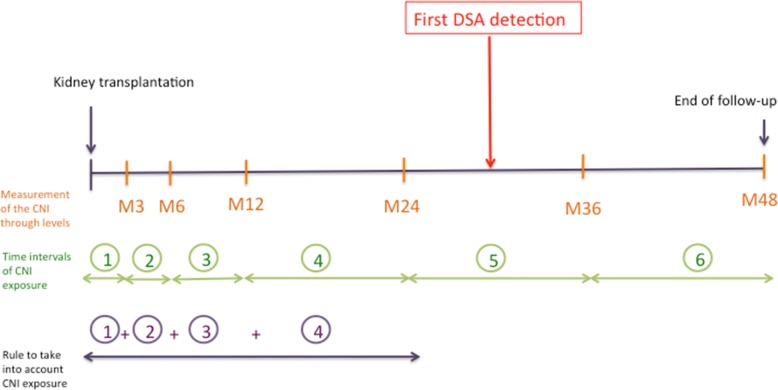
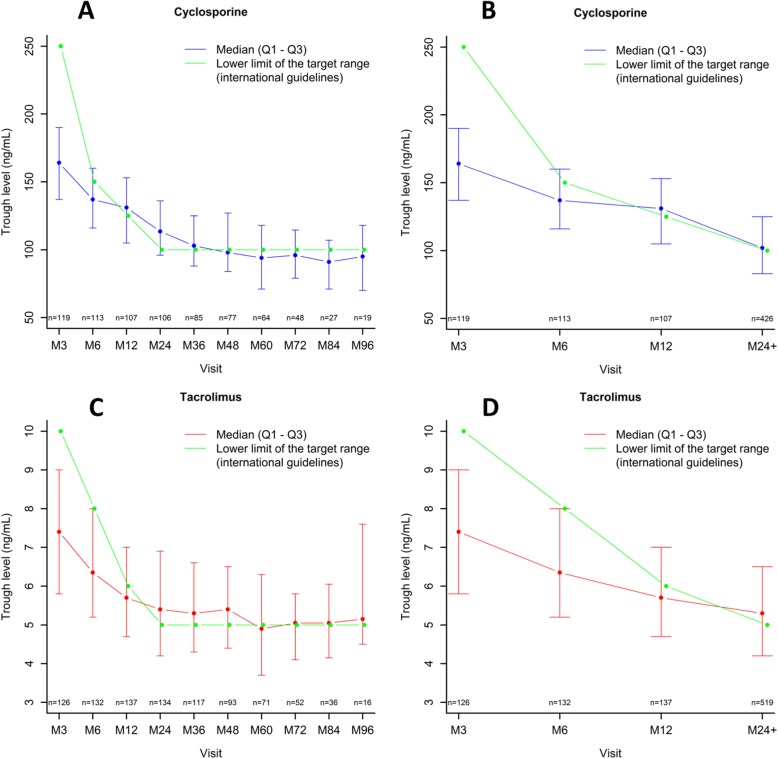
CNI exposure was retrospectively analyzed in 247 non-HLA immunized first KTRs by taking into account trough levels (C0) collected during follow-up. Reduced exposure to CNI was defined as follows: C0 less than the lower limit of the international targets for ≥50% of follow-up.

RESULTS

During a mean follow-up of 5.0 ± 2.0 years, 39 patients (15.8%) developed dnDSA (MFI ≥1000). Patients with DSA were significantly younger (46.6 ± 13.8 vs. 51.7 ± 14.0 years, p = 0.039), received more frequently poorly-matched grafts (59% with 6-8 A-B-DR-DQ HLA mismatches vs. 34.6%, p = 0.016) and had more frequently a reduced exposure to CNI (92.3% vs. 62.0%, p = 0.0002). Reduced exposure to CNI was associated with an increased risk of dnDSA (multivariable HR = 9.77, p = 0.002). Reduced exposure to CNI had no effect on patient survival, graft loss from any cause including death, or post-transplant cancer.

CONCLUSIONS

Even in a low-immunological risk population, reduced exposure to CNI is associated with increased risk of dnDSA. Benefits and risks of under-immunosuppression must be carefully evaluated before deciding on CNI minimization.

摘要

背景

在低免疫风险的肾移植受者(KTR)中,减少钙调神经磷酸酶抑制剂(CNI)的暴露对于避免不良事件似乎特别有吸引力,但可能会增加新发供者特异性抗体(dnDSA)的风险。

方法

对247例非HLA免疫的初次肾移植受者的CNI暴露情况进行回顾性分析,考虑随访期间收集的谷值水平(C0)。将减少CNI暴露定义如下:C0低于国际目标下限的时间≥随访时间的50%。

结果

在平均5.0±2.0年的随访期间,39例患者(15.8%)出现dnDSA(平均荧光强度≥1000)。发生DSA的患者明显更年轻(46.6±13.8岁 vs. 51.7±14.0岁,p = 0.039),更频繁地接受配型不佳的移植物(59%的患者有6 - 8个A - B - DR - DQ HLA错配,而34.6%的患者无错配,p = 0.016),并且更频繁地减少CNI暴露(92.3% vs. 62.0%,p = 0.0002)。减少CNI暴露与dnDSA风险增加相关(多变量风险比 = 9.77,p = 0.002)。减少CNI暴露对患者生存率、包括死亡在内的任何原因导致的移植物丢失或移植后癌症均无影响。

结论

即使在低免疫风险人群中,减少CNI暴露也与dnDSA风险增加相关。在决定最小化CNI之前,必须仔细评估免疫抑制不足的益处和风险。

https://cdn.ncbi.nlm.nih.gov/pmc/blobs/b4b7/6139146/b9ae9ff2f65f/12882_2018_1014_Fig4_HTML.jpg
https://cdn.ncbi.nlm.nih.gov/pmc/blobs/b4b7/6139146/b0a41c1fa53f/12882_2018_1014_Fig1_HTML.jpg
https://cdn.ncbi.nlm.nih.gov/pmc/blobs/b4b7/6139146/ca89e7e89578/12882_2018_1014_Fig2_HTML.jpg
https://cdn.ncbi.nlm.nih.gov/pmc/blobs/b4b7/6139146/7811751836c5/12882_2018_1014_Fig3_HTML.jpg
https://cdn.ncbi.nlm.nih.gov/pmc/blobs/b4b7/6139146/b9ae9ff2f65f/12882_2018_1014_Fig4_HTML.jpg
https://cdn.ncbi.nlm.nih.gov/pmc/blobs/b4b7/6139146/b0a41c1fa53f/12882_2018_1014_Fig1_HTML.jpg
https://cdn.ncbi.nlm.nih.gov/pmc/blobs/b4b7/6139146/ca89e7e89578/12882_2018_1014_Fig2_HTML.jpg
https://cdn.ncbi.nlm.nih.gov/pmc/blobs/b4b7/6139146/7811751836c5/12882_2018_1014_Fig3_HTML.jpg
https://cdn.ncbi.nlm.nih.gov/pmc/blobs/b4b7/6139146/b9ae9ff2f65f/12882_2018_1014_Fig4_HTML.jpg

相似文献

1
Impact of reduced exposure to calcineurin inhibitors on the development of de novo DSA: a cohort of non-immunized first kidney graft recipients between 2007 and 2014.钙调神经磷酸酶抑制剂暴露减少对新生供者特异性抗体(DSA)形成的影响:一项针对2007年至2014年间未接受免疫治疗的首次肾移植受者的队列研究。
BMC Nephrol. 2018 Sep 15;19(1):232. doi: 10.1186/s12882-018-1014-2.
2
Evolution of donor-specific antibodies (DSA) and incidence of de novo DSA in solid organ transplant recipients after switch to everolimus alone or associated with low dose of calcineurin inhibitors.在转换为单独使用依维莫司或与低剂量钙调神经磷酸酶抑制剂联合使用后,实体器官移植受者中供体特异性抗体(DSA)的演变及新发DSA的发生率。
Clin Transplant. 2014 Sep;28(9):1054-60. doi: 10.1111/ctr.12418. Epub 2014 Aug 18.
3
Early immunosuppression treatment correlates with later de novo donor-specific antibody development after kidney and pancreas transplantation.肾和胰腺移植后早期免疫抑制治疗与后期新生供者特异性抗体的产生相关。
Clin Transplant. 2015 Dec;29(12):1119-27. doi: 10.1111/ctr.12636. Epub 2015 Oct 16.
4
Impact of calcineurin inhibitor-free immunosuppression on de novo donor-specific antibody formation in liver transplant recipients.钙调磷酸酶抑制剂免抑治疗对肝移植受者体内新型供者特异性抗体形成的影响。
Liver Int. 2022 May;42(5):1132-1143. doi: 10.1111/liv.15201. Epub 2022 Mar 1.
5
Conversion From Calcineurin Inhibitors to Belatacept in HLA-sensitized Kidney Transplant Recipients With Low-level Donor-specific Antibodies.钙调磷酸酶抑制剂转换为贝利尤单抗在 HLA 致敏伴低水平供者特异性抗体的肾移植受者中的应用。
Transplantation. 2019 Oct;103(10):2150-2156. doi: 10.1097/TP.0000000000002592.
6
mTOR inhibitors and risk of chronic antibody-mediated rejection after kidney transplantation: where are we now?mTOR 抑制剂与肾移植后慢性抗体介导排斥反应的风险:我们现在在哪里?
Transpl Int. 2017 Jul;30(7):647-657. doi: 10.1111/tri.12975.
7
Conversion to mammalian target of rapamycin inhibitors increases risk of de novo donor-specific antibodies.转换为哺乳动物雷帕霉素靶蛋白抑制剂会增加新的供体特异性抗体的风险。
Transpl Int. 2014 Aug;27(8):775-83. doi: 10.1111/tri.12330. Epub 2014 May 22.
8
Role of de novo donor-specific anti-HLA antibodies in kidney graft failure: A case-control study.供者特异性抗 HLA 抗体在移植肾失功中的作用:一项病例对照研究。
HLA. 2017 Nov;90(5):267-275. doi: 10.1111/tan.13111. Epub 2017 Aug 24.
9
Safety and Efficacy Outcomes 3 Years After Switching to Belatacept From a Calcineurin Inhibitor in Kidney Transplant Recipients: Results From a Phase 2 Randomized Trial.在肾移植受者中从钙调磷酸酶抑制剂转换至贝利尤单抗后的 3 年安全性和疗效结局:一项 2 期随机试验的结果。
Am J Kidney Dis. 2017 May;69(5):587-594. doi: 10.1053/j.ajkd.2016.09.021. Epub 2016 Nov 23.
10
Clinical impact of complement (C1q, C3d) binding De Novo donor-specific HLA antibody in kidney transplant recipients.补体(C1q、C3d)结合的新型供体特异性 HLA 抗体对肾移植受者的临床影响。
PLoS One. 2018 Nov 14;13(11):e0207434. doi: 10.1371/journal.pone.0207434. eCollection 2018.

引用本文的文献

1
Measurement of the Immunosuppressant Possession Ratio by Transplant Clinical Pharmacists Captures a Non-Adherence Associated With Antibody-Mediated Rejection.移植临床药师通过测量免疫抑制剂持有率来捕捉与抗体介导的排斥反应相关的不依从性。
Transpl Int. 2023 Nov 28;36:11962. doi: 10.3389/ti.2023.11962. eCollection 2023.
2
Benefits of Switching Mycophenolic Acid to Sirolimus on Serological Response after a SARS-CoV-2 Booster Dose among Kidney Transplant Recipients: A Pilot Study.肾移植受者在接受新冠病毒加强剂量疫苗后,将霉酚酸转换为西罗莫司对血清学反应的益处:一项试点研究
Vaccines (Basel). 2022 Oct 9;10(10):1685. doi: 10.3390/vaccines10101685.
3

本文引用的文献

1
Everolimus with Reduced Calcineurin Inhibitor Exposure in Renal Transplantation.依维莫司减少肾移植中钙调磷酸酶抑制剂的暴露。
J Am Soc Nephrol. 2018 Jul;29(7):1979-1991. doi: 10.1681/ASN.2018010009. Epub 2018 May 11.
2
De novo donor-specific antibodies in belatacept-treated vs cyclosporine-treated kidney-transplant recipients: Post hoc analyses of the randomized phase III BENEFIT and BENEFIT-EXT studies.贝拉西普治疗与环孢素治疗的肾移植受者中的新型供体特异性抗体:随机 III 期 BENEFIT 和 BENEFIT-EXT 研究的事后分析。
Am J Transplant. 2018 Jul;18(7):1783-1789. doi: 10.1111/ajt.14721. Epub 2018 Apr 2.
3
Calcineurin inhibitor withdrawal or tapering for kidney transplant recipients.
Antibody-mediated rejection: prevention, monitoring and treatment dilemmas.
抗体介导的排斥反应:预防、监测和治疗的困境。
Curr Opin Organ Transplant. 2022 Oct 1;27(5):405-414. doi: 10.1097/MOT.0000000000001011. Epub 2022 Aug 11.
4
Chronic Kidney Allograft Disease: New Concepts and Opportunities.慢性肾移植疾病:新概念与机遇
Front Med (Lausanne). 2021 Jul 14;8:660334. doi: 10.3389/fmed.2021.660334. eCollection 2021.
5
Prospective Measures of Adherence by Questionnaire, Low Immunosuppression and Graft Outcome in Kidney Transplantation.通过问卷对肾移植中依从性、低免疫抑制及移植物结果进行前瞻性测量
J Clin Med. 2021 May 10;10(9):2032. doi: 10.3390/jcm10092032.
6
Donor/Recipient HLA Molecular Mismatch Scores Predict Primary Humoral and Cellular Alloimmunity in Kidney Transplantation.供体/受体人类白细胞抗原分子错配评分可预测肾移植中的原发性体液和细胞同种免疫。
Front Immunol. 2021 Mar 10;11:623276. doi: 10.3389/fimmu.2020.623276. eCollection 2020.
7
Impacts of High Intra- and Inter-Individual Variability in Tacrolimus Pharmacokinetics and Fast Tacrolimus Metabolism on Outcomes of Solid Organ Transplant Recipients.他克莫司药代动力学的高个体内和个体间变异性以及他克莫司快速代谢对实体器官移植受者结局的影响
J Clin Med. 2020 Jul 11;9(7):2193. doi: 10.3390/jcm9072193.
8
Optimizing Mycophenolic Acid Exposure in Kidney Transplant Recipients: Time for Target Concentration Intervention.优化肾移植受者麦考酚酸暴露:是时候进行目标浓度干预了。
Transplantation. 2019 Oct;103(10):2012-2030. doi: 10.1097/TP.0000000000002762.
9
Tacrolimus Variability: A Cause of Donor-Specific Anti-HLA Antibody Formation in Children.他克莫司的变异性:儿童供者特异性抗 HLA 抗体形成的一个原因。
Eur J Drug Metab Pharmacokinet. 2019 Aug;44(4):539-548. doi: 10.1007/s13318-019-00544-0. Epub 2019 Feb 8.
肾移植受者停用或减量钙调神经磷酸酶抑制剂
Cochrane Database Syst Rev. 2017 Jul 21;7(7):CD006750. doi: 10.1002/14651858.CD006750.pub2.
4
Practical Recommendations for Long-term Management of Modifiable Risks in Kidney and Liver Transplant Recipients: A Guidance Report and Clinical Checklist by the Consensus on Managing Modifiable Risk in Transplantation (COMMIT) Group.移植术后可改变风险的长期管理实用建议:移植术后可改变风险共识 (COMMIT) 专家组的指导报告和临床检查表。
Transplantation. 2017 Apr;101(4S Suppl 2):S1-S56. doi: 10.1097/TP.0000000000001651.
5
Higher calcineurin inhibitor levels predict better kidney graft survival in patients with de novo donor-specific anti-HLA antibodies: a cohort study.新型供体特异性 HLA 抗体阳性的肾移植受者中,钙调磷酸酶抑制剂水平越高,移植物存活率越高:一项队列研究。
Transpl Int. 2017 May;30(5):502-509. doi: 10.1111/tri.12934. Epub 2017 Mar 5.
6
Reduction of Extended-Release Tacrolimus Dose in Low-Immunological-Risk Kidney Transplant Recipients Increases Risk of Rejection and Appearance of Donor-Specific Antibodies: A Randomized Study.降低低免疫风险肾移植受者的缓释他克莫司剂量会增加排斥反应风险及供者特异性抗体的出现:一项随机研究。
Am J Transplant. 2017 May;17(5):1370-1379. doi: 10.1111/ajt.14109. Epub 2017 Jan 3.
7
Immunosuppression Minimization and Avoidance Protocols: When Less Is Not More.免疫抑制最小化与避免方案:少未必多。
Adv Chronic Kidney Dis. 2016 Sep;23(5):295-300. doi: 10.1053/j.ackd.2016.09.007.
8
Failure of Calcineurin Inhibitor (Tacrolimus) Weaning Randomized Trial in Long-Term Stable Kidney Transplant Recipients.钙调磷酸酶抑制剂(他克莫司)撤药在长期稳定肾移植受者中的随机试验失败。
Am J Transplant. 2016 Nov;16(11):3255-3261. doi: 10.1111/ajt.13946. Epub 2016 Jul 29.
9
Impact of Early Blood Transfusion After Kidney Transplantation on the Incidence of Donor-Specific Anti-HLA Antibodies.肾移植后早期输血对供者特异性抗HLA抗体发生率的影响
Am J Transplant. 2016 Sep;16(9):2661-9. doi: 10.1111/ajt.13795. Epub 2016 Apr 19.
10
Calcineurin Inhibitor Minimization, Conversion, Withdrawal, and Avoidance Strategies in Renal Transplantation: A Systematic Review and Meta-Analysis.肾移植中钙调神经磷酸酶抑制剂的最小化、转换、撤药及避免策略:一项系统评价与荟萃分析
Am J Transplant. 2016 Jul;16(7):2117-38. doi: 10.1111/ajt.13710. Epub 2016 Mar 15.