Kebenko Maxim, Goebeler Marie-Elisabeth, Wolf Martin, Hasenburg Annette, Seggewiss-Bernhardt Ruth, Ritter Barbara, Rautenberg Beate, Atanackovic Djordje, Kratzer Andrea, Rottman James B, Friedrich Matthias, Vieser Eva, Elm Stefanie, Patzak Ingrid, Wessiepe Dorothea, Stienen Sabine, Fiedler Walter
Department of Oncology/Hematology, Bone Marrow Transplantation and Section Pneumology, University Medical Center Hamburg-Eppendorf, Hamburg, Germany.
Comprehensive Cancer Center Mainfranken, University Hospital Würzburg, Würzburg, Germany.
Oncoimmunology. 2018 Apr 18;7(8):e1450710. doi: 10.1080/2162402X.2018.1450710. eCollection 2018.
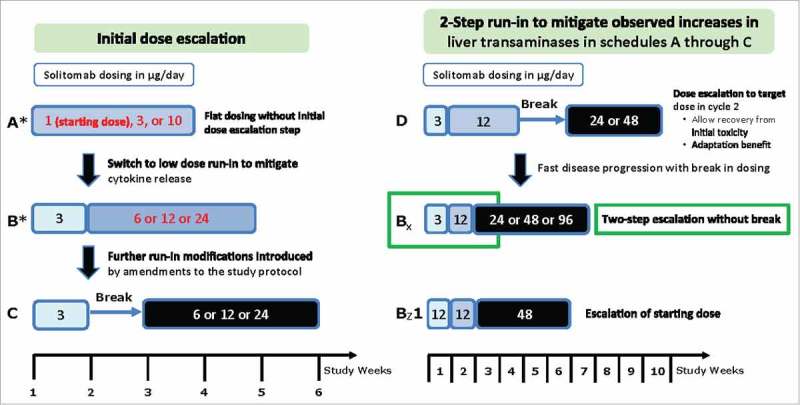
We assessed the tolerability and antitumor activity of solitomab, a bispecific T-cell engager (BiTE®) antibody construct targeting epithelial cell adhesion molecule (EpCAM). Patients with relapsed/refractory solid tumors not amenable to standard therapy received solitomab as continuous IV infusion in a phase 1 dose-escalation study with six different dosing schedules. The primary endpoint was frequency and severity of adverse events (AEs). Secondary endpoints included pharmacokinetics, pharmacodynamics, immunogenicity, and antitumor activity. Sixty-five patients received solitomab at doses between 1 and 96 µg/day for ≥28 days. Fifteen patients had dose-limiting toxicities (DLTs): eight had transient abnormal liver parameters shortly after infusion start or dose escalation (grade 3, n = 4; grade 4, n = 4), and one had supraventricular tachycardia (grade 3); all events resolved with solitomab discontinuation. Six patients had a DLT of diarrhea: four events resolved (grade 3, n = 3; grade 4, n = 1), one (grade 3) was ongoing at the time of treatment-unrelated death, and one (grade 3) progressed to grade 5 after solitomab discontinuation. The maximum tolerated dose was 24 µg/day. Overall, 95% of patients had grade ≥3 treatment-related AEs, primarily diarrhea, elevated liver parameters, and elevated lipase. Solitomab half-life was 4.5 hours; serum levels plateaued within 24 hours. One unconfirmed partial response was observed. In this study of a BiTE® antibody construct targeting solid tumors, treatment of relapsed/refractory EpCAM-positive solid tumors with solitomab was associated with DLTs, including severe diarrhea and increased liver enzymes, which precluded dose escalation to potentially therapeutic levels.
我们评估了solitomab的耐受性和抗肿瘤活性,solitomab是一种靶向上皮细胞粘附分子(EpCAM)的双特异性T细胞衔接器(BiTE®)抗体构建体。在一项1期剂量递增研究中,对无法接受标准治疗的复发/难治性实体瘤患者,采用六种不同给药方案持续静脉输注solitomab。主要终点是不良事件(AE)的频率和严重程度。次要终点包括药代动力学、药效学、免疫原性和抗肿瘤活性。65例患者接受了剂量为1至96μg/天的solitomab治疗,持续≥28天。15例患者出现剂量限制性毒性(DLT):8例在输注开始或剂量递增后不久出现短暂的肝脏参数异常(3级,n = 4;4级,n = 4),1例出现室上性心动过速(3级);所有事件在停用solitomab后均得到缓解。6例患者出现腹泻的DLT:4例事件得到缓解(3级,n = 3;4级,n = 1),1例(3级)在与治疗无关的死亡时仍在持续,1例(3级)在停用solitomab后进展为5级。最大耐受剂量为24μg/天。总体而言,95%的患者出现≥3级治疗相关AE,主要为腹泻、肝脏参数升高和脂肪酶升高。solitomab的半衰期为4.5小时;血清水平在24小时内达到平稳。观察到1例未经证实的部分缓解。在这项针对实体瘤的BiTE®抗体构建体的研究中,用solitomab治疗复发/难治性EpCAM阳性实体瘤与DLT相关,包括严重腹泻和肝酶升高,这使得无法将剂量递增至潜在的治疗水平。