
利用Moonlight通过整合转录组学和表观基因组学分析揭示癌症驱动基因。
Revealing cancer driver genes through integrative transcriptomic and epigenomic analyses with Moonlight.
作者信息
Nourbakhsh Mona, Zheng Yuanning, Noor Humaira, Chen Hongjin, Akhuli Subhayan, Tiberti Matteo, Gevaert Olivier, Papaleo Elena
机构信息
Cancer Systems Biology, Section for Bioinformatics, Department of Health Technology, Technical University of Denmark, Lyngby, Denmark.
Cancer Structural Biology, Danish Cancer Institute, Copenhagen, Denmark.
出版信息
PLoS Comput Biol. 2025 Apr 21;21(4):e1012999. doi: 10.1371/journal.pcbi.1012999. eCollection 2025 Apr.
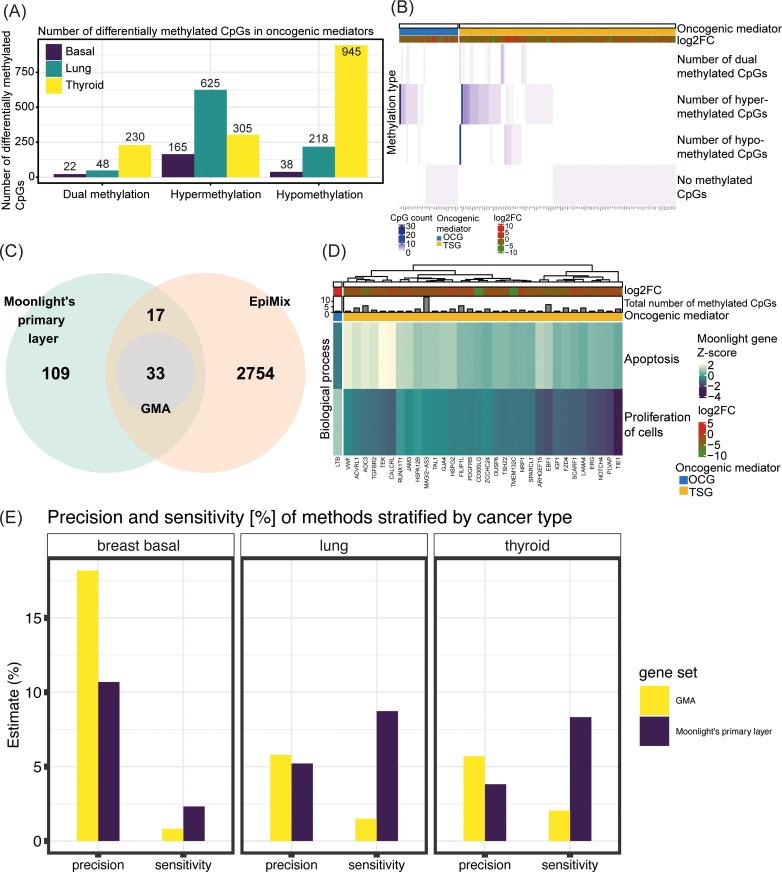
Cancer involves dynamic changes caused by (epi)genetic alterations such as mutations or abnormal DNA methylation patterns which occur in cancer driver genes. These driver genes are divided into oncogenes and tumor suppressors depending on their function and mechanism of action. Discovering driver genes in different cancer (sub)types is important not only for increasing current understanding of carcinogenesis but also from prognostic and therapeutic perspectives. We have previously developed a framework called Moonlight which uses a systems biology multi-omics approach for prediction of driver genes. Here, we present an important development in Moonlight2 by incorporating a DNA methylation layer which provides epigenetic evidence for deregulated expression profiles of driver genes. To this end, we present a novel functionality called Gene Methylation Analysis (GMA) which investigates abnormal DNA methylation patterns to predict driver genes. This is achieved by integrating the tool EpiMix which is designed to detect such aberrant DNA methylation patterns in a cohort of patients and further couples these patterns with gene expression changes. To showcase GMA, we applied it to three cancer (sub)types (basal-like breast cancer, lung adenocarcinoma, and thyroid carcinoma) where we discovered 33, 190, and 263 epigenetically driven genes, respectively. A subset of these driver genes had prognostic effects with expression levels significantly affecting survival of the patients. Moreover, a subset of the driver genes demonstrated therapeutic potential as drug targets. This study provides a framework for exploring the driving forces behind cancer and provides novel insights into the landscape of three cancer sub(types) by integrating gene expression and methylation data.
癌症涉及由(表观)遗传改变引起的动态变化,例如癌症驱动基因中发生的突变或异常DNA甲基化模式。这些驱动基因根据其功能和作用机制分为癌基因和肿瘤抑制基因。发现不同癌症(亚)类型中的驱动基因不仅对于增进当前对癌症发生机制的理解很重要,而且从预后和治疗的角度来看也很重要。我们之前开发了一个名为Moonlight的框架,它使用系统生物学多组学方法来预测驱动基因。在此,我们通过纳入一个DNA甲基化层展示了Moonlight2的一项重要进展,该层为驱动基因的失调表达谱提供了表观遗传学证据。为此,我们提出了一种名为基因甲基化分析(GMA)的新功能,它通过研究异常DNA甲基化模式来预测驱动基因。这是通过整合工具EpiMix来实现的,该工具旨在检测一组患者中的此类异常DNA甲基化模式,并进一步将这些模式与基因表达变化联系起来。为了展示GMA,我们将其应用于三种癌症(亚)类型(基底样乳腺癌、肺腺癌和甲状腺癌),在这些癌症类型中我们分别发现了33个、190个和263个表观遗传驱动基因。这些驱动基因的一个子集具有预后作用,其表达水平显著影响患者的生存。此外,一部分驱动基因作为药物靶点显示出治疗潜力。这项研究提供了一个探索癌症背后驱动因素的框架,并通过整合基因表达和甲基化数据为三种癌症亚(类)型的格局提供了新的见解。




 Zotero 插件