Department of Obstetrics, Universidade do Estado do Rio de Janeiro, Rio de Janeiro, Brazil.
Department of Clinical and Biological Sciences, Centre of Research of Immunopathology and Rare Diseases, University of Turin, Turin, Italy.
BJOG. 2019 Apr;126(5):656-661. doi: 10.1111/1471-0528.15469. Epub 2018 Oct 24.
To evaluate the subsequent rate of thrombosis among women with obstetric antiphospholipid syndrome (Ob-APS) in a multicentre database of antiphospholipid antibody (aPL)-positive patients, and the clinical utility of the adjusted Global Antiphospholipid Syndrome Score (aGAPSS), a validated tool to assess the likelihood of developing new thrombosis, in this group of patients.
Retrospective study.
The Antiphospholipid Syndrome Alliance for Clinical Trials and International Networking Clinical Database and Repository.
Women with Ob-APS.
Comparison of clinical and laboratory characteristics and measurement of aGAPSS in women with Ob-APS, with or without thrombosis, after initial pregnancy morbidity (PM).
Risk factors for thrombosis and aGAPSS.
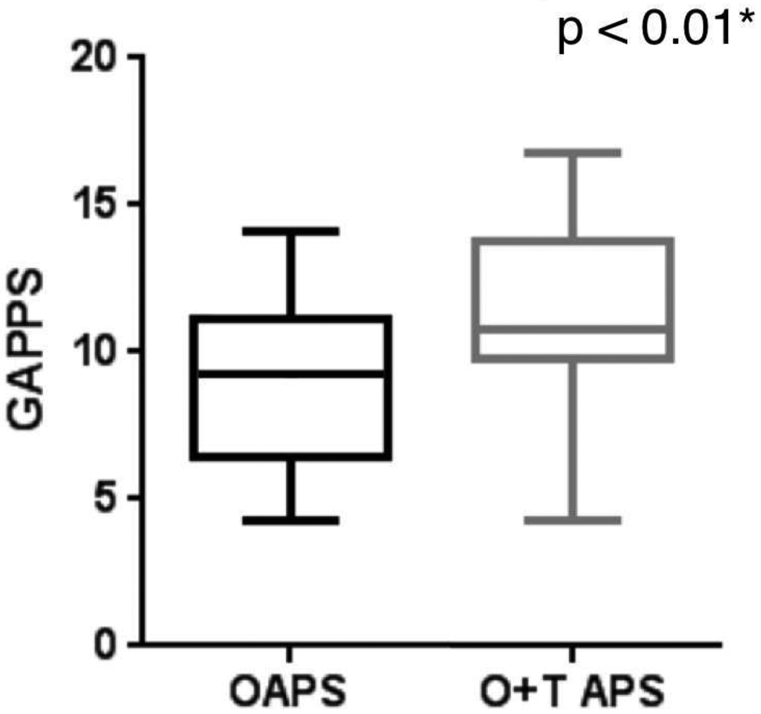
Of 550 patients, 126 had Ob-APS; 74/126 (59%) presented with thrombosis, and 47 (63%) of these women developed thrombosis after initial PM, in a mean time of 7.6 ± 8.2 years (4.9/100 patient years). Younger age at diagnosis of Ob-APS, additional cardiovascular risk factors, superficial vein thrombosis, heart valve disease, and multiple aPL positivity increased the risk of first thrombosis after PM. Women with thrombosis after PM had a higher aGAPSS compared with women with Ob-APS alone [median 11.5 (4-16) versus 9 (4-13); P = 0.0089].
Based on a retrospective analysis of our multicentre aPL database, 63% of women with Ob-APS developed thrombosis after initial obstetric morbidity; additional thrombosis risk factors, selected clinical manifestations, and high-risk aPL profile increased the risk. Women with subsequent thrombosis after Ob-APS had a higher aGAPSS at entry to the registry. We believe that aGAPSS is a valid tool to improve risk stratification in aPL-positive women.
More than 60% of women with obstetric antiphospholipid syndrome had thrombosis after initial pregnancy morbidity.
在抗磷脂抗体(aPL)阳性患者的多中心抗磷脂综合征数据库中评估产科抗磷脂综合征(Ob-APS)女性的血栓形成后续发生率,并评估经过验证的评估新血栓形成可能性的调整后全球抗磷脂综合征评分(aGAPSS)在该组患者中的临床实用性。
回顾性研究。
抗磷脂综合征联盟临床试验和国际网络临床数据库和存储库。
Ob-APS 女性。
比较初始妊娠发病(PM)后 Ob-APS 女性伴或不伴血栓形成的临床和实验室特征,并测量 aGAPSS。
血栓形成的危险因素和 aGAPSS。
在 550 名患者中,有 126 名患有 Ob-APS;74/126(59%)发生血栓形成,其中 47 名(63%)在 PM 后平均 7.6±8.2 年(4.9/100 患者年)时发生血栓形成。Ob-APS 诊断时年龄较小、存在其他心血管危险因素、浅表静脉血栓形成、心脏瓣膜疾病和多种 aPL 阳性会增加 PM 后首次血栓形成的风险。与单纯 Ob-APS 女性相比,PM 后发生血栓形成的女性的 aGAPSS 更高[中位数 11.5(4-16)与 9(4-13);P=0.0089]。
基于我们的多中心 aPL 数据库的回顾性分析,63%的 Ob-APS 女性在首次产科发病后发生血栓形成;其他血栓形成危险因素、选定的临床表现和高危 aPL 特征增加了风险。Ob-APS 后发生血栓形成的女性在登记时的 aGAPSS 更高。我们认为 aGAPSS 是一种有效的工具,可以提高 aPL 阳性女性的风险分层。
超过 60%的产科抗磷脂综合征女性在首次妊娠发病后发生血栓形成。