Lewis Leah A, Calambokidis John, Stimpert Alison K, Fahlbusch James, Friedlaender Ari S, McKenna Megan F, Mesnick Sarah L, Oleson Erin M, Southall Brandon L, Szesciorka Angela R, Širović Ana
Scripps Institution of Oceanography, University of California San Diego, 9500 Gilman Drive, La Jolla, CA 92093, USA.
Cascadia Research Collective, 218 ½ W 4th Ave., Olympia, WA 98501, USA.
R Soc Open Sci. 2018 Aug 8;5(8):180241. doi: 10.1098/rsos.180241. eCollection 2018 Aug.
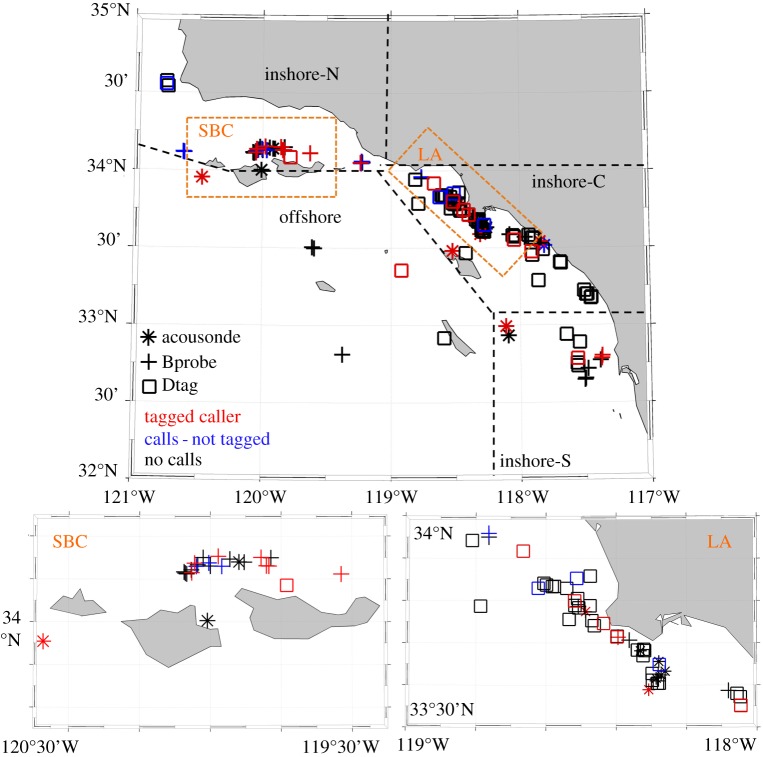
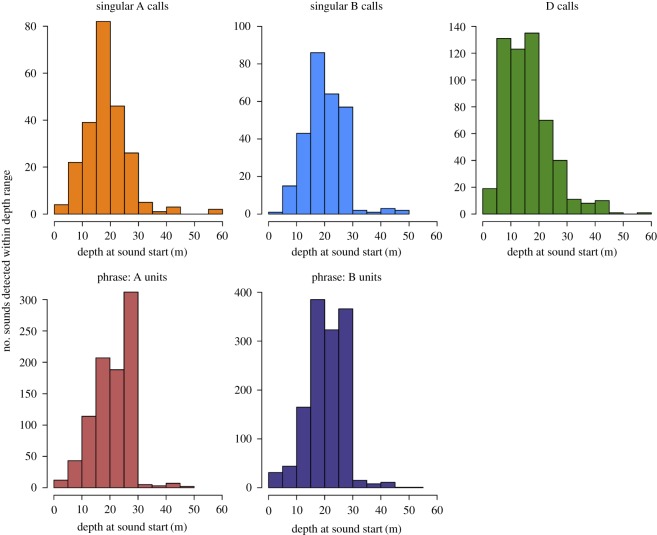
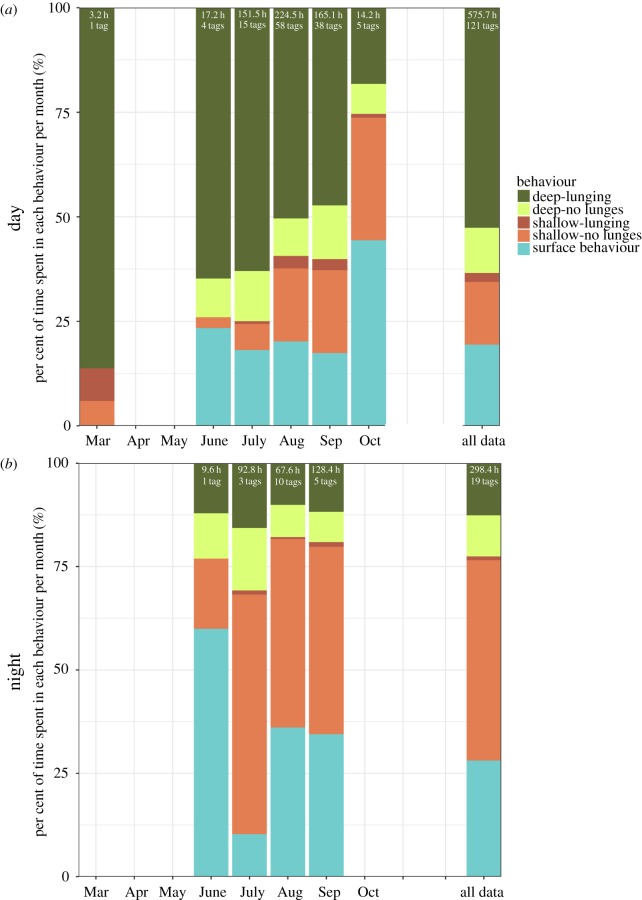
Acoustic communication is an important aspect of reproductive, foraging and social behaviours for many marine species. Northeast Pacific blue whales () produce three different call types-A, B and D calls. All may be produced as singular calls, but A and B calls also occur in phrases to form songs. To evaluate the behavioural context of singular call and phrase production in blue whales, the acoustic and dive profile data from tags deployed on individuals off southern California were assessed using generalized estimating equations. Only 22% of all deployments contained sounds attributed to the tagged animal. A larger proportion of tagged animals were female (47%) than male (13%), with 40% of unknown sex. Fifty per cent of tags deployed on males contained sounds attributed to the tagged whale, while only a few (5%) deployed on females did. Most calls were produced at shallow depths (less than 30 m). Repetitive phrasing (singing) and production of singular calls were most common during shallow, non-lunging dives, with the latter also common during surface behaviour. Higher sound production rates occurred during autumn than summer and they varied with time-of-day: singular call rates were higher at dawn and dusk, while phrase production rates were highest at dusk and night.
声学通讯是许多海洋物种繁殖、觅食和社交行为的一个重要方面。东北太平洋蓝鲸会发出三种不同类型的叫声——A、B和D型叫声。所有叫声都可能以单个叫声的形式发出,但A和B型叫声也会以短语形式出现从而形成歌声。为了评估蓝鲸发出单个叫声和短语的行为背景,利用广义估计方程对部署在南加州附近个体身上的标签所记录的声学和潜水剖面数据进行了评估。在所有的标签部署中,只有22%包含了归属于被标记动物的声音。被标记的动物中雌性比例(47%)高于雄性(13%),40%的性别未知。部署在雄性身上的标签中有50%包含了归属于被标记鲸鱼的声音,而部署在雌性身上的只有少数(5%)包含此类声音。大多数叫声是在浅深度(小于30米)发出的。重复短语(唱歌)和发出单个叫声在浅度、非猛冲潜水时最为常见,发出单个叫声在水面行为时也很常见。秋季的发声率高于夏季,并且随一天中的时间而变化:单个叫声的发声率在黎明和黄昏时较高,而短语发声率在黄昏和夜晚时最高。