Verdecchia Daniel Héctor, Monzón Agustina Maria, Urbina Jaimes Valentina, Oliveira Fernando Rocha, Paiva Laércio da Silva, de Carvalho Tatiana Dias
Departamento de Ciencias de la Salud, Kinesiología y Fisiatría, Universidad Nacional de La Matanza, San Justo, Buenos Aires, Argentina.
Área de Rehabilitación Vestibular, Universidad Maimónides, Ciudad Autónoma de Buenos Aires, Buenos Aires, Argentina.
J Aging Res. 2018 Aug 26;2018:5093501. doi: 10.1155/2018/5093501. eCollection 2018.
To describe the results of a vestibular rehabilitation (VR) program in the timed up and go (TUG), gait speed (GS), and dizziness handicap inventory (DHI) scores for elderly vestibular patients in a developing country.
Descriptive study with retrospective data collected from the clinical records of vestibular patients. The following information was recorded: sex, age, type of vestibular disorder, DHI score, and performance in TUG and GS, before and after participation in a VR program taking place from January 1 to August 30, 2017. The VR program consisted of 10 twice weekly sessions in the clinic and daily exercises at the patient's home. We used Student's -test for paired and Wilcoxon's test according to the data distribution. The level of significance was 5%.
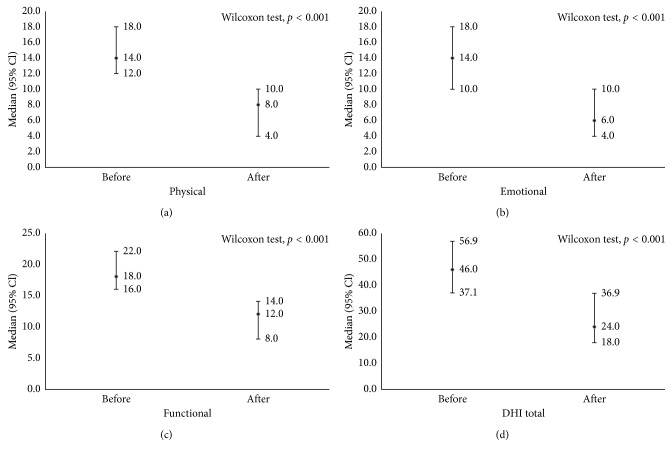
Data from 57 patients (49 females; 78 ± 5.8 years old) were used. There were statistically significant differences in TUG (12.52 versus 11.56), GS (0.81 versus 0.90 m/s), DHI total handicap (46 versus 24), physical (14 versus 8), emotional (14 versus 6), and functional (18 versus 12) domains.
The functional outcome measures reported, including TUG, gait speed, and DHI, reflect statistically significant improvements in elderly patients after vestibular rehabilitation; the DHI improvements are clinically relevant.
描述在一个发展中国家,针对老年前庭疾病患者的一项前庭康复(VR)计划在计时起立行走测试(TUG)、步速(GS)和头晕残障量表(DHI)评分方面的结果。
采用描述性研究,从前庭疾病患者的临床记录中收集回顾性数据。记录以下信息:性别、年龄、前庭疾病类型、DHI评分以及在2017年1月1日至8月30日参加VR计划前后的TUG和GS表现。VR计划包括在诊所每周两次共10次的课程以及患者在家中的日常锻炼。根据数据分布,我们使用配对t检验和威尔科克森检验。显著性水平为5%。
使用了57名患者(49名女性;78±5.8岁)的数据。在TUG(12.52对11.56)、GS(0.81对0.90米/秒)、DHI总残障(46对24)、身体(14对8)、情感(14对6)和功能(18对12)领域存在统计学上的显著差异。
报告的功能结局指标,包括TUG、步速和DHI,反映出老年患者在前庭康复后有统计学上的显著改善;DHI的改善具有临床相关性。