Pamukkale University, Faculty of Medicine, Department of Physical Medicine and Rehabilitation, Denizli, Turkey.
Pamukkale University, Faculty of Medicine, Department of Otorhinolaryngology, Head and Neck Surgery, Denizli, Turkey.
Braz J Otorhinolaryngol. 2022 Nov-Dec;88 Suppl 3(Suppl 3):S41-S49. doi: 10.1016/j.bjorl.2021.08.010. Epub 2021 Oct 26.
To investigate the effect of vestibular rehabilitation exercises supported with virtual reality containing real-life environments on dizziness, static and dynamic balance, functional mobility, fear of falling, anxiety, and depression in elderly patients with dizziness.
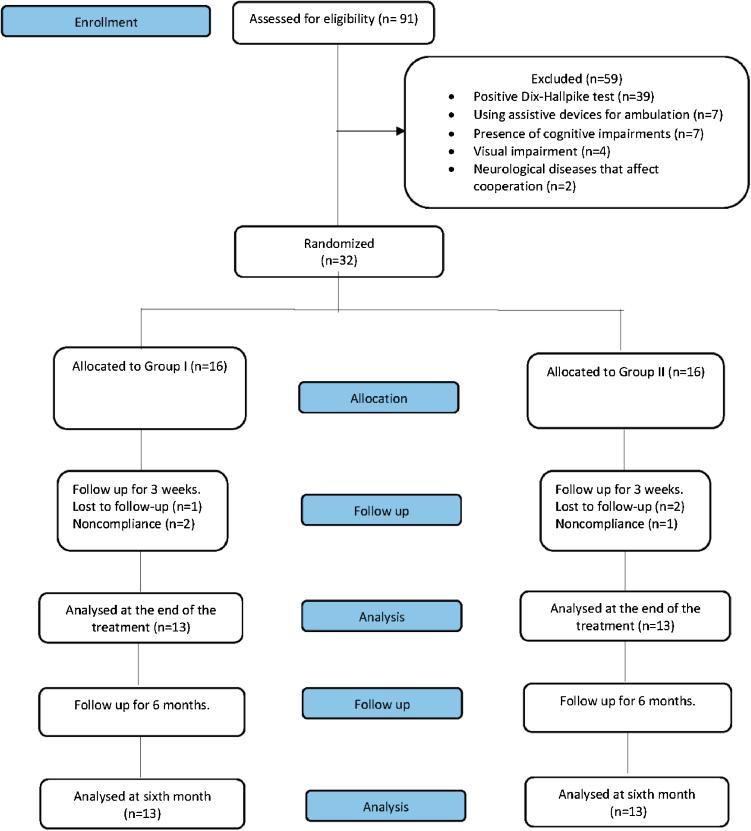
In this prospective randomized controlled study, 32-patients aged 65-years and older who applied to the otorhinolaryngology clinic with dizziness complaint randomly assigned to 2 groups. In Group 1 (n=16), vestibular rehabilitation program, supported with virtual reality, and in Group 2 (n=16), conventional vestibular rehabilitation program was applied 30-min a day, 5 sessions per week, 15 sessions in total for 3 weeks. Subjects were evaluated with The Vertigo Symptom Scale (VSS), Dizziness Handicap Inventory (DHI), Berg Balance Test (BBT) and Timed Up & Go Test (TUG), Falls Efficacy Scale-International (FES-I), Postural Stability Test (PST), Geriatric Depression Scale (GDS), Hamilton Anxiety Scale (HAS) at baseline, at the end of the treatment and 6-months after the treatment.
Statistically significant improvements were seen in the DHI emotional subscale and TUG in Group 1 compared to Group 2 at the end of the treatment in elderly with dizziness (p<0.05). Also, there were significant improvements in the VSS, all DHI subgroups, and total scores, BBT, HAS in Group 1 compared to Group 2 at the 6-months after the treatment (p<0.05).
The application of vestibular rehabilitation in a virtual reality environment can lead to additional improvements especially in dizziness symptoms, disability, balance, and mobility in the elderly with chronic dizziness.
研究虚拟现实支持的前庭康复运动对老年头晕患者头晕、静态和动态平衡、功能性移动能力、跌倒恐惧、焦虑和抑郁的影响。
在这项前瞻性随机对照研究中,32 名年龄在 65 岁及以上、因头晕症状向耳鼻喉科诊所就诊的患者被随机分为两组。在第 1 组(n=16)中,使用虚拟现实支持的前庭康复计划,在第 2 组(n=16)中,使用常规前庭康复计划,每天 30 分钟,每周 5 次,共 15 次,持续 3 周。在基线、治疗结束时和治疗结束后 6 个月,使用眩晕症状量表(VSS)、眩晕障碍量表(DHI)、伯格平衡测试(BBT)和计时起立行走测试(TUG)、跌倒效能量表国际版(FES-I)、姿势稳定性测试(PST)、老年抑郁量表(GDS)、汉密尔顿焦虑量表(HAS)对受试者进行评估。
与第 2 组相比,第 1 组在治疗结束时 DHI 情绪亚量表和 TUG 明显改善(p<0.05)。此外,在治疗结束后 6 个月,第 1 组在 VSS、所有 DHI 亚组和总分、BBT、HAS 方面的改善均优于第 2 组(p<0.05)。
虚拟现实环境中的前庭康复应用可以为慢性头晕的老年患者带来额外的改善,特别是在头晕症状、残疾、平衡和移动能力方面。