Sharma Ayush, Mukewar Saurabh, Mara Kristin C, Dierkhising Ross A, Kamath Patrick S, Cummins Nathan
Division of Gastroenterology and Hepatology, Mayo Clinic, Rochester, MN.
Division of Biomedical Statistics and Informatics, Mayo Clinic, Rochester, MN.
Mayo Clin Proc Innov Qual Outcomes. 2018 Feb 22;2(1):16-25. doi: 10.1016/j.mayocpiqo.2018.01.002. eCollection 2018 Mar.
To report the changing incidence, clinical presentation, microbiologic spectrum, and outcomes of pyogenic liver abscess (PLA) in Olmsted County, Minnesota, over the past 35 years.
The Rochester Epidemiology Project was used to identify residents with PLA from January 1, 1980, through December 31, 2014. The study included all patients older than 18 years, with the diagnosis of PLA confirmed through radiographic review and microbiologic cultures.
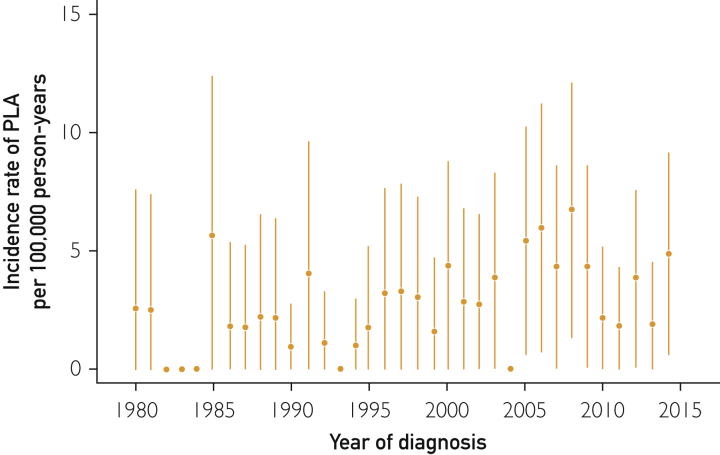
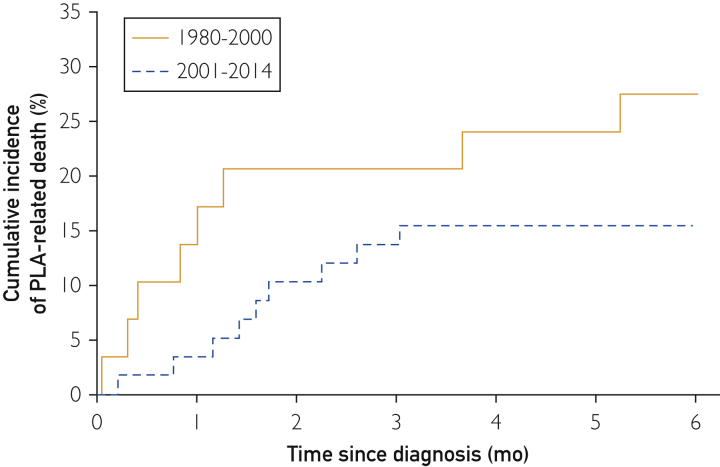
In total, 72 patients received a diagnosis of PLA from 1980 through 2014. The age-adjusted incidence for men was 3.92 cases per 100,000 person-years (95% CI, 2.76-5.09 cases per 100,000 person-years) compared with 1.87 cases per 100,000 person-years (95% CI, 1.15-2.59 cases per 100,000 person-years) for women. Incidence was higher in the period from January 1, 2001, through December 31, 2014, than in the period from January 1, 1980, through December 31, 2000, for women (incidence rate ratio [IRR], 3.8; 95% CI, 1.43-10.09; =.007) but not for men (IRR, 0.99; 95% CI, 0.55-1.76; =.96). Fifteen additional patients had postintervention PLA (1980-2000: n=3 of 29 [10.3%] vs 2001-2015: n=12 of 58 [20.6%]). A significant association was seen between age- and sex-adjusted incidence rates of PLA and year of diagnosis (per year since 1980: IRR, 1.04; 95% CI, 1.02-1.07; <.001) after including postintervention PLA. was the most common organism identified (52.5%). Organisms with multidrug resistance were more common in the period from 2001 through 2014 than in the period from 1980 through 2000 (51% vs 14%; =.005). The overall mortality rate of PLA was 16.8% (95% CI, 7.6%-25.0%) at 6 months.
The incidence of PLA is increasing, probably because of increase in frequency of hepatobiliary interventions and organisms with multidrug resistance.
报告明尼苏达州奥尔姆斯特德县过去35年中化脓性肝脓肿(PLA)的发病率变化、临床表现、微生物谱及转归。
利用罗切斯特流行病学项目,确定1980年1月1日至2014年12月31日期间患有PLA的居民。该研究纳入所有年龄大于18岁、经影像学检查和微生物培养确诊为PLA的患者。
1980年至2014年期间,共有72例患者被诊断为PLA。男性年龄调整后的发病率为每10万人年3.92例(95%CI,每10万人年2.76 - 5.09例),而女性为每10万人年1.87例(95%CI,每10万人年1.15 - 2.59例)。2001年1月1日至2014年12月31日期间女性的发病率高于1980年1月1日至2000年12月31日期间(发病率比值比[IRR],3.8;95%CI,1.43 - 10.09;P = 0.007),但男性并非如此(IRR,0.99;95%CI,0.55 - 1.76;P = 0.96)。另有15例患者发生干预后PLA(1980 - 2000年:29例中有3例[10.3%] vs 2001 - 2015年:58例中有12例[20.6%])。纳入干预后PLA后,PLA的年龄和性别调整发病率与诊断年份之间存在显著关联(自1980年起每年:IRR,1.04;95%CI,1.02 - 1.07;P < 0.001)。大肠埃希菌是最常鉴定出的病原体(52.5%)。2001年至2014年期间具有多重耐药性的病原体比1980年至2000年期间更常见(51%对14%;P = 0.005)。PLA的总体6个月死亡率为16.8%(95%CI,7.6% - 25.0%)。
PLA的发病率正在上升,可能是由于肝胆干预频率增加以及具有多重耐药性的病原体增多所致。