Ben Bouallègue Fayçal, Mariano-Goulart Denis, Agostini Denis, Manrique Alain
Nuclear Medicine Department, Montpellier University Hospital, Montpellier, France.
PhyMedExp, INSERM - CNRS, Montpellier University, Montpellier, France.
EJNMMI Res. 2018 Sep 17;8(1):92. doi: 10.1186/s13550-018-0445-x.
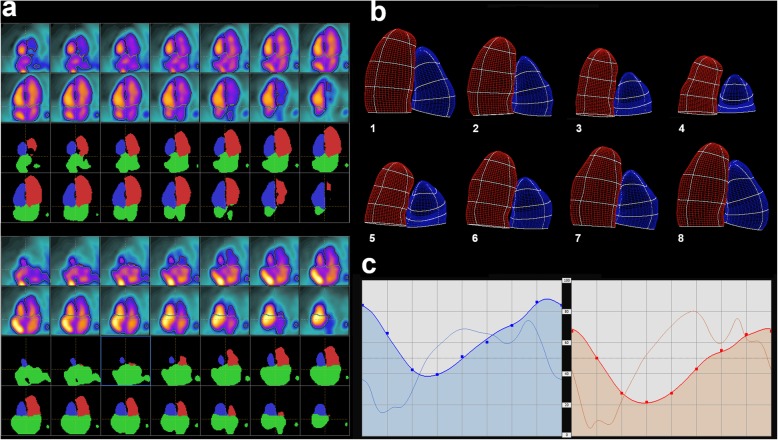
We investigated the feasibility of left ventricular (LV) and right ventricular (RV) volume and function estimation using a first-pass gated O-water PET. This prospective study included 19 patients addressed for myocardial perfusion reserve assessment using O-water PET. PET data were acquired at rest and after regadenoson stress, and gated first-pass images were reconstructed over the time range corresponding to tracer first-pass through the cardiac cavities and post-processed using TomPool software; LV and RV were segmented using a semi-automated 4D immersion algorithm. LV volumes were computed using a count-based model and a fixed threshold at 30% of the maximal activity. RV volumes were computed using a geometrical model and an adjustable threshold that was set so as to fit LV and RV stroke volumes. Ejection curves were fitted using a deformable reference curve model. LV results were compared to those obtained using Tc-sestamibi gated myocardial SPECT in terms of end-diastolic volume (EDV), end-systolic volume (ESV), stroke volume (SV), and ejection fraction (EF).
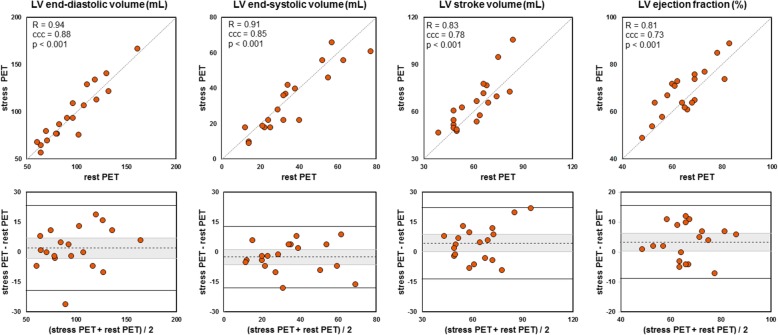
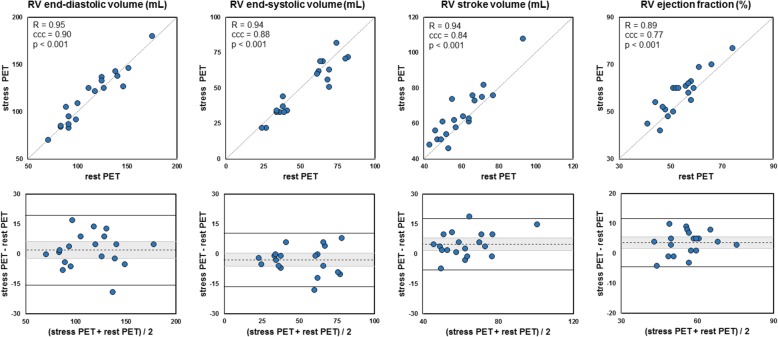
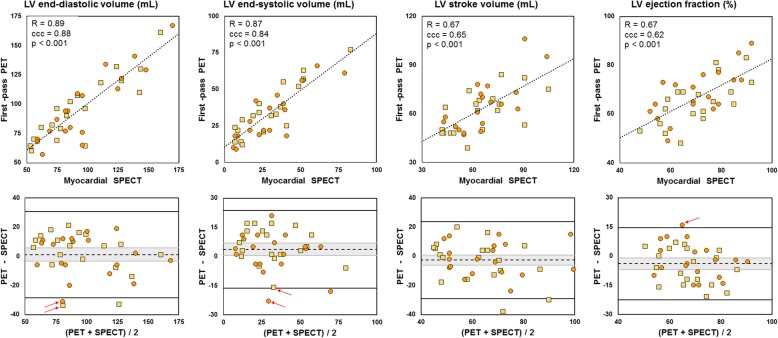
There was an excellent concordance between rest and stress PET in terms of EDV and ESV (Lin's coefficient ~ 0.85-0.90), SV (~ 0.80), and EF (~ 0.75) for both ventricles. Correlation with myocardial SPECT was high for LV EDV (Pearson's R = 0.89, p < 0.001) and ESV (R = 0.87, p < 0.001) and satisfying for LV SV (R = 0.67, p < 0.001) and EF (R = 0.67, p < 0.001). Minimal LV ESV overestimation (+ 4 mL, p = 0.03) and EF underestimation (- 4%, p = 0.01) were observed using PET.
Biventricular volume and function assessment are achievable using the first-pass PET, and LV parameters correlate well with those derived from gated myocardial SPECT.
我们研究了使用首次通过门控氧-水正电子发射断层扫描(PET)评估左心室(LV)和右心室(RV)容积及功能的可行性。这项前瞻性研究纳入了19例因使用氧-水PET评估心肌灌注储备而接受检查的患者。PET数据在静息状态和瑞加诺生负荷后采集,门控首次通过图像在示踪剂首次通过心脏腔室的时间范围内重建,并使用TomPool软件进行后处理;使用半自动4D浸没算法对左心室和右心室进行分割。左心室容积使用基于计数的模型和最大活性30%的固定阈值进行计算。右心室容积使用几何模型和可调节阈值进行计算,该阈值设置为使左心室和右心室的每搏输出量相匹配。射血曲线使用可变形参考曲线模型进行拟合。将左心室的结果与使用锝- sestamibi门控心肌单光子发射计算机断层扫描(SPECT)获得的结果在舒张末期容积(EDV)、收缩末期容积(ESV)、每搏输出量(SV)和射血分数(EF)方面进行比较。
在舒张末期容积和收缩末期容积方面,静息和负荷PET之间对于两个心室的一致性都非常好(林氏系数约为0.85 - 0.90),每搏输出量(约为0.80),射血分数(约为0.75)。左心室舒张末期容积(皮尔逊相关系数R = 0.89,p < 0.001)和收缩末期容积(R = 0.87,p < 0.001)与心肌SPECT的相关性较高,左心室每搏输出量(R = 0.67,p < 0.001)和射血分数(R = 0.67,p < 0.001)的相关性也令人满意。使用PET观察到左心室收缩末期容积有最小程度的高估(+4 mL,p = 0.03)和射血分数低估(-4%,p = 0.01)。
使用首次通过PET可以实现双心室容积和功能评估,并且左心室参数与门控心肌SPECT得出的参数相关性良好。