Medical Research Center Oulu, Research Unit of Internal Medicine and Clinical Chemistry, Oulu University Hospital and University of Oulu, Oulu, Finland.
PLoS One. 2018 Sep 18;13(9):e0203363. doi: 10.1371/journal.pone.0203363. eCollection 2018.
Biomarkers have shown promising results in risk assessment of cardiovascular events. Their role in predicting the risk of sudden cardiac death (SCD) is not well established. We tested the performance of several biomarkers in risk assessment for SCD in patients with coronary artery disease (CAD) and preserved left ventricular function.
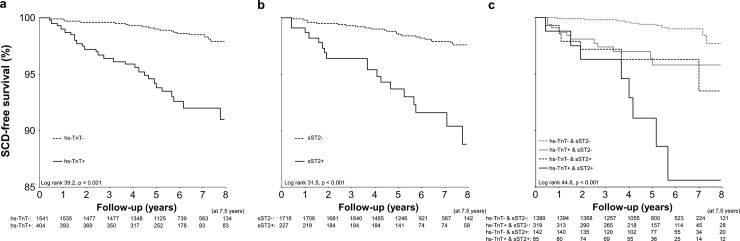
The study population consisted of 1,946 CAD patients (68% male; mean age 66.9±8.6 yrs; type 2 diabetes (T2D) 43%) enrolled in the ARTEMIS study. The study subjects underwent examinations with echocardiography and measurement of several biomarkers. The primary endpoint of the study was SCD. During the mean follow up of 76±20 months 50 patients experienced SCD. Elevated high sensitive CRP (hs-CRP, p = 0.001), soluble ST2 (sST2, p<0.001), B-type natriuretic peptide (BNP, p<0.001), and highly sensitive TroponinT (hs-TnT, p<0.001) predicted the occurrence of SCD in univariate analysis. Using the optimal cutoff points, elevated sST2 (≥27.45ng/mL; hazard ratio [HR] 2.7; 95%CI 1.4-5.1, p = 0.003) and hs-TnT (≥15 ng/mL; HR 2.9; 95% CI 1.5-5.6, p = 0.002) were the strongest predictors of SCD followed by hs-CRP (HR 2.4; 95% CI 1.3-4.4, p = 0.004) and BNP (HR 1.9; 95% CI 1.0-3.7, p = 0.046) in adjusted analysis. Combination of elevated hs-TnT and sST2 resulted in adjusted HR of 6.4 (95% CI 2.6-15.5, p<0.001).
Elevated sST2 and hs-TnT predict the occurrence of SCD among patients with CAD and preserved left ventricular function. The association between sST2, hs-TnT and SCD may be explained by an ongoing myocardial apoptosis followed by fibrosis leading to vulnerability to malignant arrhythmias.
生物标志物在心血管事件风险评估中显示出良好的效果。但其在预测心源性猝死(SCD)风险方面的作用尚未得到充分确立。我们检测了几种生物标志物在冠状动脉疾病(CAD)和左心室功能正常的患者中预测 SCD 风险的性能。
该研究人群包括 1946 例 CAD 患者(68%为男性;平均年龄 66.9±8.6 岁;2 型糖尿病(T2D)43%),他们参加了 ARTEMIS 研究。研究对象接受了超声心动图检查和几种生物标志物的测量。该研究的主要终点是 SCD。在平均 76±20 个月的随访期间,50 例患者发生 SCD。高敏 C 反应蛋白(hs-CRP,p=0.001)、可溶性 ST2(sST2,p<0.001)、B 型利钠肽(BNP,p<0.001)和高敏肌钙蛋白 T(hs-TnT,p<0.001)在单变量分析中预测 SCD 的发生。使用最佳截断点,sST2 升高(≥27.45ng/mL;风险比[HR]2.7;95%CI 1.4-5.1,p=0.003)和 hs-TnT 升高(≥15ng/mL;HR 2.9;95%CI 1.5-5.6,p=0.002)是 SCD 的最强预测因素,其次是 hs-CRP(HR 2.4;95%CI 1.3-4.4,p=0.004)和 BNP(HR 1.9;95%CI 1.0-3.7,p=0.046)。调整后的分析。hs-TnT 和 sST2 升高的联合结果显示,调整后的 HR 为 6.4(95%CI 2.6-15.5,p<0.001)。
sST2 和 hs-TnT 升高可预测 CAD 合并左心室功能正常患者 SCD 的发生。sST2、hs-TnT 与 SCD 之间的关系可能是由于持续的心肌细胞凋亡伴纤维化导致恶性心律失常易感性增加所致。