Faculty of Kinesiology, University of Calgary, Calgary, Alberta, Canada.
Running Injury Clinic, University of Calgary, Calgary, Alberta, Canada.
PLoS One. 2018 Sep 18;13(9):e0203839. doi: 10.1371/journal.pone.0203839. eCollection 2018.
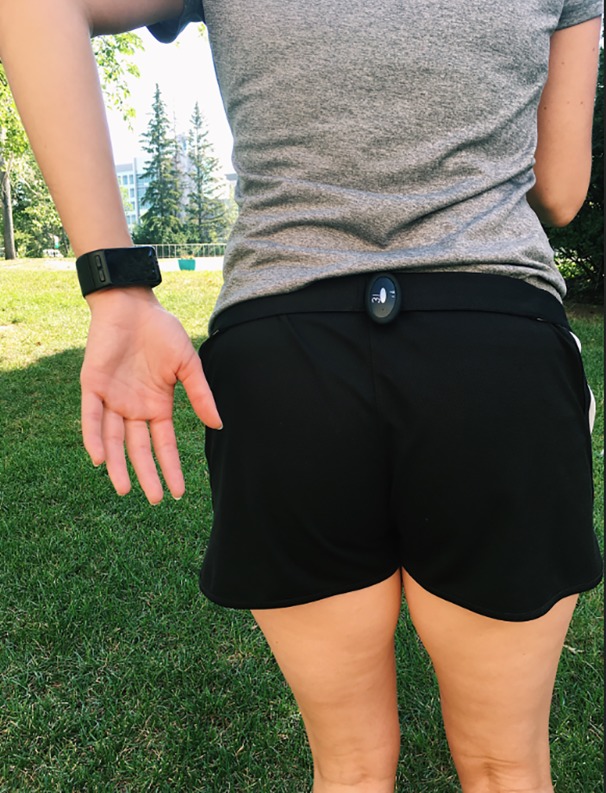
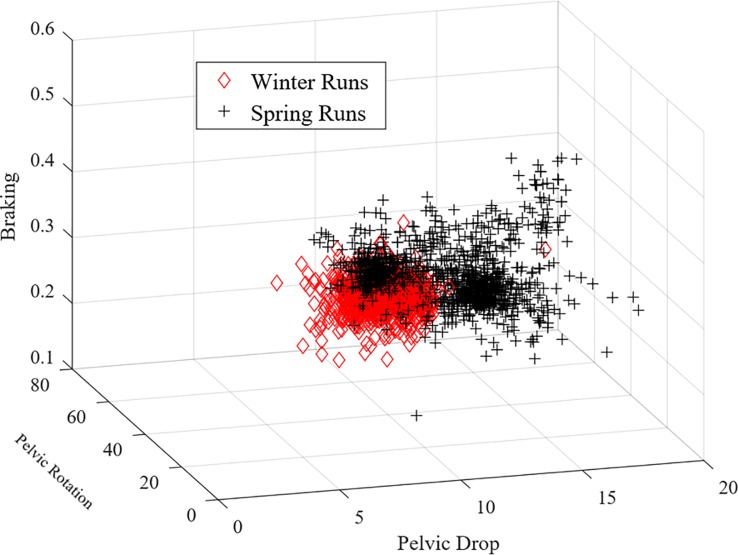
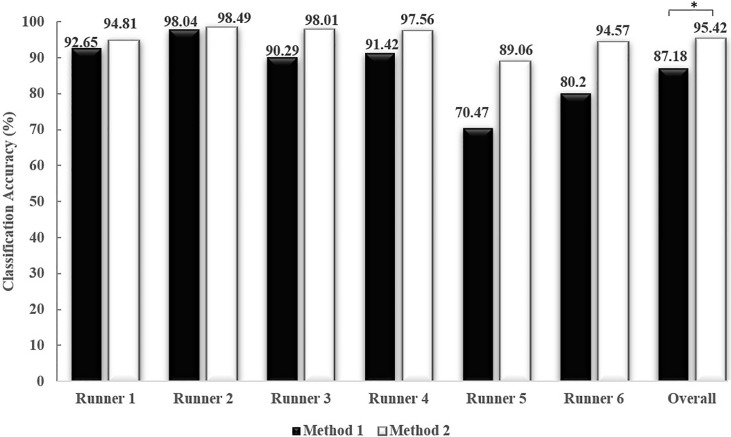
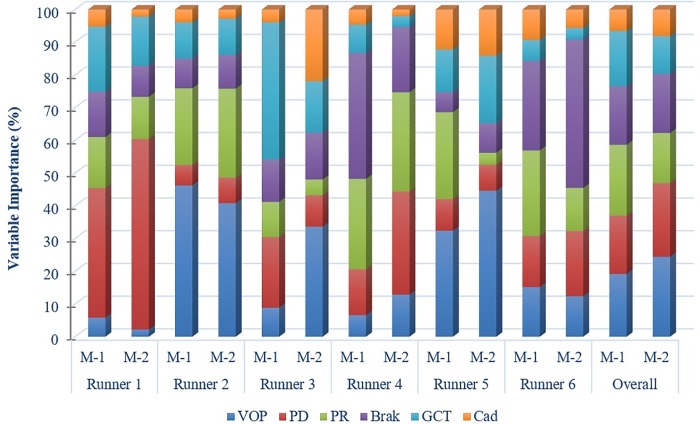
Running-related overuse injuries can result from a combination of various intrinsic (e.g., gait biomechanics) and extrinsic (e.g., running surface) risk factors. However, it is unknown how changes in environmental weather conditions affect running gait biomechanical patterns since these data cannot be collected in a laboratory setting. Therefore, the purpose of this study was to develop a classification model based on subject-specific changes in biomechanical running patterns across two different environmental weather conditions using data obtained from wearable sensors in real-world environments. Running gait data were recorded during winter and spring sessions, with recorded average air temperatures of -10° C and +6° C, respectively. Classification was performed based on measurements of pelvic drop, ground contact time, braking, vertical oscillation of pelvis, pelvic rotation, and cadence obtained from 66,370 strides (~11,000/runner) from a group of recreational runners. A non-linear and ensemble machine learning algorithm, random forest (RF), was used to classify and compute a heuristic for determining the importance of each variable in the prediction model. To validate the developed subject-specific model, two cross-validation methods (one-against-another and partitioning datasets) were used to obtain experimental mean classification accuracies of 87.18% and 95.42%, respectively, indicating an excellent discriminatory ability of the RF-based model. Additionally, the ranked order of variable importance differed across the individual runners. The results from the RF-based machine-learning algorithm demonstrates that processing gait biomechanical signals from a single wearable sensor can successfully detect changes to an individual's running patterns based on data obtained in real-world environments.
跑步相关的过度使用损伤可能是由各种内在(例如,步态生物力学)和外在(例如,跑步表面)风险因素共同作用引起的。然而,由于无法在实验室环境中收集这些数据,因此尚不清楚环境天气条件的变化如何影响跑步步态生物力学模式。因此,本研究的目的是开发一种分类模型,该模型基于特定于个体的生物力学跑步模式在两种不同环境天气条件下的变化,使用来自现实环境中可穿戴传感器的数据。在冬季和春季的训练中记录跑步步态数据,记录的平均空气温度分别为-10°C 和+6°C。分类是基于从一组休闲跑者的 66,370 步(约 11,000/跑者)中获得的骨盆下降、触地时间、制动、骨盆垂直摆动、骨盆旋转和步频的测量值进行的。使用非线性和集成机器学习算法,随机森林(RF)对其进行分类并计算确定预测模型中每个变量重要性的启发式方法。为了验证所开发的特定于个体的模型,使用两种交叉验证方法(一对一和数据集划分)分别获得了 87.18%和 95.42%的实验平均分类准确率,表明 RF 模型具有出色的辨别能力。此外,各个跑者之间的变量重要性排序不同。基于 RF 的机器学习算法的结果表明,从单个可穿戴传感器处理步态生物力学信号可以根据在现实环境中获得的数据成功检测到个体跑步模式的变化。