Arnold Carina, Schulte Claudia, Moscovich Mariana, Sünkel Ulrike, Zaunbrecher Laura, Metzger Florian, Gasser Thomas, Eschweiler Gerhard W, Hauser Ann-Kathrin, Berg Daniela, Maetzler Walter
Department of Neurodegenerative Diseases, Center of Neurology, Hertie Institute for Clinical Brain Research, University of Tübingen, Tübingen, Germany.
German Center for Neurodegenerative Diseases, Tübingen, Germany.
Front Aging Neurosci. 2018 Sep 4;10:260. doi: 10.3389/fnagi.2018.00260. eCollection 2018.
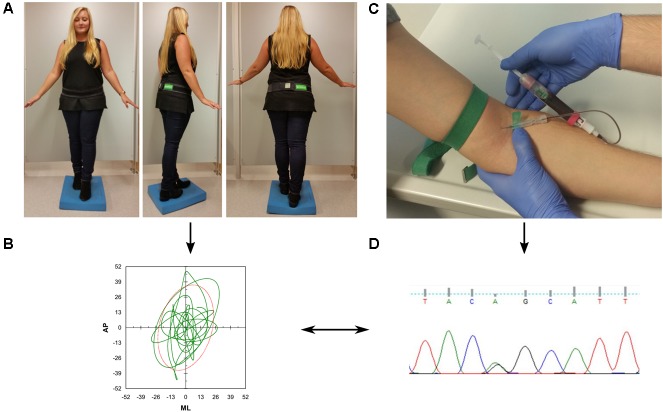
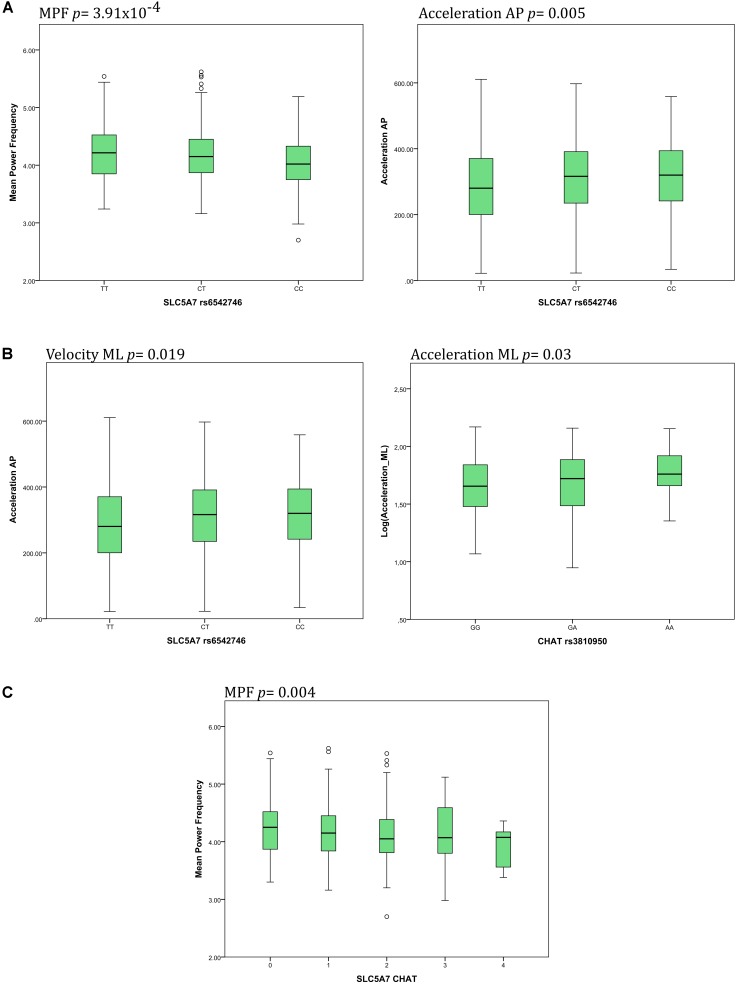
To determine whether single nucleotide polymorphisms (SNPs) of the cholinergic system and quantitative parameters of postural control are associated in healthy older adults. This is a cross-sectional analysis from the TREND study. All participants performed a static postural control task for 30 s on a foam pad in semitandem stance and eyes closed. We analyzed mean power frequency (MPF), area, acceleration, jerk, and velocity from a mobile sensor worn at the lower back using a validated algorithm. Genotypes of four SNPs in genes involved in the cholinergic system () were extracted from the NeuroX chip. All participants present a normal neurological examination and a Minimental state examination score >24. Four hundred and seventy seven participants were included. Mean age was 69 years, 41% were female. One SNP of the cholinergic pathway was significantly associated with a quantitative postural control parameter. The minor allele of rs6542746 in was associated with lower MPF (4.04 vs. 4.22 Hz; = 3.91 × 10). Moreover, the following associations showed trends toward significance: minor allele of rs6542746 in with higher anteroposterior acceleration (318 vs. 287 mG; = 0.005), and minor allele of rs3810950 in with higher mediolateral acceleration [1.77 vs. 1.65 log(mG); = 0.03] and velocity [1.83 vs. 1.74 log(mm/s); = 0.019]. Intraindividual occurrence of rs6542746 and rs3810950 minor alleles was dose-dependently related with lower MPF ( = 0.004). This observational study suggests an influence of SNPs of the cholinergic pathway on postural control in older adults.
确定在健康老年人中,胆碱能系统的单核苷酸多态性(SNP)与姿势控制的定量参数是否相关。这是一项来自TREND研究的横断面分析。所有参与者在半串联站立且闭眼的状态下,在泡沫垫上进行30秒的静态姿势控制任务。我们使用经过验证的算法,分析了佩戴在下背部的移动传感器记录的平均功率频率(MPF)、面积、加速度、急动度和速度。从NeuroX芯片中提取参与胆碱能系统的基因中的四个SNP的基因型。所有参与者均进行了正常的神经系统检查,且简易精神状态检查得分>24。共纳入477名参与者。平均年龄为69岁,41%为女性。胆碱能途径的一个SNP与姿势控制的定量参数显著相关。CHRFAM7A基因中rs6542746的次要等位基因与较低的MPF相关(4.04对4.22 Hz;P = 3.91×10)。此外,以下关联显示出显著趋势:CHRFAM7A基因中rs6542746的次要等位基因与较高的前后向加速度相关(318对287 mG;P = 0.005),以及CHRM2基因中rs3810950的次要等位基因与较高的内外侧加速度[1.77对1.65 log(mG);P = 0.03]和速度[1.83对1.74 log(mm/s);P = 0.019]相关。rs6542746和rs3810950次要等位基因的个体内出现与较低的MPF呈剂量依赖性相关(P = 0.004)。这项观察性研究表明,胆碱能途径的SNP对老年人的姿势控制有影响。