Division of Immune Receptors and T Cell Activation, Medical University of Vienna, Vienna, Austria.
Division of Clinical and Experimental Immunology, Center for Pathophysiology, Infectiology, and Immunology, Institute of Immunology, Medical University of Vienna, Vienna, Austria.
Front Immunol. 2018 Aug 31;9:1909. doi: 10.3389/fimmu.2018.01909. eCollection 2018.
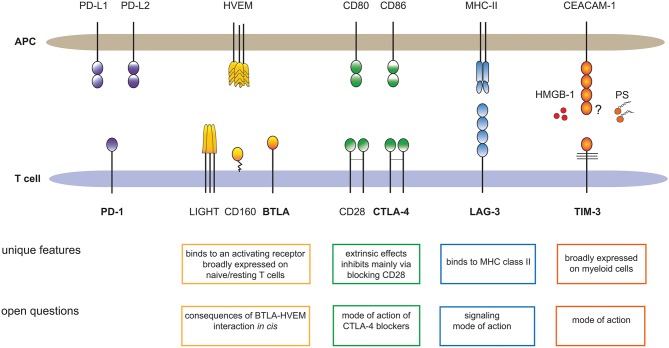
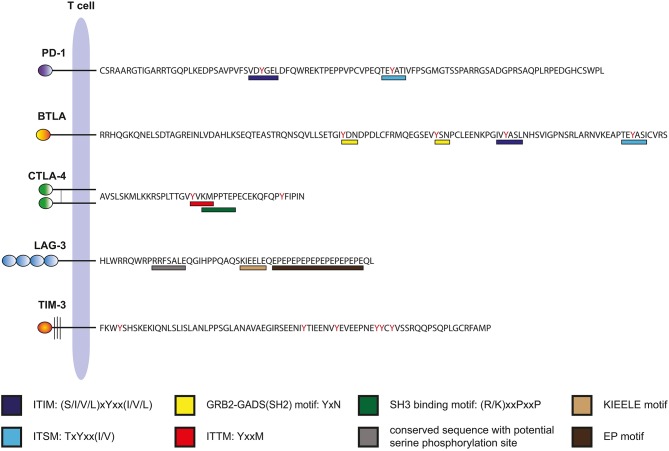
Antibodies that block T cell inhibition via the immune checkpoints CTLA-4 and PD-1 have revolutionized cancer therapy during the last 15 years. T cells express additional inhibitory surface receptors that are considered to have potential as targets in cancer immunotherapy. Antibodies against LAG-3 and TIM-3 are currently clinically tested to evaluate their effectiveness in patients suffering from advanced solid tumors or hematologic malignancies. In addition, blockade of the inhibitory BTLA receptors on human T cells may have potential to unleash T cells to effectively combat cancer cells. Much research on these immune checkpoints has focused on mouse models. The analysis of animals that lack individual inhibitory receptors has shed some light on the role of these molecules in regulating T cells, but also immune responses in general. There are current intensive efforts to gauge the efficacy of antibodies targeting these molecules called immune checkpoint inhibitors alone or in different combinations in preclinical models of cancer. Differences between mouse and human immunology warrant studies on human immune cells to appreciate the potential of individual pathways in enhancing T cell responses. Results from clinical studies are not only highlighting the great benefit of immune checkpoint inhibitors for treating cancer but also yield precious information on their role in regulating T cells and other cells of the immune system. However, despite the clinical relevance of CTLA-4 and PD-1 and the high potential of the emerging immune checkpoints, there are still substantial gaps in our understanding of the biology of these molecules, which might prevent the full realization of their therapeutic potential. This review addresses PD-1, CTLA-4, BTLA, LAG-3, and TIM-3, which are considered major inhibitory immune checkpoints expressed on T cells. It provides summaries of our current conception of the role of these molecules in regulating T cell responses, and discussions about major ambiguities and gaps in our knowledge. We emphasize that each of these molecules harbors unique properties that set it apart from the others. Their distinct functional profiles should be taken into account in therapeutic strategies that aim to exploit these pathways to enhance immune responses to combat cancer.
在过去的 15 年中,通过免疫检查点 CTLA-4 和 PD-1 阻断 T 细胞抑制的抗体彻底改变了癌症治疗。T 细胞表达其他抑制性表面受体,这些受体被认为是癌症免疫治疗的潜在靶点。目前正在临床测试针对 LAG-3 和 TIM-3 的抗体,以评估它们在患有晚期实体瘤或血液恶性肿瘤的患者中的有效性。此外,阻断人 T 细胞上的抑制性 BTLA 受体可能具有释放 T 细胞以有效对抗癌细胞的潜力。许多针对这些免疫检查点的研究都集中在小鼠模型上。分析缺乏单个抑制性受体的动物,为这些分子在调节 T 细胞以及一般免疫反应中的作用提供了一些线索。目前正在进行密集的努力,以评估针对这些称为免疫检查点抑制剂的分子的抗体在癌症的临床前模型中单独或联合使用的疗效。老鼠和人类免疫学之间的差异需要研究人类免疫细胞,以了解个体途径增强 T 细胞反应的潜力。临床研究的结果不仅突出了免疫检查点抑制剂治疗癌症的巨大益处,而且还提供了有关它们在调节 T 细胞和免疫系统其他细胞中的作用的宝贵信息。然而,尽管 CTLA-4 和 PD-1 具有临床相关性,新兴的免疫检查点具有很高的潜力,但我们对这些分子的生物学理解仍存在很大差距,这可能会阻碍它们治疗潜力的充分实现。本综述介绍了 PD-1、CTLA-4、BTLA、LAG-3 和 TIM-3,它们被认为是 T 细胞上表达的主要抑制性免疫检查点。它提供了我们目前对这些分子在调节 T 细胞反应中的作用的认识总结,并讨论了我们知识中的主要模糊和差距。我们强调,这些分子中的每一个都具有独特的特性,使其与其他分子区别开来。在旨在利用这些途径增强免疫反应以对抗癌症的治疗策略中,应考虑到它们独特的功能特征。