Brown Graham, Reeders Daniel, Cogle Aaron, Madden Annie, Kim Jules, O'Donnell Darryl
Australian Research Centre in Sex, Health and Society, La Trobe University, Melbourne, VIC, Australia.
School of Regulation and Global Governance, Australian National University, Canberra, ACT, Australia.
Front Public Health. 2018 Aug 31;6:231. doi: 10.3389/fpubh.2018.00231. eCollection 2018.
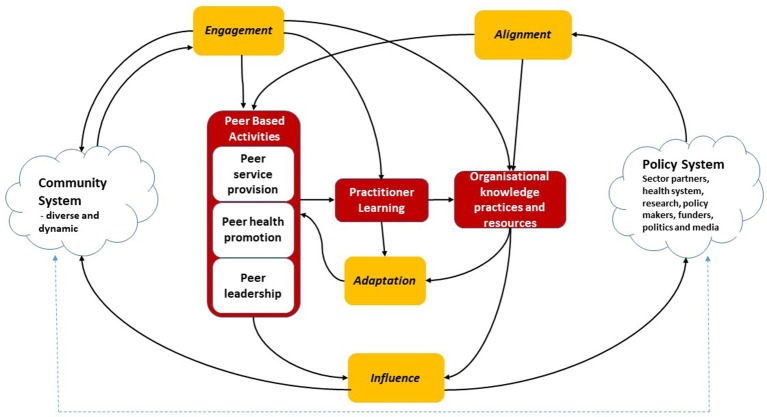
The central role of community and peer-led programs has been a key characteristic of the Australian partnership response to HIV and hepatitis C since the beginning of the epidemics. Despite this, peer-led programs continue to have limited capacity to demonstrate their role and value as part of a multi-sectoral response. What makes one peer-led program a better investment than another? What role does the rest of the sector have in ensuring we gain the most value from these investments? To investigate this, we facilitated interactive systems thinking methods with 10 programs working within communities of people who inject drugs, gay men, sex workers and people living with HIV across Australia. This included articulating program theories in diagram and textual form to help us understand the role of peer-based programs promoting peer leadership within the Australian HIV and hepatitis C responses. Our aim was to develop a framework for monitoring and evaluation that could be applied to peer led programs at different levels and in different contexts. We found that for peer-led programs to fulfill their role, and to navigate the rapid changes occurring in the both epidemics, they need to: demonstrate the credibility of their peer and community insights; continually adapt to changing contexts and policy priorities in tandem with their communities; and maintain influence in both community and policy systems. We developed a framework of four key functions (Engagement, Alignment, Adaptation, and Influence) which peer-based programs need to demonstrate, which form the basis for identifying quality indicators. This article presents a new way of framing and monitoring investments in peer-led programs and peer eadership actions by these programs. If health policy is committed to strengthening the leadership shown by affected communities, then we need to understand, enhance, monitor and value the role of peer-led programs and peer leadership within the overall prevention system. We believe the W3 framework, drawing on systems thinking and modeling, can support funders, policy-makers and programs to achieve this.
自艾滋病和丙型肝炎疫情开始以来,社区和同伴主导项目的核心作用一直是澳大利亚应对这两种疾病伙伴关系的一个关键特征。尽管如此,同伴主导项目作为多部门应对措施的一部分,展示其作用和价值的能力仍然有限。是什么使得一个同伴主导项目比另一个项目更具投资价值?该领域的其他部分在确保我们从这些投资中获得最大价值方面发挥着什么作用?为了对此进行调查,我们与澳大利亚10个在注射吸毒者、男同性恋者、性工作者以及艾滋病毒感染者社区开展工作的项目共同推动了互动式系统思维方法。这包括以图表和文本形式阐明项目理论,以帮助我们理解基于同伴的项目在澳大利亚应对艾滋病毒和丙型肝炎过程中促进同伴领导力的作用。我们的目标是制定一个可应用于不同层面和不同背景下同伴主导项目的监测和评估框架。我们发现,为了履行其职责并应对两种疫情中迅速发生的变化,同伴主导项目需要:展示其同伴和社区见解的可信度;与所在社区同步不断适应变化的环境和政策重点;并在社区和政策体系中保持影响力。我们制定了一个框架,其中包含同伴主导项目需要展示的四个关键功能(参与、协调、适应和影响),这些功能构成了确定质量指标的基础。本文提出了一种新的方式来构建和监测对同伴主导项目以及这些项目中的同伴领导力行动的投资。如果卫生政策致力于加强受影响社区所展现的领导力,那么我们需要理解、加强、监测并重视同伴主导项目和同伴领导力在整个预防体系中的作用。我们相信,借鉴系统思维和建模的W3框架能够支持资助者、政策制定者和项目实现这一目标。