Zhao Pingsen, Lin Lifang, Lan Liubing
Clinical Core Laboratory Center for Precision Medicine, Meizhou People's Hospital (Huangtang Hospital), Meizhou Hospital Affiliated to Sun Yat-sen University Guangdong Provincial Engineering and Technology Research Center for Molecular Diagnostics of Cardiovascular Diseases Meizhou Municipal Engineering and Technology Research Center for Molecular Diagnostics of Cardiovascular Diseases Meizhou Municipal Engineering and Technology Research Center for Molecular Diagnostics of Major Genetic Disorders Prenatal Diagnosis Center, Meizhou People's Hospital (Huangtang Hospital), Meizhou Hospital Affiliated to Sun Yat-sen University, Meizhou, P. R. China.
Medicine (Baltimore). 2018 Sep;97(38):e12285. doi: 10.1097/MD.0000000000012285.
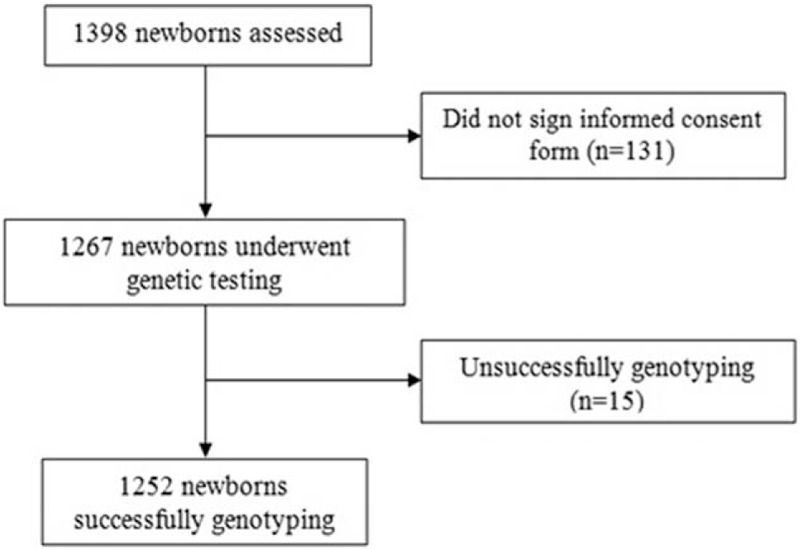
Hearing loss is a common neurosensory disorder, approximately half of the cases are caused by genetic factors, and approximately 70% of hereditary hearing impairments are nonsyndromic hearing loss (NSHL). The mutations of GJB2 (gap junction beta-2 protein), GJB3 (gap junction beta-3 protein), SLC26A4 (solute carrier family 26 member 4), and MT-RNR1 (mitochondrially encoded 12S RNA) are the most common inherited causes of NSHL. Because of different genetic backgrounds, the mutation spectrum of these common deafness-causing genes varies among different regions in China. Because no data are known on these mutations among the Hakka population of Southern China, we aim to investigate the mutation spectrum to add these to neonatal screening and genetic counseling. A total of 1252 blood samples from newborns have been detected by semiconductor sequencing for 100 mutations loci of 18 deafness-causing genes. Of the participants, 95 subjects carried deafness-causing genes mutations with the carrier rate of 7.59%. The mutation frequencies of GJB2, SLC26A4, GJB3, and mitochondrial genes were 3.04%, 3.51%, 0.16%, and 0.88%, respectively. We followed up subjects with single-gene homozygous or compound heterozygous mutations. Our study firstly analyzed deafness-causing genes mutation spectrum in Hakka population, providing evidence for future neonatal screening and genetic counseling in this area.
听力损失是一种常见的神经感觉障碍,约半数病例由遗传因素引起,约70%的遗传性听力障碍为非综合征性听力损失(NSHL)。GJB2(缝隙连接蛋白β-2)、GJB3(缝隙连接蛋白β-3)、SLC26A4(溶质载体家族26成员4)和MT-RNR1(线粒体编码的12S RNA)的突变是NSHL最常见的遗传病因。由于遗传背景不同,这些常见致聋基因的突变谱在中国不同地区存在差异。由于中国南方客家人群中这些突变的数据未知,我们旨在调查突变谱,以便将其纳入新生儿筛查和遗传咨询。通过半导体测序对1252份新生儿血样进行了18个致聋基因的100个突变位点检测。在参与者中,95名受试者携带致聋基因突变,携带率为7.59%。GJB2、SLC26A4、GJB3和线粒体基因的突变频率分别为3.04%、3.51%、0.16%和0.88%。我们对单基因纯合或复合杂合突变的受试者进行了随访。我们的研究首次分析了客家人群中致聋基因的突变谱,为该地区未来的新生儿筛查和遗传咨询提供了依据。