State Key Laboratory of Power Transmission Equipment and System Security and New Technology, School of Electrical Engineering, Chongqing University, No. 174 Shazhengjie, Shapingba District, Chongqing, 400044, China.
Department of Biomedical Engineering and Mechanics, Virginia Tech, 329 ICTAS Stanger St (0298), Blacksburg, VA, 24061, USA.
Biomed Eng Online. 2018 Sep 20;17(1):126. doi: 10.1186/s12938-018-0562-9.
Irreversible electroporation (IRE) therapy relies on pulsed electric fields to non-thermally ablate cancerous tissue. Methods for evaluating IRE ablation in situ are critical to assessing treatment outcome. Analyzing changes in tissue impedance caused by electroporation has been proposed as a method for quantifying IRE ablation. In this paper, we assess the hypothesis that irreversible electroporation ablation outcome can be monitored using the impedance change measured by the electrode pairs not in use, getting more information about the ablation size in different directions.
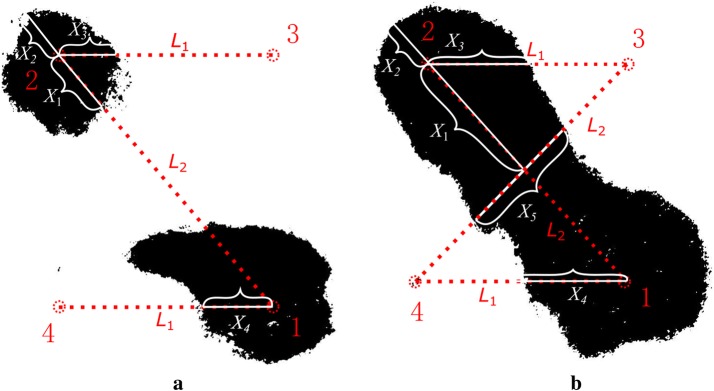
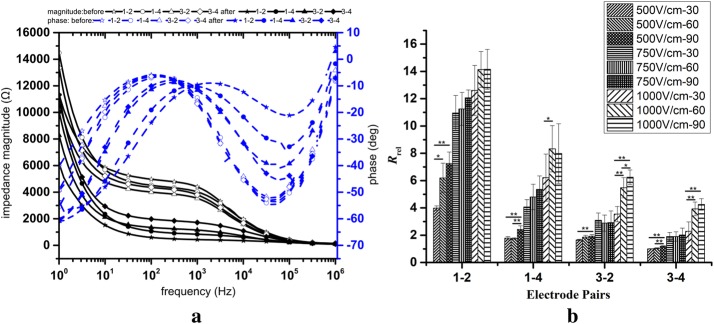
Using a square four-electrode configuration, the two diagonal electrodes were used to electroporate potato tissue. Next, the impedance changes, before and after treatment, were measured from different electrode pairs and the impedance information was extracted by fitting the data to an equivalent circuit model. Finally, we correlated the change of impedance from various electrode pairs to the ablation geometry through the use of fitted functions; then these functions were used to predict the ablation size and compared to the numerical simulation results.
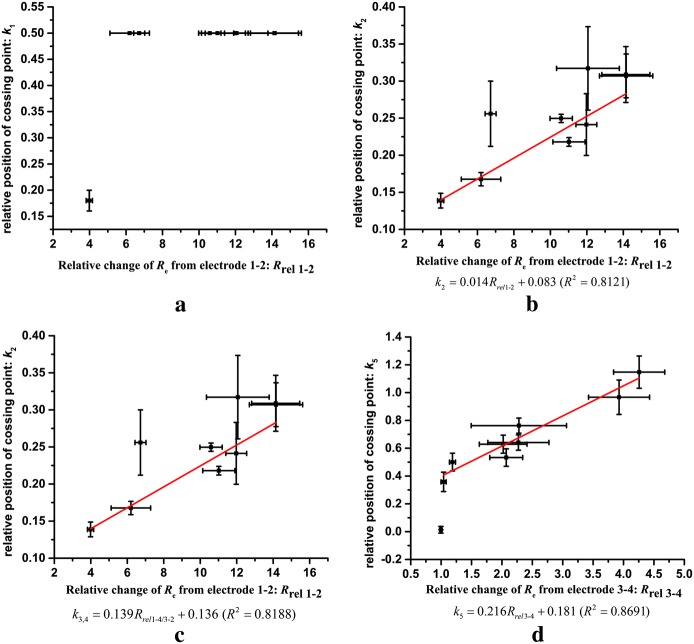
The change in impedance from the electrodes used to apply pulses is larger and has higher deviation than the other electrode pairs. The ablation size and the change in resistance in the circuit model correlate with various linear functions. The coefficients of determination for the three functions are 0.8121, 0.8188 and 0.8691, respectively, showing satisfactory agreement. The functions can well predict the ablation size under different pulse numbers, and in some directions it did even better than the numerical simulation method, which used different electric field thresholds for different pulse numbers.
The relative change in tissue impedance measured from the non-energized electrodes can be used to assess ablation size during treatment with IRE according to linear functions.
不可逆电穿孔(IRE)疗法依赖于脉冲电场来非热消融癌组织。评估IRE 消融的原位方法对于评估治疗效果至关重要。分析电穿孔引起的组织阻抗变化已被提出作为量化 IRE 消融的一种方法。在本文中,我们评估了以下假设,即可以使用未使用的电极对测量的阻抗变化来监测不可逆电穿孔消融结果,从而获得关于不同方向消融大小的更多信息。
使用方形四电极配置,对角电极用于电穿孔土豆组织。然后,从不同的电极对测量治疗前后的阻抗变化,并通过将数据拟合到等效电路模型来提取阻抗信息。最后,我们通过使用拟合函数将来自不同电极对的阻抗变化与消融几何形状相关联;然后,这些函数被用于预测消融尺寸,并与数值模拟结果进行比较。
用于施加脉冲的电极的阻抗变化较大,且偏差较高。电路模型中的消融尺寸和电阻变化与各种线性函数相关。三个函数的决定系数分别为 0.8121、0.8188 和 0.8691,显示出良好的一致性。这些函数可以很好地预测不同脉冲数下的消融尺寸,在某些方向上甚至比使用不同电场阈值的不同脉冲数的数值模拟方法更好。
根据线性函数,从未通电电极测量的组织阻抗的相对变化可用于评估 IRE 治疗期间的消融尺寸。