• 文献检索
  • 文档翻译
  • 深度研究
  • 学术资讯
  • Suppr Zotero 插件Zotero 插件
  • 邀请有礼
  • 套餐&价格
  • 历史记录
应用&插件
Suppr Zotero 插件Zotero 插件浏览器插件Mac 客户端Windows 客户端微信小程序
定价
高级版会员购买积分包购买API积分包
服务
文献检索文档翻译深度研究API 文档MCP 服务
关于我们
关于 Suppr公司介绍联系我们用户协议隐私条款
关注我们

Suppr 超能文献

核心技术专利:CN118964589B侵权必究
粤ICP备2023148730 号-1Suppr @ 2026

文献检索

告别复杂PubMed语法,用中文像聊天一样搜索,搜遍4000万医学文献。AI智能推荐,让科研检索更轻松。

立即免费搜索

文件翻译

保留排版,准确专业,支持PDF/Word/PPT等文件格式,支持 12+语言互译。

免费翻译文档

深度研究

AI帮你快速写综述,25分钟生成高质量综述,智能提取关键信息,辅助科研写作。

立即免费体验

家庭为基础与以办公室为基础的生物反馈疗法治疗便秘伴功能性排便障碍:一项随机对照试验。

Home-based versus office-based biofeedback therapy for constipation with dyssynergic defecation: a randomised controlled trial.

机构信息

Division of Gastroenterology and Hepatology, Medical College of Georgia, Augusta University, Augusta, GA, USA; Department of Medicine, University of Iowa Carver College of Medicine, Iowa City, IA, USA.

Department of Medicine, University of Iowa Carver College of Medicine, Iowa City, IA, USA.

出版信息

Lancet Gastroenterol Hepatol. 2018 Nov;3(11):768-777. doi: 10.1016/S2468-1253(18)30266-8. Epub 2018 Sep 18.

DOI:10.1016/S2468-1253(18)30266-8
PMID:30236904
原文链接:https://pmc.ncbi.nlm.nih.gov/articles/PMC6206847/
Abstract

BACKGROUND

Office-based biofeedback therapy is effective for constipation with dyssynergic defecation, but must be performed by skilled staff, is only available in selected centres, and requires multiple visits. The efficacy of home-based biofeedback therapy is unknown. We compared clinical and subjective outcomes with home-based and office-based approaches.

METHODS

In this randomised controlled trial, eligible patients were adult outpatients (age 18-80 years) who met the Rome III criteria for functional constipation and who had been referred to a tertiary-care centre after non-response to routine management, and who had dyssynergic defecation. Patients were randomly assigned according to a schedule generated in advance by the study biostatistician, in permuted blocks of four, to receive office-based or home-based biofeedback therapy. Office-based biofeedback comprised therapist-guided pelvic floor training for six sessions over 3 months (visits every 2 weeks). Home-based biofeedback comprised 20 min self-training sessions twice per day, in which a self-inserted probe was used to provide visual feedback via a handheld monitoring device of anal sphincter pressure and push effort. Patients recorded in diaries the time of each defecation attempt, stool consistency, straining effort, feeling of incomplete evacuation, need for digital assistance with stooling, and satisfaction with bowel function, from 1 week before enrolment to the end of follow-up. Treatment responders were defined post hoc as those with normalisation of dyssynergic defecation and an increase in the number of complete spontaneous bowel movements per week by 3 months. Cost outcomes calculated from health-care costs and loss of salary were assessed from hospital billing and medical records and questionnaires. Primary outcome measures were the presence of a dyssynergic pattern during attempted defecation, balloon expulsion time, the number of complete spontaneous bowel movements per week, and satisfaction with bowel function, assessed by intention to treat (non-inferiority) and per protocol. This trial is registered with ClinicalTrials.gov, number NCT03202771.

FINDINGS

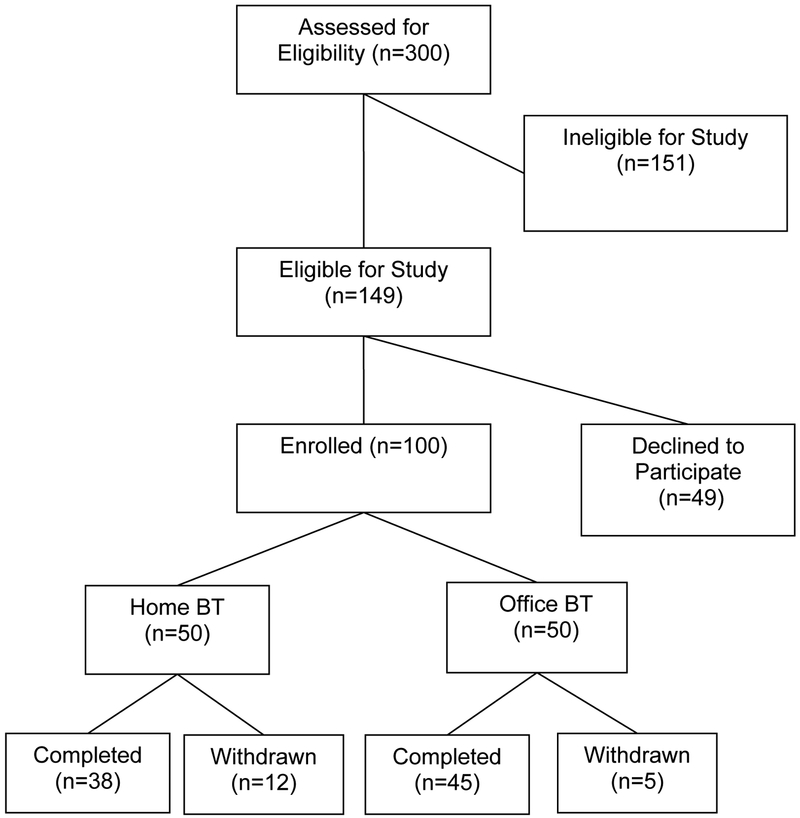
Of 300 patients screened we enrolled 100, from Jan 7, 2005, to Jan 31, 2010. 83 patients completed training (38 [76%] of 50 in the home-based biofeedback group and 45 [90%] of 50 in the office-based biofeedback group). 34 (68%) patients in the home-based group and 35 (70%) in the office-based group were classified as responders. All primary outcomes improved significantly from baseline in the two treatment groups (all p<0·0001). Home-based biofeedback therapy was non-inferior to office-based therapy for number of complete spontaneous bowel movements per week, satisfaction with bowel function, and balloon expulsion time in the intention-to-treat and per-protocol analyses, and for dyssynergia in the per-protocol analysis. No adverse events were reported. The median cost of home-based biofeedback therapy was significantly lower than that for office-based treatment (US$1081·70, IQR 794·90-1399·30 vs $1942·50, 1621·70-2369·00, p=0·009).

INTERPRETATION

Home-based and office-based biofeedback therapy for dyssynergic defecation improved bowel symptoms and physiology with similar efficacy. A home-based programme could substantially broaden the availability and use of this treatment.

FUNDING

National Institutes of Health.

https://cdn.ncbi.nlm.nih.gov/pmc/blobs/66ba/6206847/d969ff6b7150/nihms-989813-f0001.jpg
摘要

背景

对于伴有功能性出口梗阻的便秘患者,基于诊室的生物反馈治疗有效,但必须由熟练的医护人员操作,仅在部分中心开展,且需要多次就诊。家庭为基础的生物反馈治疗的疗效尚不清楚。我们比较了基于诊室和家庭两种方法的临床和主观疗效。

方法

在这项随机对照试验中,合格的患者为成年门诊患者(年龄 18-80 岁),符合罗马 III 功能性便秘标准,在常规治疗无反应后被转诊至三级医疗中心,并且存在功能性出口梗阻。患者根据研究生物统计学家预先制定的时间表,按 4 个患者为一组的顺序进行随机分组,接受基于诊室或家庭的生物反馈治疗。基于诊室的生物反馈包括治疗师指导的骨盆底训练,共 6 次,持续 3 个月(每 2 周就诊一次)。家庭为基础的生物反馈包括每天两次 20 分钟的自我训练,在此过程中,一个自插入的探头用于通过手持监测设备提供肛门括约肌压力和推力的视觉反馈。患者从入组前 1 周开始,至随访结束时,每天记录每次排便尝试的时间、粪便稠度、用力程度、不完全排空感、排便时需要数字辅助的感觉,以及对排便功能的满意度。治疗应答者定义为:在 3 个月时,通过异常的肛门直肠动力学改善和每周完全自发性排便次数增加 3 次。从医院账单和医疗记录以及问卷调查中评估医疗保健费用和工资损失的成本结果。主要结局指标为尝试排便时存在的异常肛门直肠动力学模式、球囊排出时间、每周完全自发性排便次数以及基于意向治疗(非劣效性)和方案的排便功能满意度。这项试验在 ClinicalTrials.gov 注册,编号为 NCT03202771。

结果

在筛选的 300 名患者中,我们纳入了 100 名患者,纳入时间为 2005 年 1 月 7 日至 2010 年 1 月 31 日。83 名患者完成了训练(50 名家庭为基础的生物反馈组中 38 名[76%],50 名基于诊室的生物反馈组中 45 名[90%])。家庭为基础的生物反馈组中 34 名(68%)患者和基于诊室的生物反馈组中 35 名(70%)患者被分类为应答者。两组患者的所有主要结局指标均较基线显著改善(所有 p<0·0001)。基于意向治疗和方案的分析,家庭为基础的生物反馈治疗在每周完全自发性排便次数、排便功能满意度和球囊排出时间方面不劣于基于诊室的治疗,而在方案分析中,家庭为基础的生物反馈治疗在异常肛门直肠动力学方面不劣于基于诊室的治疗。未报告不良事件。家庭为基础的生物反馈治疗的中位费用明显低于基于诊室的治疗(1081.70 美元,794.90-1399.30 美元 vs 1942.50 美元,1621.70-2369.00 美元,p=0·009)。

解释

对于伴有功能性出口梗阻的便秘患者,基于诊室的生物反馈治疗和家庭为基础的生物反馈治疗均可改善肠道症状和生理功能,疗效相当。家庭为基础的方案可以显著扩大这种治疗的可及性和使用范围。

资助

美国国立卫生研究院。

相似文献

1
Home-based versus office-based biofeedback therapy for constipation with dyssynergic defecation: a randomised controlled trial.家庭为基础与以办公室为基础的生物反馈疗法治疗便秘伴功能性排便障碍:一项随机对照试验。
Lancet Gastroenterol Hepatol. 2018 Nov;3(11):768-777. doi: 10.1016/S2468-1253(18)30266-8. Epub 2018 Sep 18.
2
Randomized controlled trial of biofeedback, sham feedback, and standard therapy for dyssynergic defecation.生物反馈、假反馈和标准疗法治疗排便协同失调的随机对照试验。
Clin Gastroenterol Hepatol. 2007 Mar;5(3):331-8. doi: 10.1016/j.cgh.2006.12.023.
3
Factors Associated With Response to Biofeedback Therapy for Dyssynergic Defecation.与生物反馈治疗协同性排便障碍的反应相关的因素。
Clin Gastroenterol Hepatol. 2018 May;16(5):715-721. doi: 10.1016/j.cgh.2017.10.027. Epub 2017 Oct 27.
4
Long-term efficacy of biofeedback therapy for dyssynergic defecation: randomized controlled trial.生物反馈治疗协同性排便障碍的长期疗效:随机对照试验。
Am J Gastroenterol. 2010 Apr;105(4):890-6. doi: 10.1038/ajg.2010.53. Epub 2010 Feb 23.
5
Habit training versus habit training with direct visual biofeedback in adults with chronic constipation: study protocol for a randomised controlled trial.成人慢性便秘患者中习惯训练与直接视觉生物反馈习惯训练的比较:一项随机对照试验的研究方案
Trials. 2017 Mar 24;18(1):139. doi: 10.1186/s13063-017-1880-0.
6
Assessment of the effectiveness of biofeedback in children with dyssynergic defecation and recalcitrant constipation/encopresis: does home biofeedback improve long-term outcomes.对排便协同失调及顽固性便秘/大便失禁儿童进行生物反馈治疗有效性的评估:家庭生物反馈能否改善长期疗效?
Clin Pediatr (Phila). 2005 Jan-Feb;44(1):63-71. doi: 10.1177/000992280504400108.
7
Home Biofeedback for the Treatment of Dyssynergic Defecation: Does It Improve Quality of Life and Is It Cost-Effective?家庭生物反馈治疗协同性排便障碍:是否能提高生活质量且具有成本效益?
Am J Gastroenterol. 2019 Jun;114(6):938-944. doi: 10.14309/ajg.0000000000000278.
8
Obstructed defecation syndrome associated with paradoxical puborectalis contraction: osteopathic treatment versus anal biofeedback. Results of a pilot study.排便障碍综合征与耻骨直肠肌反常收缩相关:整骨疗法治疗与肛门生物反馈治疗的对比。一项初步研究的结果。
Tech Coloproctol. 2021 May;25(5):589-595. doi: 10.1007/s10151-020-02381-9. Epub 2021 Feb 27.
9
Effectiveness of Biofeedback Therapy on Quality of Life in Patients with Dyssynergic Defecation Disorder.生物反馈疗法对协同性排便障碍患者生活质量的影响。
Turk J Gastroenterol. 2021 Jan;32(1):22-29. doi: 10.5152/tjg.2020.19678.
10
Outcome of biofeedback therapy in dyssynergic defecation patients with and without irritable bowel syndrome.协同失调性排便障碍伴或不伴肠易激综合征患者的生物反馈治疗结果。
J Clin Gastroenterol. 2011 Aug;45(7):593-8. doi: 10.1097/MCG.0b013e31820c6001.

引用本文的文献

1
Clinical efficacy and regulatory mechanisms of Shi Pi Zeng Ye formula in treating functional constipation comorbid with depression: integrating clinical observation, mass spectrometry, bioinformatics, and molecular docking.实脾增液方治疗功能性便秘合并抑郁的临床疗效及调控机制:整合临床观察、质谱分析、生物信息学和分子对接
Front Pharmacol. 2025 Aug 20;16:1645277. doi: 10.3389/fphar.2025.1645277. eCollection 2025.
2
Outlet type constipation in adult patients treated with type A botulinum toxin: a cohort study.A型肉毒杆菌毒素治疗成年患者出口型便秘的队列研究。
Int J Colorectal Dis. 2025 Jan 21;40(1):22. doi: 10.1007/s00384-024-04795-5.
3

本文引用的文献

1
ANMS-ESNM position paper and consensus guidelines on biofeedback therapy for anorectal disorders.ANMS-ESNM关于肛门直肠疾病生物反馈治疗的立场文件和共识指南。
Neurogastroenterol Motil. 2015 May;27(5):594-609. doi: 10.1111/nmo.12520. Epub 2015 Apr 1.
2
American Gastroenterological Association medical position statement on constipation.美国胃肠病学会关于便秘的医学立场声明。
Gastroenterology. 2013 Jan;144(1):211-7. doi: 10.1053/j.gastro.2012.10.029.
3
Biofeedback therapy for constipation in adults.成人便秘的生物反馈治疗。
Effect of Biofeedback Combined with Psychotherapy on Functional Constipation Complicated with Anxiety and Depression.
生物反馈联合心理治疗对合并焦虑抑郁的功能性便秘的影响
Appl Psychophysiol Biofeedback. 2025 Mar;50(1):65-69. doi: 10.1007/s10484-024-09670-1. Epub 2024 Nov 21.
4
Randomized controlled trial of an Internet-of-Medical-Things device for patient-guided anorectal biofeedback therapy.一项针对患者引导的肛门直肠生物反馈治疗的物联网设备的随机对照试验。
PLoS One. 2024 Sep 27;19(9):e0311134. doi: 10.1371/journal.pone.0311134. eCollection 2024.
5
2022 Seoul Consensus on Clinical Practice Guidelines for Functional Constipation.《2022年功能性便秘临床实践指南首尔共识》
J Neurogastroenterol Motil. 2023 Jul 30;29(3):271-305. doi: 10.5056/jnm23066.
6
State of the Art Bowel Management for Pediatric Colorectal Problems: Functional Constipation.小儿结直肠问题的最新肠道管理:功能性便秘
Children (Basel). 2023 Jun 19;10(6):1078. doi: 10.3390/children10061078.
7
Optimizing the Utility of Anorectal Manometry for Diagnosis and Therapy: A Roundtable Review and Recommendations.优化肛肠测压在诊断和治疗中的效用:圆桌会议综述及建议。
Clin Gastroenterol Hepatol. 2023 Oct;21(11):2727-2739.e1. doi: 10.1016/j.cgh.2023.05.025. Epub 2023 Jun 9.
8
Single-session hospital-based biofeedback therapy in dyssynergic defecation.基于医院的单次生物反馈疗法治疗排便协同失调
Indian J Gastroenterol. 2023 Apr;42(2):294-295. doi: 10.1007/s12664-022-01325-5. Epub 2023 Apr 27.
9
Insights and Future Directions on the Combined Effects of Mind-Body Therapies with Transcranial Direct Current Stimulation: An Evidence-based Review.身心疗法与经颅直流电刺激联合效应的见解与未来方向:一项基于证据的综述
J Int Soc Phys Rehabil Med. 2022 Oct-Dec;5(4):129-148. doi: 10.4103/ijprm.jisprm-000167. Epub 2022 Dec 13.
10
The Effects of Cognitive Behavioral Therapy with Biofeedback Therapy on the Quality of Life, Anxiety, Depression and Somatic Symptoms in Patients with Dyssynergic Defecation: A Randomized Controlled Trial.认知行为疗法联合生物反馈疗法对排便协同失调患者生活质量、焦虑、抑郁及躯体症状的影响:一项随机对照试验
Med J Islam Repub Iran. 2022 Jul 5;36:74. doi: 10.47176/mjiri.36.74. eCollection 2022.
Best Pract Res Clin Gastroenterol. 2011 Feb;25(1):159-66. doi: 10.1016/j.bpg.2011.01.004.
4
Randomized controlled trial of biofeedback, sham feedback, and standard therapy for dyssynergic defecation.生物反馈、假反馈和标准疗法治疗排便协同失调的随机对照试验。
Clin Gastroenterol Hepatol. 2007 Mar;5(3):331-8. doi: 10.1016/j.cgh.2006.12.023.
5
Functional anorectal disorders.功能性肛门直肠疾病
Gastroenterology. 2006 Apr;130(5):1510-8. doi: 10.1053/j.gastro.2005.11.064.
6
Functional bowel disorders.功能性肠病
Gastroenterology. 2006 Apr;130(5):1480-91. doi: 10.1053/j.gastro.2005.11.061.
7
Biofeedback is superior to laxatives for normal transit constipation due to pelvic floor dyssynergia.对于因盆底失协调导致的慢传输型便秘,生物反馈疗法优于泻药。
Gastroenterology. 2006 Mar;130(3):657-64. doi: 10.1053/j.gastro.2005.11.014.
8
Clinical utility of diagnostic tests for constipation in adults: a systematic review.成人便秘诊断测试的临床效用:一项系统评价
Am J Gastroenterol. 2005 Jul;100(7):1605-15. doi: 10.1111/j.1572-0241.2005.41845.x.
9
Investigation of the utility of colorectal function tests and Rome II criteria in dyssynergic defecation (Anismus).结直肠功能测试及罗马II标准在排便协同失调(盆底失弛缓综合征)中的应用研究
Neurogastroenterol Motil. 2004 Oct;16(5):589-96. doi: 10.1111/j.1365-2982.2004.00526.x.
10
Epidemiology of constipation in North America: a systematic review.北美便秘的流行病学:一项系统综述。
Am J Gastroenterol. 2004 Apr;99(4):750-9. doi: 10.1111/j.1572-0241.2004.04114.x.