Institute for Geology, Leibniz Universität Hannover, 30167, Hannover, Germany.
Institute of Geology and Palaeontology, Université de Lausanne, 1015, Lausanne, Switzerland.
Nat Commun. 2018 Sep 20;9(1):3832. doi: 10.1038/s41467-018-06319-6.
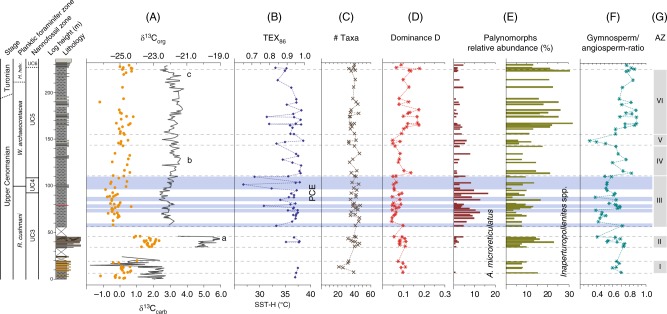
The Cenomanian-Turonian Oceanic Anoxic Event (OAE2; ~94.5 million years ago) represents an episode of global-scale marine anoxia and biotic turnover, which corresponds to one of the warmest time intervals in the Phanerozoic. Despite its global significance, information on continental ecosystem response to this greenhouse episode is lacking. Here we present a terrestrial palynological record combined with marine-derived temperature data (TEX) across an expanded OAE2 section from the Southern Provençal Basin, France. Despite high TEX-derived temperature estimates reaching up to 38 °C, the continental hinterland did support a diverse vegetation, adapted to persist under elevated temperatures. A transient phase of climatic instability and cooling during OAE2 known as Plenus Cold Event (PCE) is marked by the proliferation of open, savanna-type vegetation rich in angiosperms at the expanse of conifer-dominated forest ecosystems. A rise in early representatives of Normapolles-type pollen during the PCE marks the initial radiation of this important angiosperm group.
白垩纪中晚期大洋缺氧事件(OAE2;约 9450 万年前)代表了一次全球性海洋缺氧和生物更替事件,与显生宙中最温暖的时期之一相对应。尽管它具有全球性意义,但对于大陆生态系统对这一温室事件的响应的信息还很缺乏。在这里,我们展示了来自法国南部普罗旺斯盆地扩展 OAE2 剖面的陆地孢粉记录以及海洋衍生的温度数据(TEX)。尽管 TEX 衍生的温度估计值高达 38°C,但内陆腹地确实支持了多样化的植被,适应在高温下生存。OAE2 期间被称为 Plenus Cold Event(PCE)的气候不稳定和冷却的短暂阶段,以开阔的、以草本植物为主的热带稀树草原型植被的增殖为标志,这些植被取代了以针叶树为主的森林生态系统。在 PCE 期间,早期的 Normapolles 型花粉代表的增加标志着这个重要的被子植物群体的最初辐射。