Paleontological Institute and Museum, University of Zurich, Karl-Schmid-Strasse 4, 8006, Zurich, Switzerland.
Institute of Geology, Leibniz University Hannover, Callinstrasse 30, 30167, Hannover, Germany.
Sci Rep. 2023 Feb 22;13(1):3074. doi: 10.1038/s41598-023-30072-6.
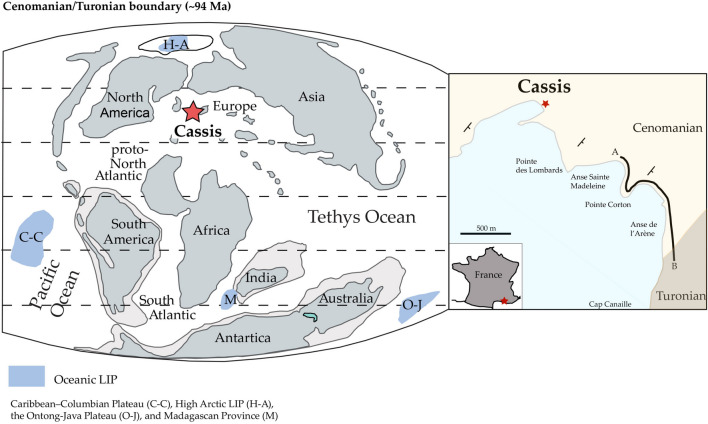
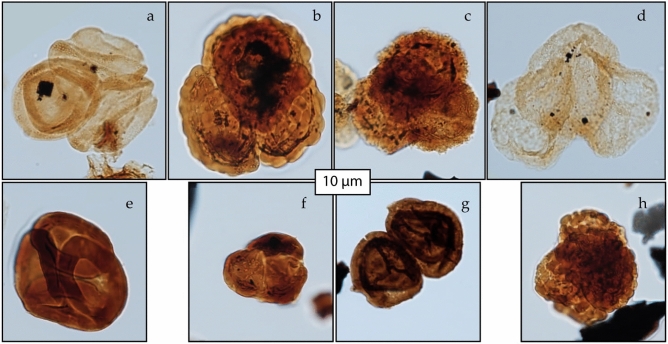
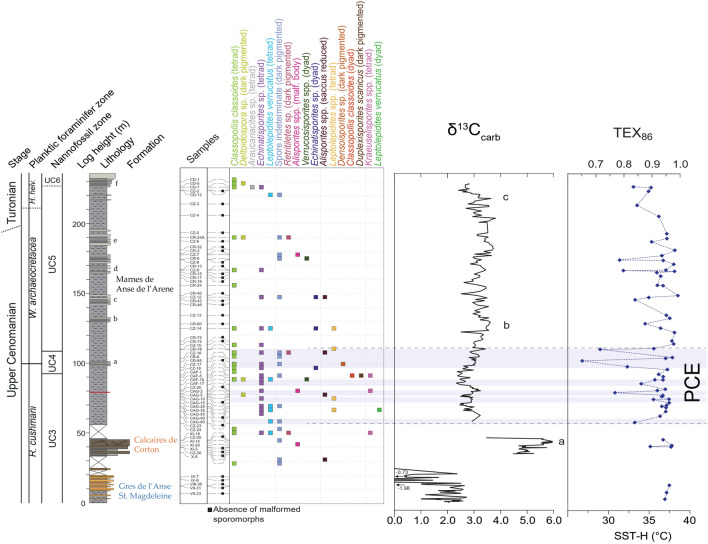
The Cenomanian/Turonian boundary interval is associated with an oceanic anoxic event (OAE 2, 94.0 Ma) during one of the warmest episodes in the Mesozoic. To date, plant responses to these climatic conditions are known only from the northern mid-latitudinal succession in Cassis, France. There, conifer-dominated and angiosperm-dominated vegetation types alternate. However, whether the exceptional environmental conditions had an impact on plant reproduction is unknown to date. We applied a new environmental proxy based on spore and pollen teratology on palynological samples from the Cassis succession, to explore if this phenomenon also occurs across the OAE 2. The observed frequencies of<1% malformed spores and pollen grains suggest that plant reproduction was not affected during the Cenomanian/Turonian boundary interval. While the effects of continental Large Igneous Province(s) on plant reproduction have shown to produce abnormal spore or pollen morphologies as evidence for severe environmental pollution, by contrast the effects of oceanic LIP(s) seems to be inconsequential.
白垩纪中最温暖的时期之一的科马罗姆阶/土仑阶之交与一次海洋缺氧事件(OAE2,940 百万年前)有关。迄今为止,人们仅从法国卡西斯的北部中纬度地层序列中了解到植物对这些气候条件的反应。在那里,针叶树主导和被子植物主导的植被类型交替出现。然而,目前尚不清楚特殊的环境条件是否对植物繁殖有影响。我们在卡西斯地层的孢粉样品上应用了一种基于孢子和花粉畸形学的新环境指标,以探讨这种现象是否也发生在 OAE2 期间。观察到<1%的畸形孢子和花粉粒的频率表明,在科马罗姆阶/土仑阶之交期间,植物繁殖没有受到影响。虽然大陆大火成岩省对植物繁殖的影响已被证明会产生异常的孢子或花粉形态,作为严重环境污染的证据,但相比之下,海洋大火成岩省的影响似乎无关紧要。