• 文献检索
  • 文档翻译
  • 深度研究
  • 学术资讯
  • Suppr Zotero 插件Zotero 插件
  • 邀请有礼
  • 套餐&价格
  • 历史记录
应用&插件
Suppr Zotero 插件Zotero 插件浏览器插件Mac 客户端Windows 客户端微信小程序
定价
高级版会员购买积分包购买API积分包
服务
文献检索文档翻译深度研究API 文档MCP 服务
关于我们
关于 Suppr公司介绍联系我们用户协议隐私条款
关注我们

Suppr 超能文献

核心技术专利:CN118964589B侵权必究
粤ICP备2023148730 号-1Suppr @ 2026

文献检索

告别复杂PubMed语法,用中文像聊天一样搜索,搜遍4000万医学文献。AI智能推荐,让科研检索更轻松。

立即免费搜索

文件翻译

保留排版,准确专业,支持PDF/Word/PPT等文件格式,支持 12+语言互译。

免费翻译文档

深度研究

AI帮你快速写综述,25分钟生成高质量综述,智能提取关键信息,辅助科研写作。

立即免费体验

葡萄糖酸洗必泰沐浴对入住新生儿重症监护病房新生儿皮肤细菌负荷的影响。

The impact of chlorhexidine gluconate bathing on skin bacterial burden of neonates admitted to the Neonatal Intensive Care Unit.

机构信息

Department of Pediatrics, Division of Neonatology, Johns Hopkins University School of Medicine, Baltimore, MD, USA.

Department of Pathology, Division of Medical Microbiology, Johns Hopkins University School of Medicine, Baltimore, MD, USA.

出版信息

J Perinatol. 2019 Jan;39(1):63-71. doi: 10.1038/s41372-018-0231-7. Epub 2018 Sep 20.

DOI:10.1038/s41372-018-0231-7
PMID:30237474
原文链接:https://pmc.ncbi.nlm.nih.gov/articles/PMC6298801/
Abstract

OBJECTIVE

To assess the impact of chlorhexidine gluconate (CHG) bathing on skin bacterial burden in neonates.

STUDY DESIGN

In this prospective observational study, arm and groin skin bacterial growth was measured in 40 CHG-exposed and nonexposed neonates admitted to the NICU. Exposed neonates received 2% CHG baths per protocol for central line-associated bloodstream infection (CLABSI) prevention or Staphylococcus aureus decolonization.

RESULTS

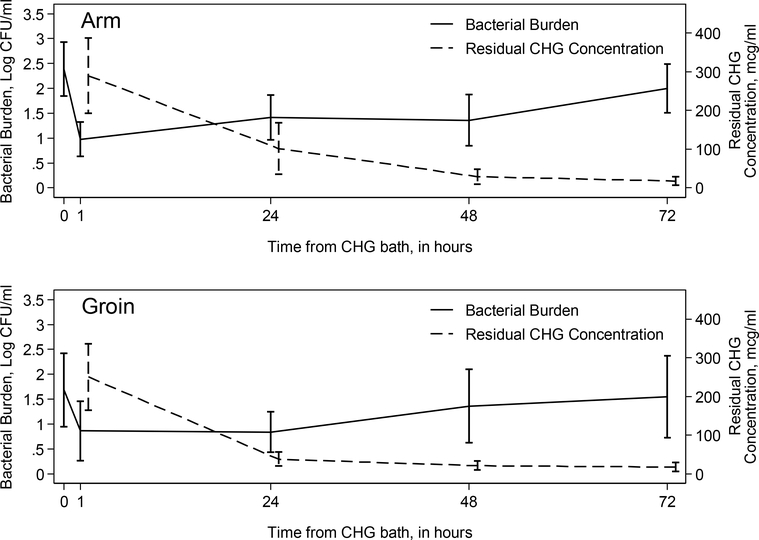
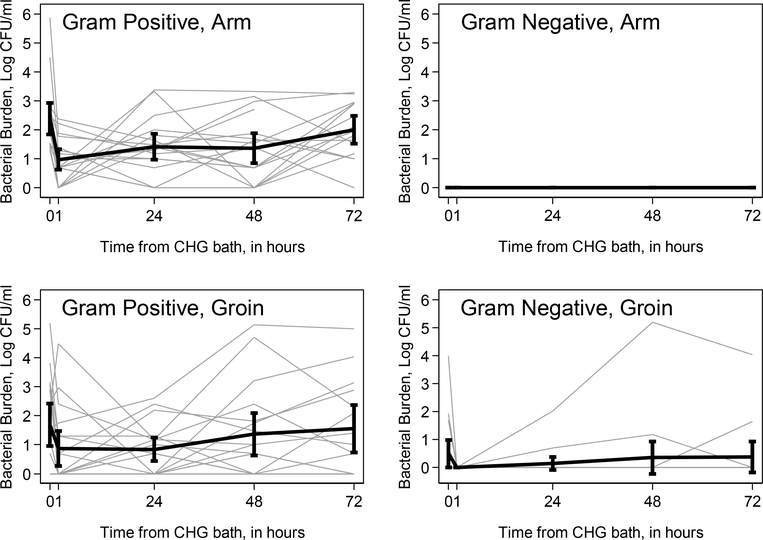
Forty neonates were enrolled, 18 of whom were CHG-exposed. Mean baseline Gram-positive (GP) bacterial burden was 2.19 log CFU/ml on the arm and 1.81 log CFU/ml on the groin. Bacterial burden decreased after the first bath, but returned to baseline by 72 h. Residual skin CHG concentration declined over time, with a corresponding increase in GP bacterial burden.

CONCLUSIONS

CHG bathing reduces skin bacterial burden, but burden returns to baseline after 72 h. Twice weekly CHG bathing may be inadequate to suppress skin bacterial growth in hospitalized neonates.

摘要

目的

评估葡萄糖酸氯己定(CHG)沐浴对新生儿皮肤细菌负担的影响。

研究设计

在这项前瞻性观察研究中,对入住新生儿重症监护病房(NICU)的 40 名接受 CHG 暴露和未暴露的新生儿的手臂和腹股沟皮肤细菌生长进行了测量。暴露的新生儿根据预防中心静脉相关血流感染(CLABSI)或金黄色葡萄球菌去定植的方案接受 2% CHG 沐浴。

结果

共纳入 40 名新生儿,其中 18 名接受 CHG 暴露。手臂上的革兰阳性(GP)细菌负荷的基线平均值为 2.19 log CFU/ml,腹股沟处为 1.81 log CFU/ml。第一次沐浴后细菌负荷减少,但在 72 小时后恢复到基线。随着时间的推移,皮肤残留 CHG 浓度下降,GP 细菌负荷相应增加。

结论

CHG 沐浴可降低皮肤细菌负担,但 72 小时后负担会恢复到基线。每周两次的 CHG 沐浴可能不足以抑制住院新生儿的皮肤细菌生长。
https://cdn.ncbi.nlm.nih.gov/pmc/blobs/d926/6298801/e16277a3bc66/nihms-1504425-f0002.jpg
https://cdn.ncbi.nlm.nih.gov/pmc/blobs/d926/6298801/c1bc0e8a854a/nihms-1504425-f0001.jpg
https://cdn.ncbi.nlm.nih.gov/pmc/blobs/d926/6298801/e16277a3bc66/nihms-1504425-f0002.jpg
https://cdn.ncbi.nlm.nih.gov/pmc/blobs/d926/6298801/c1bc0e8a854a/nihms-1504425-f0001.jpg
https://cdn.ncbi.nlm.nih.gov/pmc/blobs/d926/6298801/e16277a3bc66/nihms-1504425-f0002.jpg

相似文献

1
The impact of chlorhexidine gluconate bathing on skin bacterial burden of neonates admitted to the Neonatal Intensive Care Unit.葡萄糖酸洗必泰沐浴对入住新生儿重症监护病房新生儿皮肤细菌负荷的影响。
J Perinatol. 2019 Jan;39(1):63-71. doi: 10.1038/s41372-018-0231-7. Epub 2018 Sep 20.
2
Chlorhexidine bathing in a tertiary care neonatal intensive care unit: impact on central line-associated bloodstream infections.在三级医疗新生儿重症监护病房进行洗必泰沐浴:对中心静脉导管相关血流感染的影响
Infect Control Hosp Epidemiol. 2014 Feb;35(2):158-63. doi: 10.1086/674862. Epub 2013 Dec 24.
3
Relationship between chlorhexidine gluconate skin concentration and microbial density on the skin of critically ill patients bathed daily with chlorhexidine gluconate.洗必泰葡萄糖酸皮肤浓度与重症患者每日用洗必泰葡萄糖酸沐浴后皮肤微生物密度的关系。
Infect Control Hosp Epidemiol. 2012 Sep;33(9):889-96. doi: 10.1086/667371. Epub 2012 Jul 23.
4
Impact of unit-wide chlorhexidine bathing in intensive care on bloodstream infection and drug-resistant organism acquisition.重症监护病房全单元洗必泰沐浴对血流感染及耐药菌获得的影响
Crit Care Resusc. 2018 Jun;20(2):109-116.
5
A Multicenter Pragmatic Interrupted Time Series Analysis of Chlorhexidine Gluconate Bathing in Community Hospital Intensive Care Units.社区医院重症监护病房葡萄糖酸氯己定沐浴的多中心实用中断时间序列分析
Infect Control Hosp Epidemiol. 2016 Jul;37(7):791-7. doi: 10.1017/ice.2016.23. Epub 2016 Feb 10.
6
Evidence for the effectiveness of chlorhexidine bathing and health care-associated infections among adult intensive care patients: a trial sequential meta-analysis.氯己定沐浴对成人重症监护患者的有效性及与医疗保健相关感染的证据:一项试验序贯荟萃分析。
BMC Infect Dis. 2018 Dec 19;18(1):679. doi: 10.1186/s12879-018-3521-y.
7
Prevention of hospital-acquired bloodstream infections through chlorhexidine gluconate-impregnated washcloth bathing in intensive care units: a systematic review and meta-analysis of randomised crossover trials.通过在重症监护病房使用葡萄糖酸氯己定浸渍的毛巾进行沐浴预防医院获得性血流感染:随机交叉试验的系统评价和荟萃分析
Euro Surveill. 2016 Nov 17;21(46). doi: 10.2807/1560-7917.ES.2016.21.46.30400.
8
Safety of Biweekly Chlorhexidine Gluconate Bathing in Infants 36 To 48 Weeks' Postmenstrual Age.36 至 48 周龄婴儿每周两次用葡萄糖酸氯己定沐浴的安全性。
Am J Crit Care. 2019 Nov;28(6):451-459. doi: 10.4037/ajcc2019967.
9
Results of the CHlorhexidine Gluconate Bathing implementation intervention to improve evidence-based nursing practices for prevention of central line associated bloodstream infections Study (CHanGing BathS): a stepped wedge cluster randomized trial.葡萄糖酸氯己定沐浴实施干预以改善基于证据的预防中心静脉相关血流感染护理实践的研究(CHanGing BathS)结果:一项阶梯式楔形集群随机试验。
Implement Sci. 2021 Apr 26;16(1):45. doi: 10.1186/s13012-021-01112-4.
10
You get back what you give: Decreased hospital infections with improvement in CHG bathing, a mathematical modeling and cost analysis.付出就有回报:通过改进 CHG 沐浴,用数学模型和成本分析降低医院感染率。
Am J Infect Control. 2019 Dec;47(12):1471-1473. doi: 10.1016/j.ajic.2019.07.003. Epub 2019 Aug 7.

引用本文的文献

1
Epidemiology and Mortality of Invasive Staphylococcus aureus Infections in Hospitalized Infants.住院婴儿侵袭性金黄色葡萄球菌感染的流行病学与死亡率
JAMA Pediatr. 2025 Apr 14. doi: 10.1001/jamapediatrics.2025.0429.
2
Safety and efficacy of whole-body chlorhexidine gluconate cleansing with or without emollient in hospitalised neonates (NeoCHG): a multicentre, randomised, open-label, factorial pilot trial.住院新生儿使用或不使用润肤剂的全身葡萄糖酸氯己定清洗的安全性和有效性(NeoCHG):一项多中心、随机、开放标签、析因性试点试验。
EClinicalMedicine. 2024 Feb 25;69:102463. doi: 10.1016/j.eclinm.2024.102463. eCollection 2024 Mar.
3

本文引用的文献

1
Matrix assisted laser desorption time of flight mass spectrometry (MALDI-TOF MS) in clinical microbiology.基质辅助激光解吸飞行时间质谱(MALDI-TOF MS)在临床微生物学中的应用
J Microbiol Methods. 2017 Jul;138:20-29. doi: 10.1016/j.mimet.2016.09.003. Epub 2016 Sep 6.
2
Trends in Chlorhexidine Use in US Neonatal Intensive Care Units: Results From a Follow-Up National Survey.美国新生儿重症监护病房洗必泰使用趋势:全国跟踪调查结果
Infect Control Hosp Epidemiol. 2016 Sep;37(9):1116-8. doi: 10.1017/ice.2016.125. Epub 2016 Jun 20.
3
Chlorhexidine skin or cord care for prevention of mortality and infections in neonates.
Impact of daily octenidine skin washing versus nonwashing on antiseptic tolerance of coagulase-negative staphylococci in two neonatal intensive care units with different skin cleansing practices.
在两个采用不同皮肤清洁方法的新生儿重症监护病房中,每日使用奥替尼啶进行皮肤清洗与不清洗对凝固酶阴性葡萄球菌抗菌耐受性的影响。
Infect Prev Pract. 2024 Feb 3;6(1):100344. doi: 10.1016/j.infpip.2024.100344. eCollection 2024 Mar.
4
Incidence, pathogens and antimicrobial resistance of blood and cerebrospinal fluid isolates from a tertiary neonatal unit in South Africa: A 10 year retrospective review.南非一家三级新生儿病房血和脑脊液分离株的发生率、病原体和抗菌药物耐药性:一项 10 年回顾性研究。
PLoS One. 2024 Jan 19;19(1):e0297371. doi: 10.1371/journal.pone.0297371. eCollection 2024.
5
Antiseptic solutions for skin preparation during central catheter insertion in neonates.用于新生儿中心静脉导管插入时皮肤准备的抗菌溶液。
Cochrane Database Syst Rev. 2023 May 4;5(5):CD013841. doi: 10.1002/14651858.CD013841.pub2.
6
Chlorhexidine bathing in a tertiary care neonatal intensive care unit: A pilot study.三甲医院新生儿重症监护病房中洗必泰沐浴:一项试点研究。
PLoS One. 2023 Mar 23;18(3):e0283132. doi: 10.1371/journal.pone.0283132. eCollection 2023.
7
Myelin toxicity of chlorhexidine in zebrafish larvae.氯己定对斑马鱼幼鱼的髓鞘毒性。
Pediatr Res. 2023 Mar;93(4):845-851. doi: 10.1038/s41390-022-02186-6. Epub 2022 Jul 19.
8
Neonatal sepsis and the skin microbiome.新生儿败血症与皮肤微生物组。
J Perinatol. 2022 Nov;42(11):1429-1433. doi: 10.1038/s41372-022-01451-0. Epub 2022 Jul 11.
9
Longitudinal Dynamics of Skin Bacterial Communities in the Context of Staphylococcus aureus Decolonization.定植金黄色葡萄球菌消除过程中皮肤细菌群落的纵向动态变化。
Microbiol Spectr. 2022 Apr 27;10(2):e0267221. doi: 10.1128/spectrum.02672-21. Epub 2022 Apr 6.
10
Viability-Resolved Metagenomics Reveals Antagonistic Colonization Dynamics of Staphylococcus epidermidis Strains on Preterm Infant Skin.活化解剖宏基因组学揭示表皮葡萄球菌菌株在早产儿皮肤的拮抗定植动力学。
mSphere. 2021 Oct 27;6(5):e0053821. doi: 10.1128/mSphere.00538-21. Epub 2021 Sep 15.
洗必泰用于新生儿皮肤或脐带护理以预防死亡和感染。
Cochrane Database Syst Rev. 2015 Mar 5;2015(3):CD007835. doi: 10.1002/14651858.CD007835.pub2.
4
Evaluation of efficacy of skin cleansing with chlorhexidine in prevention of neonatal nosocomial sepsis - a randomized controlled trial.氯己定皮肤清洁预防新生儿医院感染性败血症疗效评估——一项随机对照试验
J Matern Fetal Neonatal Med. 2016;29(2):242-7. doi: 10.3109/14767058.2014.996126. Epub 2014 Dec 24.
5
Strategies to prevent central line-associated bloodstream infections in acute care hospitals: 2014 update.急性护理医院预防中心静脉导管相关血流感染的策略:2014年更新版
Infect Control Hosp Epidemiol. 2014 Jul;35(7):753-71. doi: 10.1086/676533.
6
Skin antisepsis in the neonate: what should we use?新生儿皮肤消毒:我们应该使用什么?
Curr Opin Infect Dis. 2014 Jun;27(3):244-50. doi: 10.1097/QCO.0000000000000064.
7
Methicillin-resistant Staphylococcus aureus transmission and infections in a neonatal intensive care unit despite active surveillance cultures and decolonization: challenges for infection prevention.尽管进行了主动监测培养和去定植,但耐甲氧西林金黄色葡萄球菌仍在新生儿重症监护病房传播和感染:感染预防面临的挑战
Infect Control Hosp Epidemiol. 2014 Apr;35(4):412-8. doi: 10.1086/675594.
8
Chlorhexidine bathing in a tertiary care neonatal intensive care unit: impact on central line-associated bloodstream infections.在三级医疗新生儿重症监护病房进行洗必泰沐浴:对中心静脉导管相关血流感染的影响
Infect Control Hosp Epidemiol. 2014 Feb;35(2):158-63. doi: 10.1086/674862. Epub 2013 Dec 24.
9
Daily chlorhexidine bathing and hospital-acquired infection.每日洗必泰沐浴与医院获得性感染
N Engl J Med. 2013 Jun 13;368(24):2332. doi: 10.1056/NEJMc1304820.
10
Daily chlorhexidine bathing to reduce bacteraemia in critically ill children: a multicentre, cluster-randomised, crossover trial.每日氯己定沐浴以减少危重症儿童的菌血症:一项多中心、集群随机、交叉试验。
Lancet. 2013 Mar 30;381(9872):1099-106. doi: 10.1016/S0140-6736(12)61687-0. Epub 2013 Jan 28.