Fujimoto Keisaku, Yamazaki Haruna, Uematsu Akikazu
Department of Clinical Laboratory Sciences, Shinshu University School of Health Sciences, Matsumoto, Nagano, Japan,
Department of Biomedical Laboratory Sciences, Graduate School of Medicine, Shinshu University, Matsumoto, Nagano, Japan.
Int J Chron Obstruct Pulmon Dis. 2018 Sep 11;13:2841-2848. doi: 10.2147/COPD.S170163. eCollection 2018.
OBJECTIVE/BACKGROUND: This study was performed to evaluate the association of nocturnal autonomic nerve (AN) dysfunction, especially parasympathetic nerve (PN) function instability, and nocturnal oxygen desaturation (NOD) in patients with chronic lung diseases (CLD).
Twenty-nine stable CLD patients with irreversible pulmonary dysfunction and mild-to-moderate daytime hypoxemia, 13 CLD patients receiving long-term oxygen therapy (LTOT) with maintained SpO >90%, and 17 senior healthy volunteers underwent two-night examinations of nocturnal AN function by pulse rate variability (PRV) instead of heart rate variation using a photoelectrical plethysmograph simultaneously monitoring SpO and the presence of sleep disordered breathing at home. AN function was examined by instantaneous time-frequency analysis of PRV using a complex demodulation method.
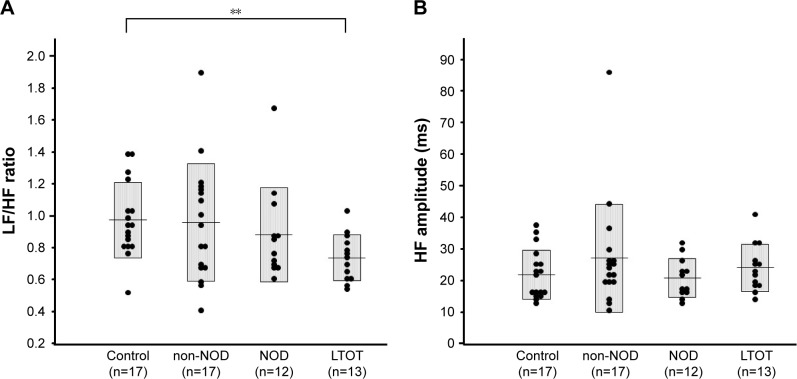
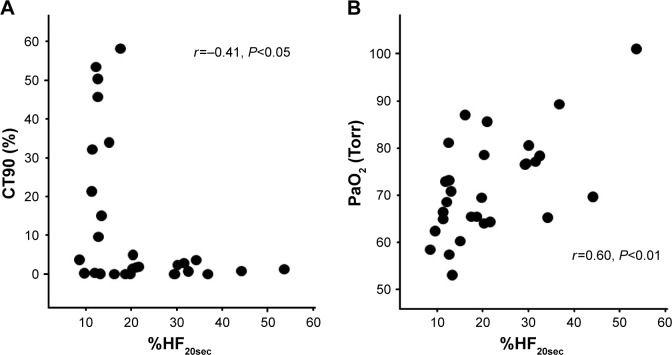
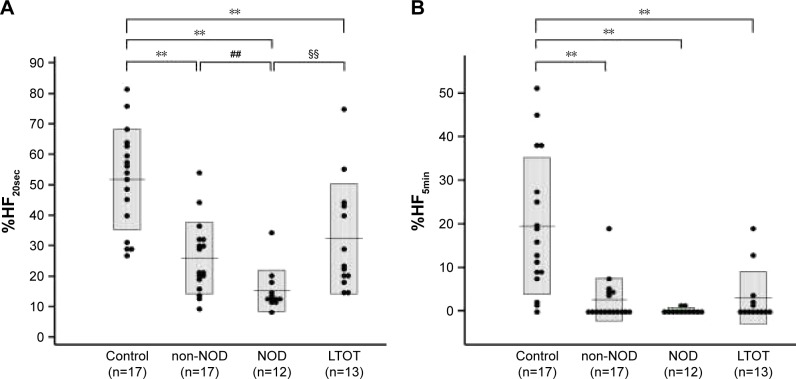
There were no significant differences in mean low frequency/high frequency (HF) ratio (index of sympathetic nerve activity) or mean HF amplitude (index of PN activity) among controls and CLD patients with and without NOD (defined as SpO <90% for at least 3% of total recording time at night). However, the relative times over which the same main HF peak was sustained for at least 20 seconds (%HF) and 5 minutes in total recording time, indexes of PN function stability, were significantly reduced in CLD patients compared with controls, and further decreased in CLD patients with NOD compared with non-NOD. %HF was significantly higher in the LTOT group than the NOD group. Furthermore, PaO at rest and nocturnal hypoxia were significantly correlated with PN function instability in CLD patients.
PN function is unstable at night associated with nocturnal hypoxemia in CLD patients, which may reflect poor quality of sleep.
目的/背景:本研究旨在评估慢性肺病(CLD)患者夜间自主神经(AN)功能障碍,尤其是副交感神经(PN)功能不稳定与夜间氧饱和度下降(NOD)之间的关联。
29例患有不可逆性肺功能障碍且白天有轻度至中度低氧血症的稳定CLD患者、13例接受长期氧疗(LTOT)且SpO₂维持>90%的CLD患者以及17名老年健康志愿者,使用光电体积描记法同时监测SpO₂和睡眠呼吸紊乱情况,通过脉搏率变异性(PRV)而非心率变异性进行两晚的夜间AN功能检查。使用复解调方法通过PRV的瞬时时间频率分析来检查AN功能。
在对照组以及有和没有NOD(定义为夜间总记录时间中至少3%的时间SpO₂<90%)的CLD患者中,平均低频/高频(HF)比值(交感神经活动指标)或平均HF幅度(PN活动指标)没有显著差异。然而,与对照组相比,CLD患者中PN功能稳定性指标,即同一主要HF峰值在总记录时间中持续至少20秒(%HF)和5分钟的相对时间显著减少,并且与无NOD的CLD患者相比,有NOD的CLD患者中该指标进一步降低。LTOT组的%HF显著高于NOD组。此外,CLD患者静息时的PaO₂和夜间低氧与PN功能不稳定显著相关。
CLD患者夜间PN功能不稳定与夜间低氧血症相关,这可能反映了睡眠质量较差。