Correa Mercè, SanMiguel Noemí, López-Cruz Laura, Carratalá-Ros Carla, Olivares-García Régulo, Salamone John D
Àrea de Psicobiologia, Campus de Riu Sec, Universitat Jaume I, Castelló, Spain.
Behavioral Neuroscience Division, University of Connecticut, Storrs, CT, United States.
Front Psychiatry. 2018 Sep 6;9:411. doi: 10.3389/fpsyt.2018.00411. eCollection 2018.
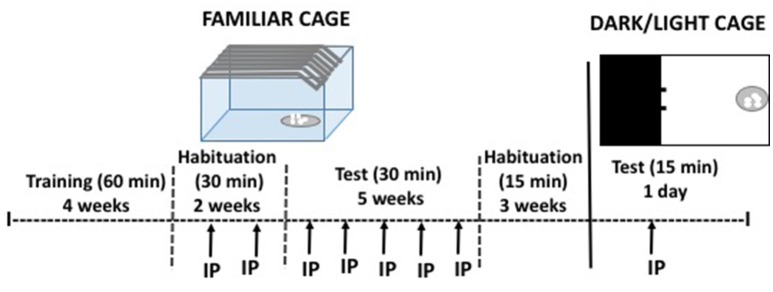
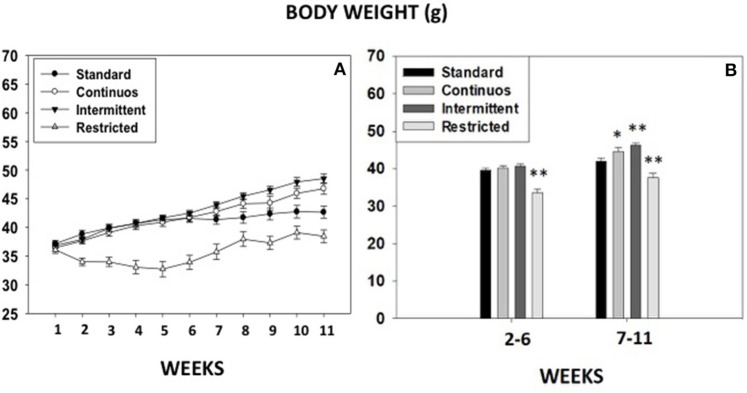
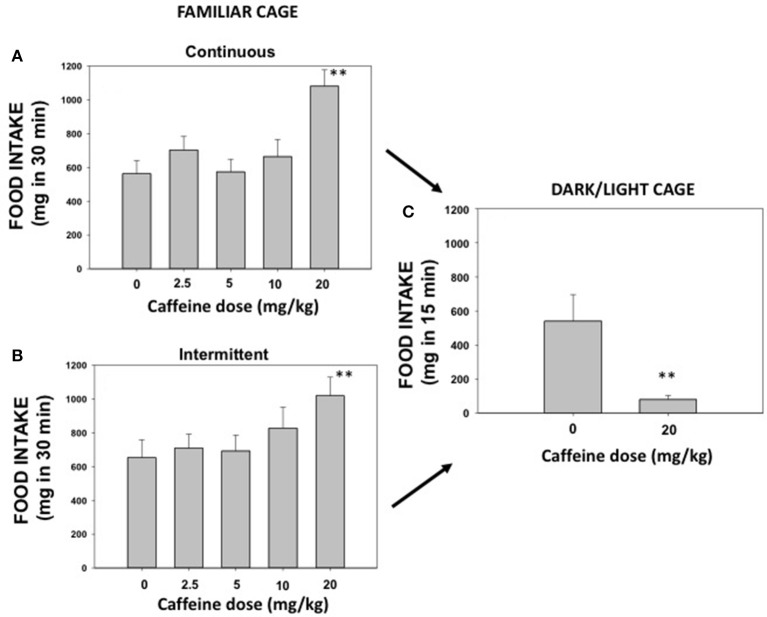
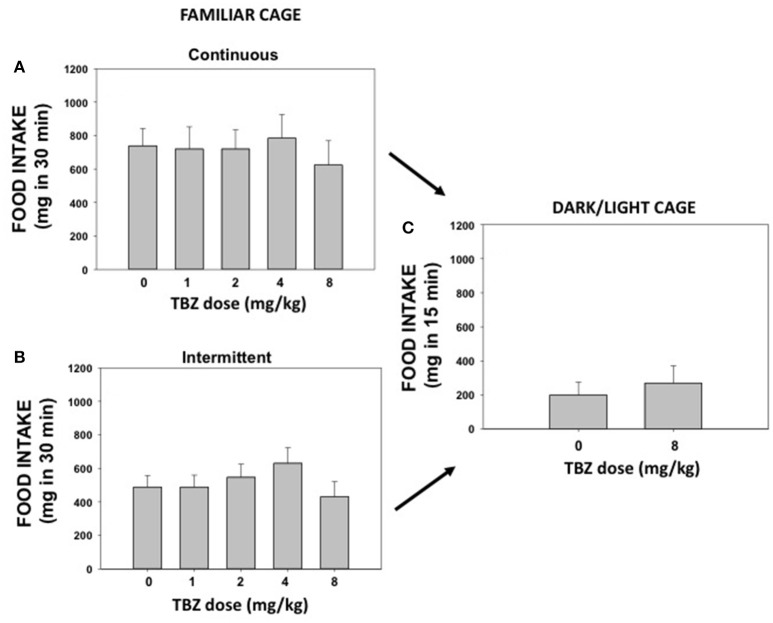
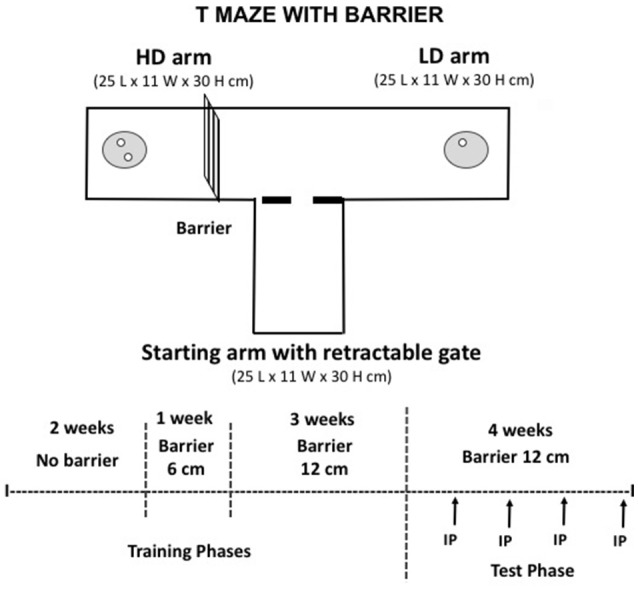
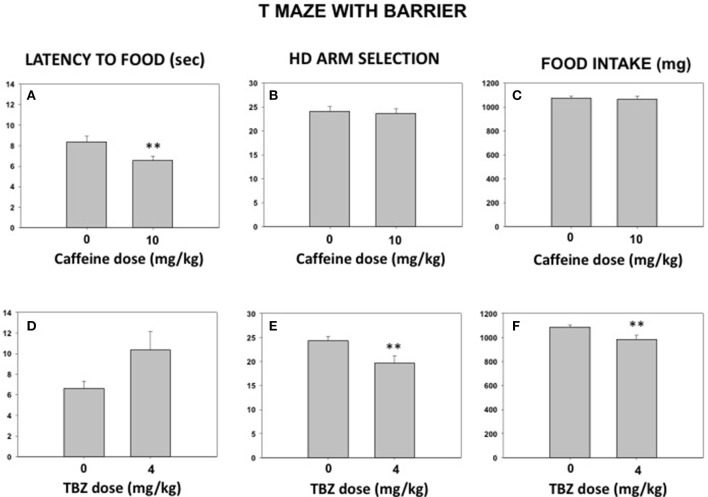
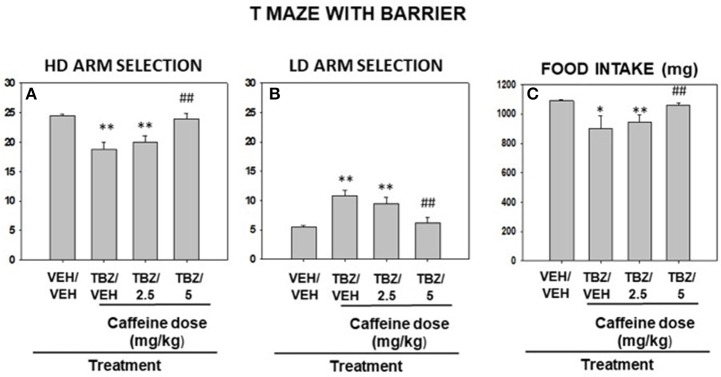
Caffeine is a methylxanthine consumed in different contexts to potentiate alertness and reduce fatigue. However, caffeine can induce anxiety at high doses. Caffeine is also a minor psychostimulant that seems to act as an appetite suppressant, but there are also reports indicating that it could stimulate appetite. Dopamine also is involved in food motivation and in behavioral activation. In the present series of experiments, we evaluated the effects of acute administration of caffeine on food consumption under different access conditions. CD1 male adult mice had access to highly palatable food (50% sucrose) in a restricted but habitual context, under continuous or intermittent access as well as under anxiogenic, or effortful conditions. Caffeine (2.5-20.0 mg/kg) increased intake at the highest dose under familiar continuous and intermittent access. However, this high dose reduced food intake in the dark-light paradigm. In contrast, a dopamine-depleting agent, tetrabenazine (TBZ; 1.0-8.0 mg/kg) did not affect food intake in any of those experimental conditions. In the T-maze-barrier task that evaluates seeking and taking of food under effortful conditions, caffeine (10.0 mg/kg) decreased latency to reach the food, but did not affect selection of the high-food density arm that required more effort, or the total amount of food consumed. In contrast, TBZ (4.0 mg/kg) reduced selection of the high food density arm with the barrier, thus affecting amount of food consumed. Interestingly, a small dose of caffeine (5.0 mg/kg) was able to reverse the anergia-inducing effects produced by TBZ in the T-maze. These results suggest that caffeine can potentiate or suppress food consumption depending on the context. Moreover, caffeine did not change appetite, and did not impair orientation toward food under effortful conditions, but it rather helped to achieve the goal by improving speed and by reversing performance to normal levels when fatigue was induced by dopamine depletion.
咖啡因是一种甲基黄嘌呤,在不同情况下被摄入以增强警觉性并减轻疲劳。然而,高剂量的咖啡因会诱发焦虑。咖啡因还是一种轻度精神兴奋剂,似乎具有食欲抑制作用,但也有报告表明它可能会刺激食欲。多巴胺也参与食物动机和行为激活。在本系列实验中,我们评估了急性给予咖啡因在不同获取条件下对食物消耗的影响。CD1雄性成年小鼠在受限但习惯的环境中,在持续或间歇性获取以及在致焦虑或费力的条件下,能够获取高度可口的食物(50%蔗糖)。咖啡因(2.5 - 20.0毫克/千克)在熟悉的持续和间歇性获取条件下,以最高剂量增加了食物摄入量。然而,在明暗范式中,这个高剂量减少了食物摄入量。相比之下,一种多巴胺耗竭剂,丁苯那嗪(TBZ;1.0 - 8.0毫克/千克)在任何这些实验条件下都不影响食物摄入量。在评估在费力条件下寻找和获取食物的T迷宫屏障任务中,咖啡因(10.0毫克/千克)缩短了到达食物的潜伏期,但不影响对需要更多努力的高食物密度臂的选择,也不影响消耗的食物总量。相比之下,TBZ(4.0毫克/千克)减少了有屏障的高食物密度臂的选择,从而影响了消耗的食物量。有趣的是,小剂量的咖啡因(5.0毫克/千克)能够逆转TBZ在T迷宫中产生的无活力诱导效应。这些结果表明,咖啡因根据环境情况可以增强或抑制食物消耗。此外,咖啡因不会改变食欲,在费力条件下也不会损害对食物的定向,但它通过提高速度以及在多巴胺耗竭导致疲劳时将表现恢复到正常水平来帮助实现目标。